Geometriyi kaydedin
Hatve, genişlik, makara/burç, pim, plaka, toplam genişlik ve bağlantı deseni.
Fırın Zinciri Teknik Kılavuzu
How to Select Attachments for Bakery Pans is best answered by combining measured chain geometry, machine duty and the operating environment. This guide shows what to inspect, record and discuss before a replacement or new-chain decision.
How to Select Attachments for Bakery Pans should be evaluated from the actual conveyor. Start with chain pitch, transverse geometry, sprocket condition and any carrier attachment, then add temperature, moisture, washdown, load, speed and take-up information. The objective is not to identify a chain by appearance; it is to produce an RFQ that preserves the machine interface and makes application-dependent choices explicit.
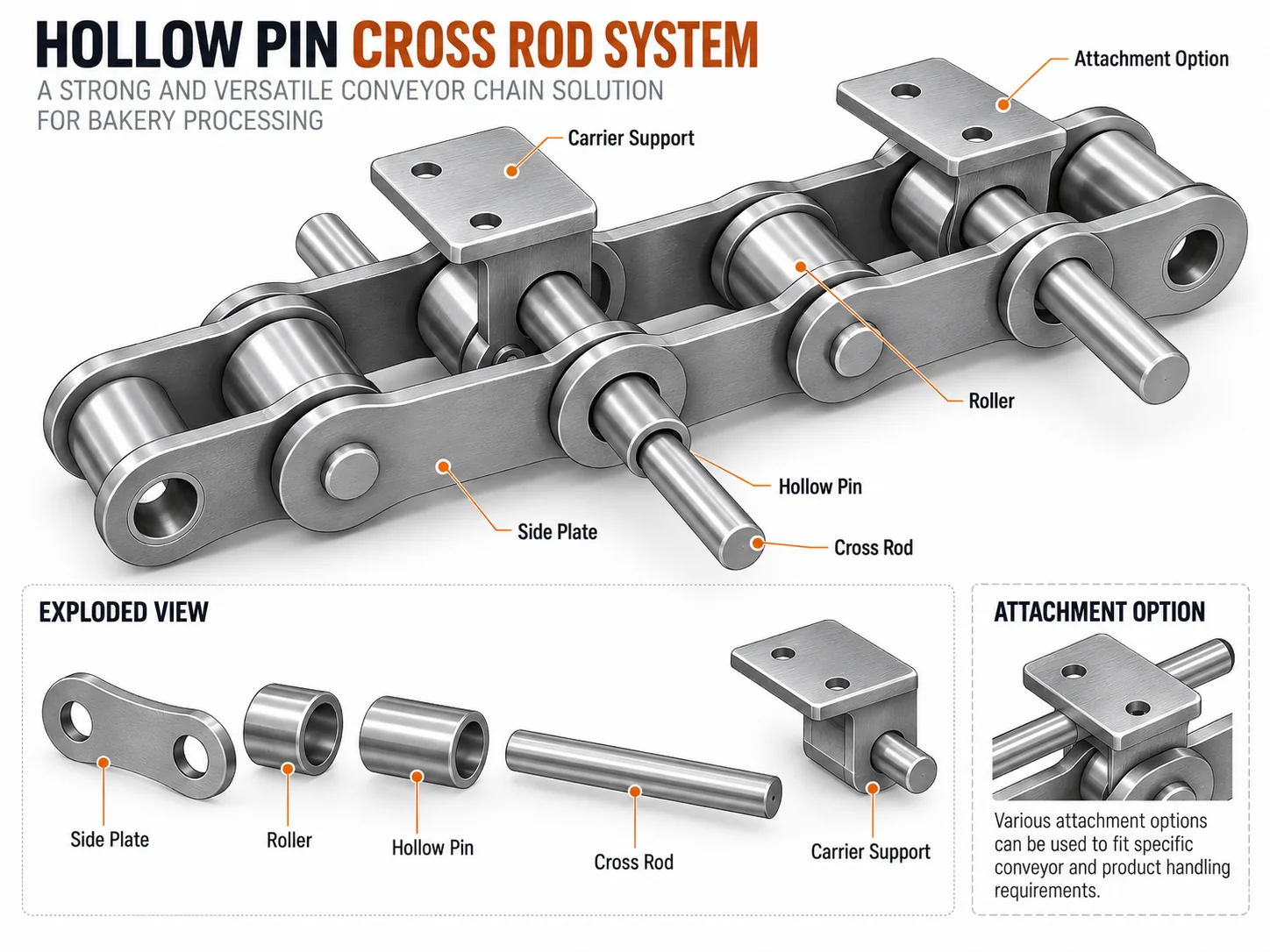
Zinciri çıkarmadan önce birkaç özelliği ölçün. Dişli adımı temel dişli ilişkisini belirler, ancak iç genişlik, makara veya burç çapı, pim çapı, plaka yüksekliği, toplam genişlik ve bağlantı boyutları, aynı nominal dişli adımını paylaşabilen konfigürasyonları birbirinden ayırır.
Aşınmış bir zincir için, birden fazla bağlantı boyunca toplam adım uzunluğunu ölçün. Zinciri yandan ve uçtan fotoğraflayın ve mümkünse dişliyi de kadraja alın.
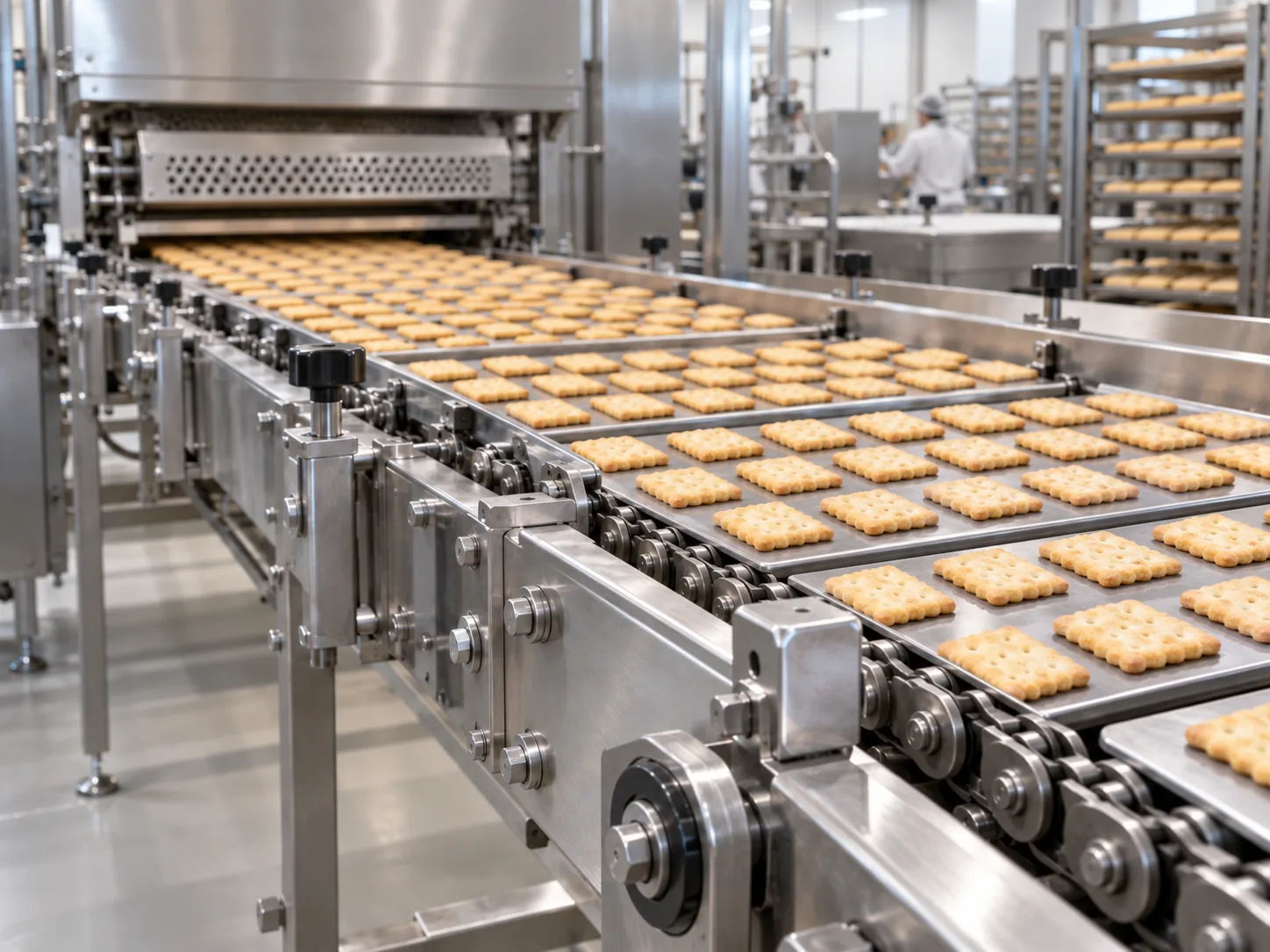
The same chain geometry can behave differently in a humid proofer, a hot oven, an ambient cooling section or a washdown area. For how to select attachments for bakery pans, document the exact machine zone, whether the chain carries product directly or moves pans/fixtures, and whether the joint sees heat, moisture, cleaning chemicals or abrasive residue.
Proses verileri, hangi özelliklerin değiştirilebilirlik yoluyla sabit olduğunu ve hangi özelliklerin (malzeme, boşluk veya bağlantı üretim yöntemi gibi) uygulama için gözden geçirilmesi gerektiğini belirlemeye yardımcı olur.
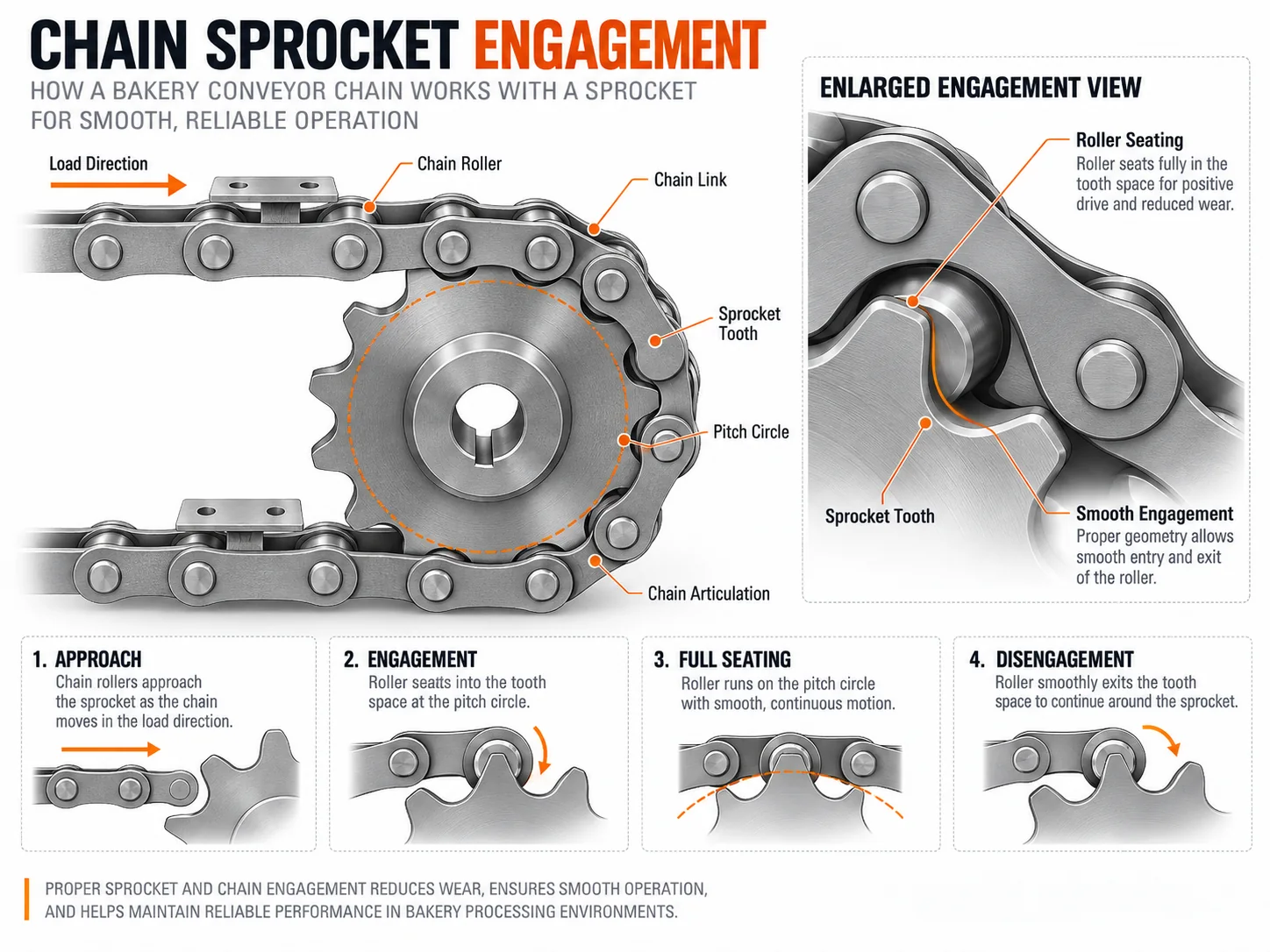
Bir zincir bağımsız olarak çalışmaz. Makaralar veya burçlar, dişli çark boşluklarına sorunsuz bir şekilde girip çıkmalı, kılavuz raylar ise zinciri yana doğru zorlamadan desteklemelidir. Kancalı dişler, şaft hizalama hatası, eksantrik dişli çarklar veya sıkı bir kılavuz, yeni bir zincirin hızlı aşınmasına neden olabilir.
Devrenin tamamını tek bir hat üzerinden inceleyin. Hasar aynı makine konumunda tekrarlanıyorsa, zincirin kendisinin arızalı olduğunu varsaymadan önce yerel destek, aktarım veya taşıyıcıyı inceleyin.
Hatve, genişlik, makara/burç, pim, plaka, toplam genişlik ve bağlantı deseni.
Sıcaklık, nem, yıkama, hız, yük, üretim saatleri ve başlatmalar.
Dişli çarklar, kılavuzlar, zincir merkezleri, gergi mekanizması, hizalama ve taşıyıcı boşlukları.
Montajdan önce, sipariş edilen son geometriyi, malzemeyi ve uygulamaya bağlı konfigürasyonu onaylayın.
Sorun ortaya çıkmadan önce nelerin değiştiğini sorun: üretim hızı, ürün veya tava ağırlığı, temizleme döngüsü, yağlayıcı, sıcaklık, bakım aralığı veya değiştirilen dişliler. Eğilim bilgisi, aşınmanın homojen mi yoksa yoğunlaşmış mı olduğunu gösterdiği için tek bir fotoğraftan daha değerlidir.
Rutin kontroller sırasında, sertleşmiş bağlantı noktaları, makara aşınması, pim hareketi, çatlamış veya bükülmüş bağlantı parçaları, anormal yan temas ve düzensiz çekme olup olmadığını kontrol edin. Koruyucu ekipmanları ve güvenlik prosedürlerini makine sahibinin gereksinimlerine göre uygulayın.
Ölçülen boyutları, makine/işlem adını, fotoğrafları, varsa çizimi, miktarı veya gerekli zincir uzunluğunu, bağlantı aralığını, zincir merkez aralığını, dişli çark bilgilerini, sıcaklığı, yıkama durumunu, yükü ve hedef teslimat zaman aralığını ekleyin. Gözden geçirin. fırın zinciri seçim rehberi ve ürün ailesine genel bakış Bir sonraki karar aşaması için.
A useful diagnosis starts with evidence that can be repeated by a second person. matching pan support geometry to the chain while allowing assembly, cleaning and thermal movement. Record hole pattern, support height, offset, pan pitch, chain centers and attachment interval. When the chain is worn, note which readings may be influenced by joint clearance or deformation, and prefer multi-pitch or multi-point measurements over one isolated dimension.
The chain does not operate by itself. In pan conveyors through proofing, baking or return handling, inspect the sprockets, guides, return path, take-up and carrier interface at the same time. The symptom to watch is pan skew, binding, difficult cleaning or contact with guides. A local problem that repeats at one machine position often points to alignment, clearance or mating-hardware issues rather than a uniform chain problem.
The practical decision is to start from the pan support/load path and work back to the attachment rather than choosing from appearance. That prevents a common error: changing chain tension, material or size before the root constraint has been identified. Use the chain drawing and the machine envelope together, because a configuration that looks correct in isolation can still interfere with a guard, transfer plate, sensor bracket or carrier.
“Sıcak,” “ıslak” veya “gıda sınıfı” gibi tek bir sıfat yerine, çalışma döngüsünü tanımlayın. Gerektiğinde normal ve en yüksek sıcaklığı, nem veya temizlik maruziyetini, hızı, başlatma/durdurma davranışını ve yağlama sınırlamalarını belirtin. Bu ayrıntılar, temel geometri sabit kalırken boşlukların, malzemelerin veya bakım uygulamalarının değiştirilmesi gerekip gerekmediğine karar verir.
| Kontrol etmek | Neden önemli? | Ne gönderilecek veya doğrulanacak? |
|---|---|---|
| Tanılama | Confirm hole pattern, support height, offset, pan pitch, chain centers and attachment interval. Use a measurement sequence that can be repeated after removal so the installed and bench readings can be compared. | Ölçülendirilmiş çizim, ölçek bilgisine sahip fotoğraflar ve varsa eski çizimler veya parça numaraları. |
| Rota konumu | Map where the chain runs through pan conveyors through proofing, baking or return handling. Mark the exact location of pan skew, binding, difficult cleaning or contact with guides instead of reporting the condition only as a whole-line problem. | Konveyör bölümünü, tahrik/arka konumlarını ve dönüş yolunu gösteren bağlam fotoğrafı. |
| Birbirine geçen parçalar | Diş profili, makara yuvası, şaft/dişli hizalaması, kılavuz teması ve geri alma rezervini inceleyin. Bu parçalar, zincir seçimi sorununu taklit eden aşınma desenleri oluşturabilir. | Dişli çark diş sayısı ve fotoğrafları, kılavuz düzeni ve mevcut sarım pozisyonu. |
| Yükleme yolu | Identify how product carriers, pans, rods or fixtures transfer load into the chain. For this topic, the key focus is matching pan support geometry to the chain while allowing assembly, cleaning and thermal movement. | Taşıyıcı çizimi, bağlantı aralığı, zincir merkezi aralığı ve bilinen durumlarda desteklenen kütle/kuvvet. |
| Çevre | Makine bölgelerine göre sıcaklık, nem, yıkama, kirlenme ve yağlama kısıtlamalarını kaydedin. Sürekli maruz kalmayı kısa süreli zirvelerden veya temizleme işlemlerinden ayırın. | Çalışma koşullarının özeti ve bakım/yağlama uygulamaları. |
| Serbest bırakmak | The final engineering action is to start from the pan support/load path and work back to the attachment rather than choosing from appearance. The approved drawing should distinguish fixed interchange dimensions from selectable options. | pan drawing, attachment sketch, chain centers, load, temperature and cleaning method. |
A uniform change along the whole strand suggests a different mechanism from damage concentrated at one sprocket, guide or transfer. For How to Select Attachments for Bakery Pans, compare left/right sides and loaded/return paths. The distribution of wear can reveal whether the driver is joint wear, side loading, contamination, thermal change or a carrier that is forcing the chain out of its natural path.
Increasing tension can temporarily change noise or tracking without correcting the underlying cause. If the observed issue is pan skew, binding, difficult cleaning or contact with guides, first confirm alignment, take-up geometry and articulation. Excessive tension can add bearing load and make a marginal guide or attachment problem worse.
Fırın ekipmanları üretim, temizlik ve durdurma durumları arasında geçiş yapabilir. Bir zincir soğukken normal şekilde hareket edebilir ve ısıtıldığında sıkışabilir veya üretim sırasında serbestçe çalışabilir ancak tekrarlanan ıslak durdurmalardan sonra korozyona uğrayabilir. Seçilen düzeltici eylemin gerçek çalışma döngüsünü ele alması için belirtinin hangi durumda ortaya çıktığını kaydedin.
For an unknown chain, one close-up is not enough. Pair a complete machine-zone image with side and end views of several pitches, a sprocket-engagement photo and a clear attachment/carrier view. Place a scale only where it does not hide the feature being measured. This photo set makes matching pan support geometry to the chain while allowing assembly, cleaning and thermal movement easier to evaluate remotely.
Record hole pattern, support height, offset, pan pitch, chain centers and attachment interval, chain centers, sprocket tooth count and the carrier interface before changing components.
Describe what happens in pan conveyors through proofing, baking or return handling, including temperature or moisture changes, speed, load and cleaning/lubrication constraints.
Document where pan skew, binding, difficult cleaning or contact with guides appears. Compare drive, tail, loaded run, return run and transfer points rather than averaging the entire conveyor.
Include pan drawing, attachment sketch, chain centers, load, temperature and cleaning method. State the required quantity or chain length and any documentation needed with the order.
Review pitch, widths, pin/roller geometry, attachments and material notes on one controlled drawing revision. For How to Select Attachments for Bakery Pans, the release decision should explicitly address matching pan support geometry to the chain while allowing assembly, cleaning and thermal movement.
Montajdan sonra, en az bir tam tur atın, dişli giriş/çıkışını ve taşıyıcı boşluğunu kontrol edin ve makine üreticisinin prosedürüne göre sarımı tekrar kontrol edin. Aşınmış veya yanlış hizalanmış donanımı telafi etmek için yeni zincir kullanılmamalıdır.
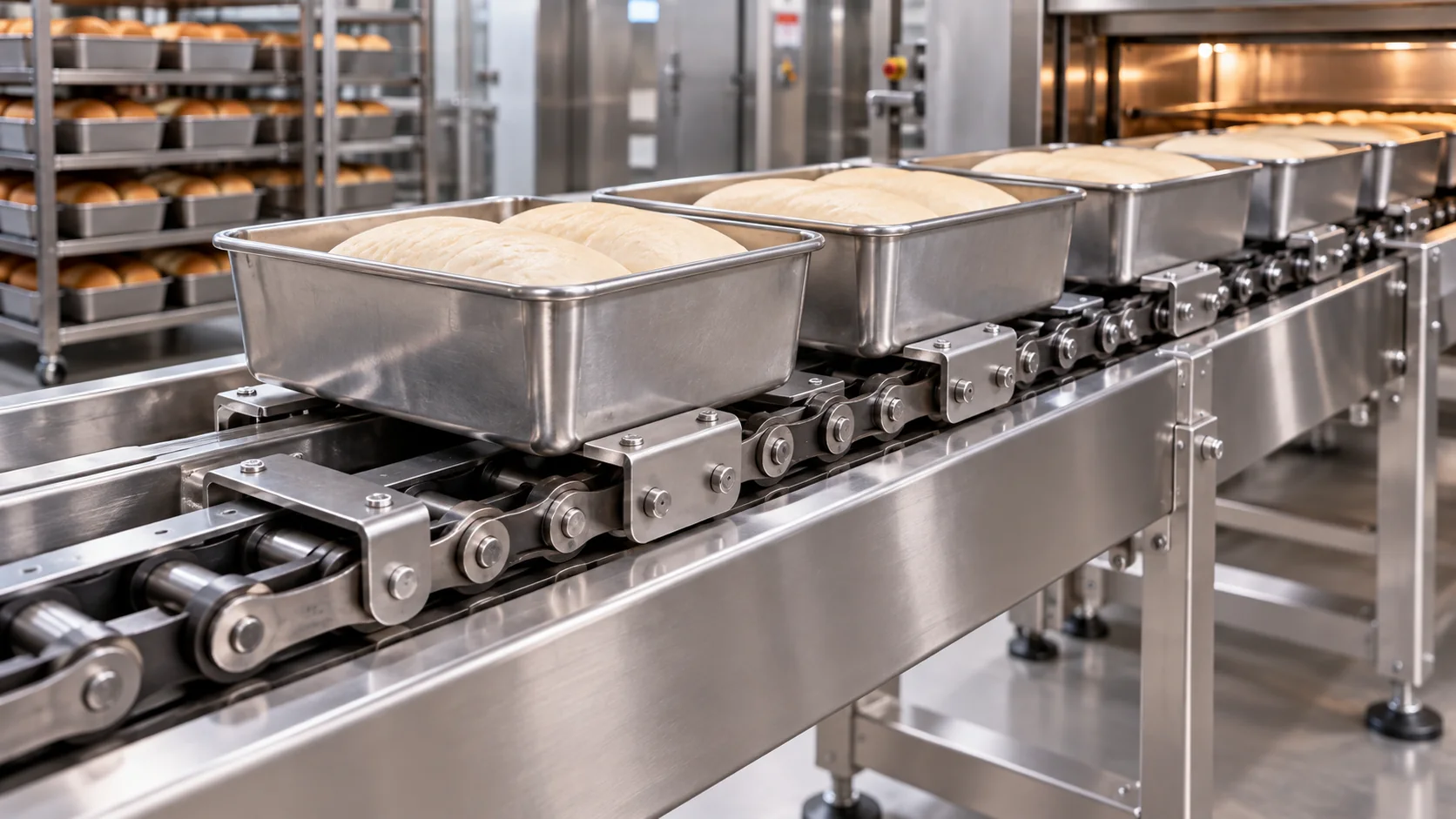
The main reason to keep this process structured is that matching pan support geometry to the chain while allowing assembly, cleaning and thermal movement interacts with more than one component. A change that improves one symptom can shift load into another part of the mechanism. For example, correcting guide alignment may reduce side wear but also expose a take-up setting that was previously compensating for the misalignment. Record changes one at a time so the result can be interpreted.
For planned maintenance, compare the present condition with a baseline whenever one exists. If there is no baseline, create one during the next shutdown: photograph the sprockets and guide surfaces, record take-up position, measure a defined number of pitches, and note the chain’s location in pan conveyors through proofing, baking or return handling. Repeating the same observations later is more informative than relying on general statements such as “the chain has stretched.”
Mevcut bir çizim varsa, kurulu donanımın hala çizimle eşleştiğini doğrulayın. Fırıncılık ekipmanları genellikle kullanım ömrü boyunca değiştirilir: taşıyıcılar onarılabilir, kılavuz raylar hareket ettirilebilir, dişliler değiştirilebilir ve bağlantı aralıkları değiştirilebilir. Çizim hala faydalıdır, ancak saha doğrulaması, geçmişe ait bir belgenin mevcut konfigürasyonun kanıtı olarak değerlendirilmesini önler.
Procurement and engineering should use the same evidence package. The RFQ should not separate commercial quantity from technical context: pan drawing, attachment sketch, chain centers, load, temperature and cleaning method. This makes it possible to judge whether a standard series, a modified attachment or a custom replacement is the appropriate route without creating unnecessary back-and-forth.
Finally, treat the website as a preparation tool rather than the controlling product drawing. Measurements and diagrams narrow the family and help organize the RFQ; the released drawing defines the ordered configuration. That distinction is especially important where pan skew, binding, difficult cleaning or contact with guides could have more than one mechanical cause.
Use How to Select Attachments for Bakery Pans as a machine-level question, not just a chain inspection. Compare the loaded and return runs, drive and tail ends, and any transfer or carrier transition in pan conveyors through proofing, baking or return handling. Document whether pan skew, binding, difficult cleaning or contact with guides is distributed along the strand or repeats at one location. That pattern helps separate progressive joint wear from alignment, guide, sprocket or carrier problems that a new chain alone will not correct.
The working record should include hole pattern, support height, offset, pan pitch, chain centers and attachment interval. Mark which values are fixed by the existing machine and which values can be changed to improve service. The central engineering focus is matching pan support geometry to the chain while allowing assembly, cleaning and thermal movement. When a legacy part number conflicts with field measurements, hold the RFQ until the installed interface and the controlled drawing can be reconciled.
A useful enquiry combines commercial quantity with the technical package: pan drawing, attachment sketch, chain centers, load, temperature and cleaning method. Also state whether the request is a direct replacement, a planned modification or a new machine design. The release objective is to start from the pan support/load path and work back to the attachment rather than choosing from appearance. This reduces quote revisions and prevents a visually similar chain from being treated as interchangeable before geometry and duty have been checked.
Mümkünse eski referansı kullanın, ancak takılı geometriyi ve çalışma şeklini doğrulayın. Makine modifikasyonları, önceki ikameler veya aşınma, yalnızca parça numarasının yetersiz kalmasına neden olabilir.
Pratik sayıda bağlantı boyunca çoklu adım ölçümü kullanın ve yöntemi kaydedin. Tek bir bitişik bağlantı ölçümüne güvenmek yerine, bunu nominal adım ve makine bakım sınırlarıyla karşılaştırın.
Diş aşınması, takılma, hizalama sorunları veya tekrarlayan erken zincir aşınması durumlarında zincir ve dişli çark birbirine kenetlenen bir sistem olarak çalışır.