Geometria rekordu
Skok, szerokość, rolka/tuleja, sworzeń, płytka, szerokość całkowita i wzór mocowania.
Przewodnik techniczny sieci piekarni
Conveyor Chain Attachment Spacing Guide is best answered by combining measured chain geometry, machine duty and the operating environment. This guide shows what to inspect, record and discuss before a replacement or new-chain decision.
Conveyor Chain Attachment Spacing Guide should be evaluated from the actual conveyor. Start with chain pitch, transverse geometry, sprocket condition and any carrier attachment, then add temperature, moisture, washdown, load, speed and take-up information. The objective is not to identify a chain by appearance; it is to produce an RFQ that preserves the machine interface and makes application-dependent choices explicit.
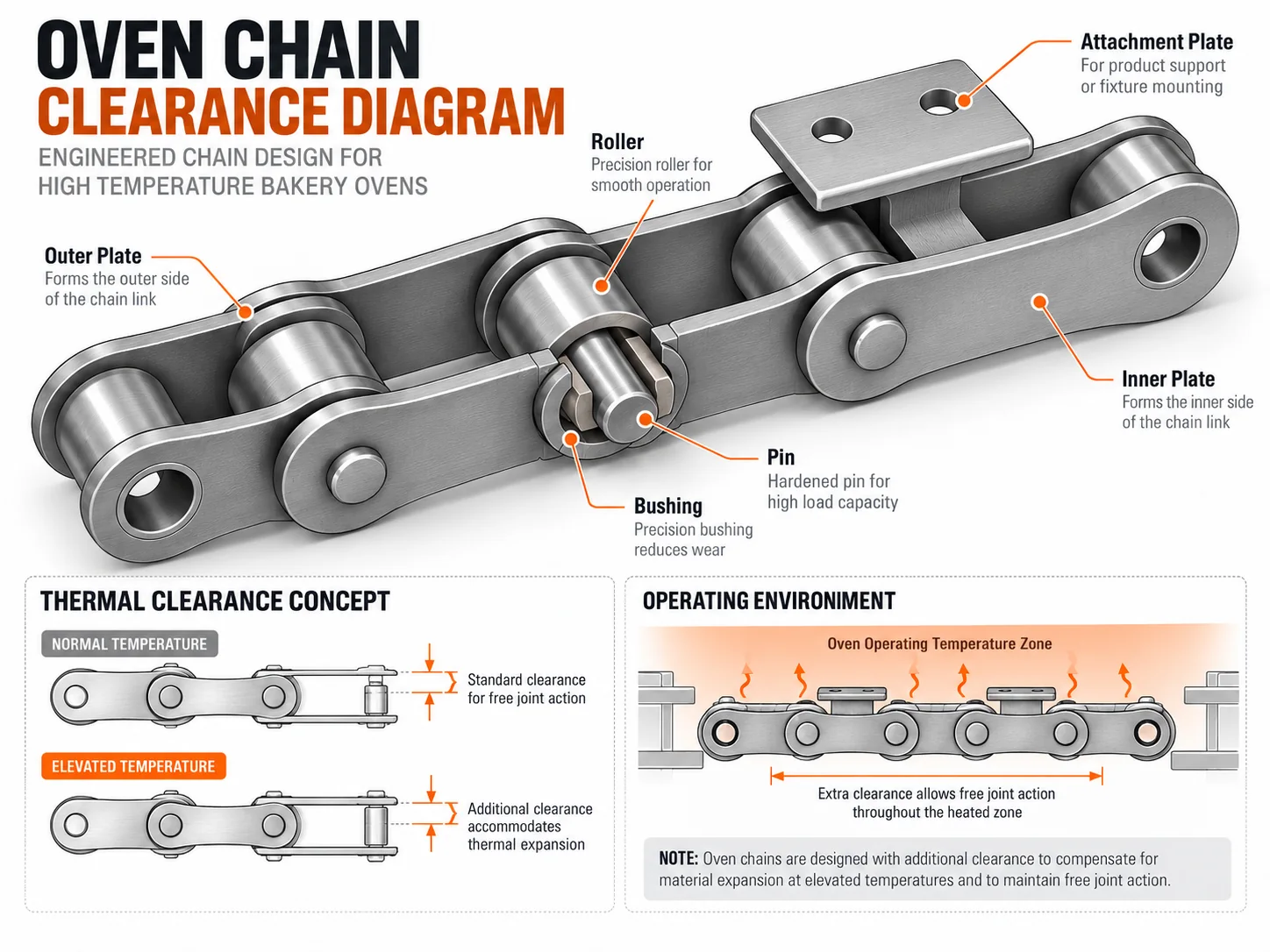
Przed zdjęciem łańcucha należy zmierzyć kilka cech. Podziałka określa podstawowe zależności przełożenia, ale szerokość wewnętrzna, średnica rolki lub tulei, średnica sworznia, wysokość płytki, szerokość całkowita i wymiary mocowania odróżniają konfiguracje, które mogą mieć tę samą nominalną podziałkę.
W przypadku zużycia łańcucha należy zmierzyć skumulowany podział na kilku ogniwach. Sfotografuj łańcuch z boku i z końca, uwzględniając zębatkę, jeśli to możliwe.
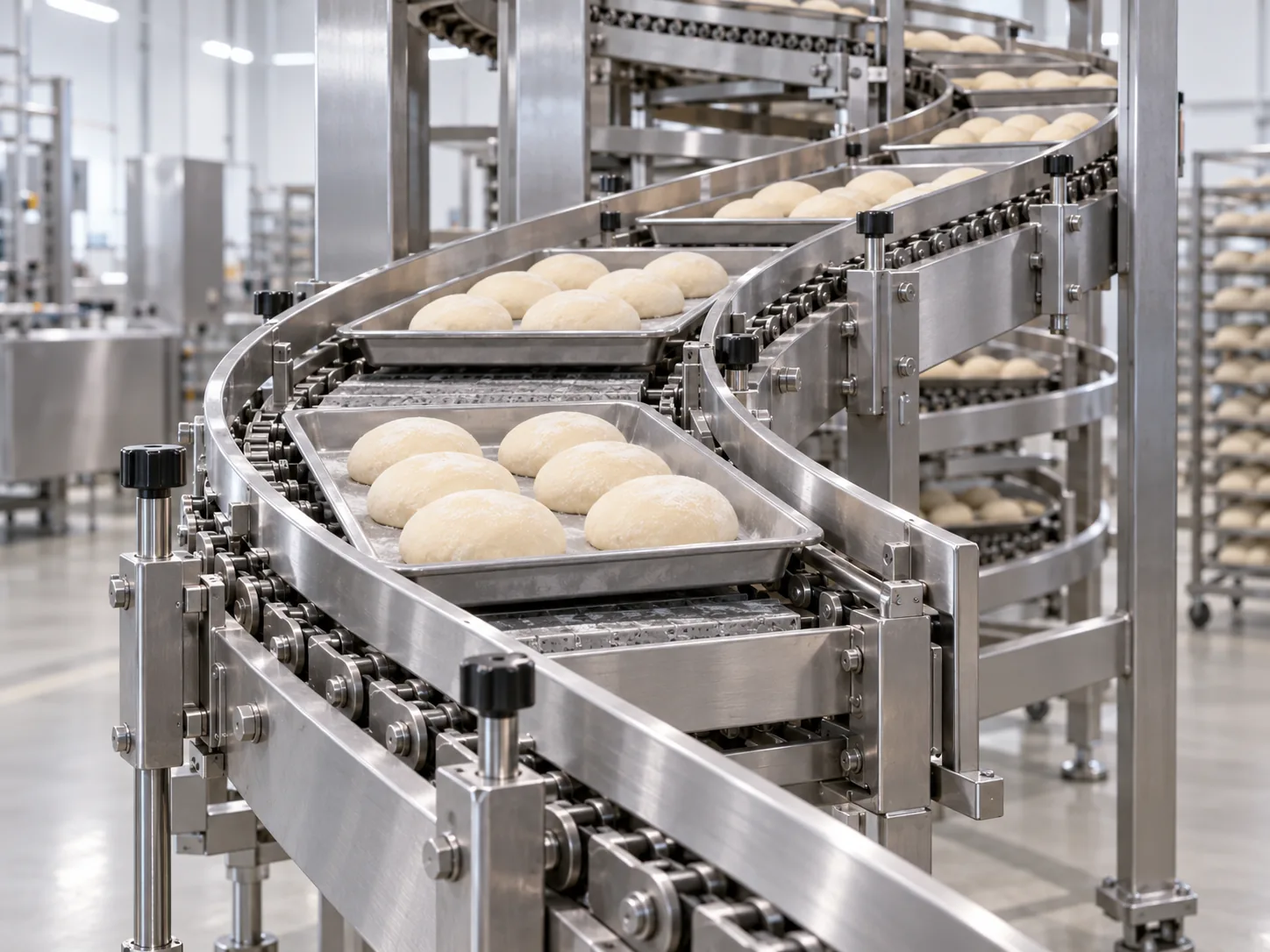
The same chain geometry can behave differently in a humid proofer, a hot oven, an ambient cooling section or a washdown area. For conveyor chain attachment spacing guide, document the exact machine zone, whether the chain carries product directly or moves pans/fixtures, and whether the joint sees heat, moisture, cleaning chemicals or abrasive residue.
Dane procesowe pomagają ustalić, które cechy są stałe i zamienne, a które cechy — takie jak materiał, luz lub metoda produkcji osprzętu — należy przeanalizować w kontekście danego zastosowania.
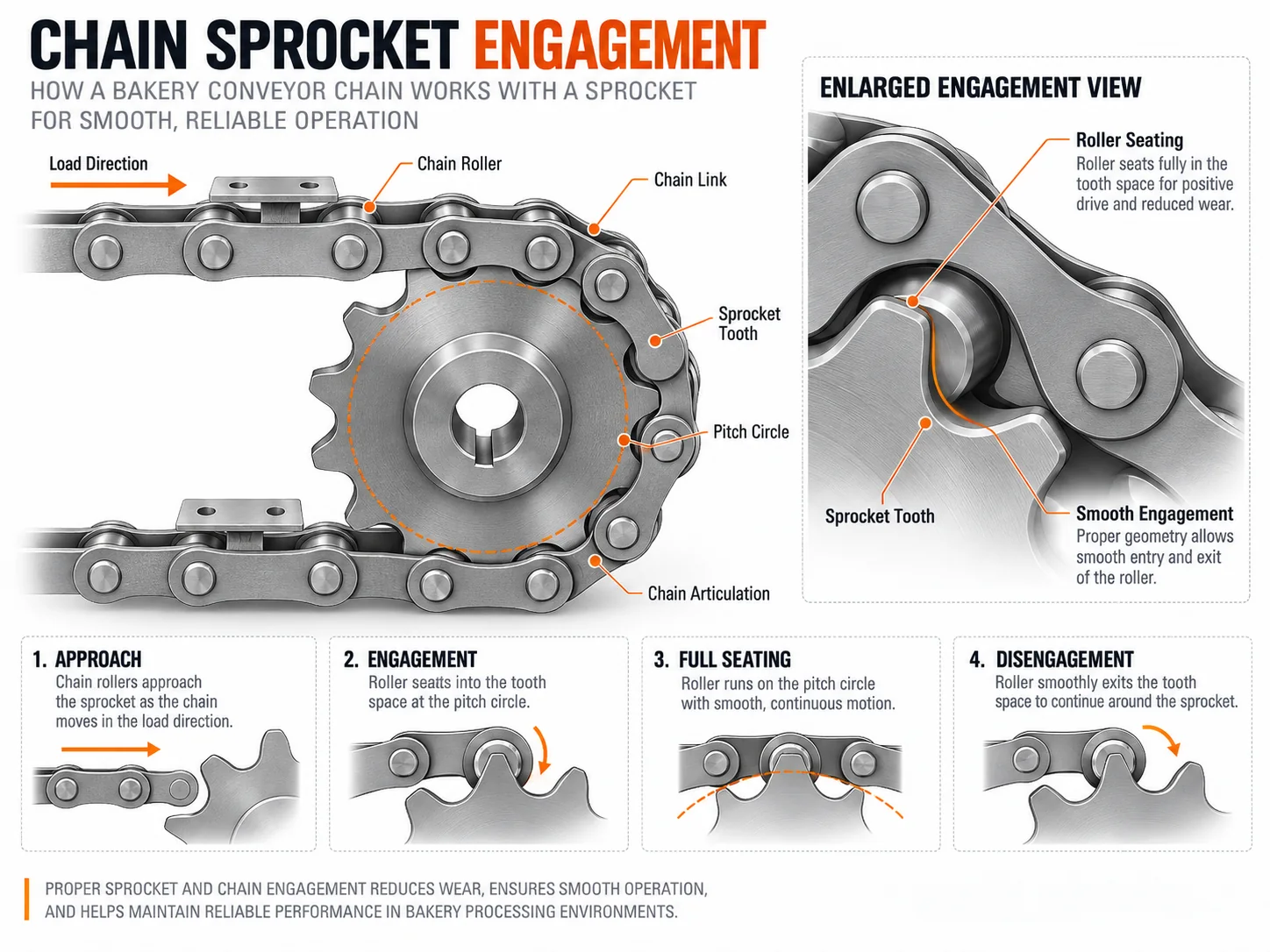
Łańcuch nie działa niezależnie. Rolki lub tuleje muszą płynnie wchodzić i wychodzić z przestrzeni między zębami, podczas gdy prowadnice podtrzymują łańcuch bez jego bocznego przesuwania. Haczykowate zęby, niewspółosiowość wału, mimośrodowe koła zębate lub ciasna prowadnica mogą powodować szybkie zużycie nowego łańcucha.
Sprawdź całą ścieżkę przez jeden pełny obwód. Jeśli uszkodzenie powtarza się w tym samym miejscu maszyny, skontaktuj się z lokalnym działem wsparcia, transferu lub przewoźnikiem, zanim założysz, że sam łańcuch jest uszkodzony.
Skok, szerokość, rolka/tuleja, sworzeń, płytka, szerokość całkowita i wzór mocowania.
Temperatura, wilgotność, mycie, prędkość, obciążenie, godziny produkcji i uruchomienia.
Zębatki, prowadnice, środki łańcuchów, napinacze, wyrównanie i odstępy między zabierakami.
Przed instalacją zatwierdź ostateczną konfigurację geometrii, materiału i zastosowania.
Zapytaj, co się zmieniło przed pojawieniem się problemu: tempo produkcji, masa produktu lub miski, cykl czyszczenia, środek smarny, temperatura, częstotliwość konserwacji czy wymiana kół zębatych. Informacje o trendzie są cenniejsze niż pojedyncze zdjęcie, ponieważ pokazują, czy zużycie jest równomierne, czy skoncentrowane.
Podczas rutynowej kontroli należy zwrócić uwagę na sztywność połączeń, zużycie rolek, ruch sworzni, pęknięte lub wygięte elementy mocujące, nieprawidłowy kontakt boczny i nierównomierne naciąganie. Należy stosować osłony i procedury bezpieczeństwa zgodnie z wymaganiami właściciela maszyny.
Uwzględnij zmierzone wymiary, nazwę maszyny/procesu, zdjęcia, rysunek (jeśli dostępny), ilość lub wymaganą długość łańcucha, odstęp między mocowaniami, rozstaw środków łańcucha, informacje o zębach, temperaturę, warunki mycia, obciążenie i docelowy czas dostawy. Sprawdź przewodnik po wyborze sieci piekarni i przegląd rodziny produktów do następnego kroku decyzyjnego.
A useful diagnosis starts with evidence that can be repeated by a second person. relating attachment interval to chain pitch, machine index and carrier timing. Record chain pitch, attachment repeat, carrier length, sprocket index and parallel-strand synchronization. When the chain is worn, note which readings may be influenced by joint clearance or deformation, and prefer multi-pitch or multi-point measurements over one isolated dimension.
The chain does not operate by itself. In indexed pan, tray and product-carrier conveyors, inspect the sprockets, guides, return path, take-up and carrier interface at the same time. The symptom to watch is cyclic overload or mistimed carriers from an interval that is one pitch off. A local problem that repeats at one machine position often points to alignment, clearance or mating-hardware issues rather than a uniform chain problem.
The practical decision is to measure several repeated intervals and verify them against the machine sequence. That prevents a common error: changing chain tension, material or size before the root constraint has been identified. Use the chain drawing and the machine envelope together, because a configuration that looks correct in isolation can still interfere with a guard, transfer plate, sensor bracket or carrier.
Opisz cykl pracy, a nie pojedynczy przymiotnik, taki jak „gorący”, „mokry” lub „dopuszczony do kontaktu z żywnością”. W stosownych przypadkach podaj temperaturę normalną i maksymalną, wilgotność lub narażenie na czyszczenie, prędkość, zachowanie podczas startu/zatrzymania oraz ograniczenia dotyczące smarowania. Te szczegóły decydują o konieczności zmiany luzów, materiałów lub sposobu konserwacji, przy zachowaniu niezmiennej podstawowej geometrii.
| Sprawdzać | Dlaczego to ważne | Co wysłać lub zweryfikować |
|---|---|---|
| Identyfikacja | Confirm chain pitch, attachment repeat, carrier length, sprocket index and parallel-strand synchronization. Use a measurement sequence that can be repeated after removal so the installed and bench readings can be compared. | Wymiarowany szkic, zdjęcia uwzględniające skalę oraz wszelkie starsze rysunki i numery części. |
| Pozycja trasy | Map where the chain runs through indexed pan, tray and product-carrier conveyors. Mark the exact location of cyclic overload or mistimed carriers from an interval that is one pitch off instead of reporting the condition only as a whole-line problem. | Zdjęcie kontekstowe przedstawiające sekcję przenośnika, pozycje napędu/ogonu i ścieżkę powrotną. |
| Części łączące | Sprawdź profil zęba, osadzenie rolki, współosiowość wału/koła zębatego, styk prowadnicy i zapas naciągu. Elementy te mogą powodować powstawanie śladów zużycia imitujących problem z doborem łańcucha. | Liczba zębów koła zębatego i zdjęcia, układ prowadnicy i aktualna pozycja odbioru. |
| Załaduj ścieżkę | Identify how product carriers, pans, rods or fixtures transfer load into the chain. For this topic, the key focus is relating attachment interval to chain pitch, machine index and carrier timing. | Rysunek nośnika, odstęp między mocowaniami, rozstaw środków łańcucha i nośna masa/siła, jeśli znane. |
| Środowisko | Rejestruj ograniczenia dotyczące temperatury, wilgotności, mycia, zanieczyszczeń i smarowania dla każdej strefy maszyny. Oddzielaj ciągłą ekspozycję od krótkotrwałych szczytów lub czynności związanych z czyszczeniem. | Podsumowanie warunków eksploatacyjnych oraz praktyk konserwacyjnych/smarowania. |
| Uwolnienie | The final engineering action is to measure several repeated intervals and verify them against the machine sequence. The approved drawing should distinguish fixed interchange dimensions from selectable options. | repeated-spacing measurement, carrier drawing, sprocket data and line speed. |
A uniform change along the whole strand suggests a different mechanism from damage concentrated at one sprocket, guide or transfer. For Conveyor Chain Attachment Spacing Guide, compare left/right sides and loaded/return paths. The distribution of wear can reveal whether the driver is joint wear, side loading, contamination, thermal change or a carrier that is forcing the chain out of its natural path.
Increasing tension can temporarily change noise or tracking without correcting the underlying cause. If the observed issue is cyclic overload or mistimed carriers from an interval that is one pitch off, first confirm alignment, take-up geometry and articulation. Excessive tension can add bearing load and make a marginal guide or attachment problem worse.
Urządzenia piekarnicze mogą przechodzić między stanami produkcji, czyszczenia i wyłączenia. Łańcuch może poruszać się normalnie po schłodzeniu i napinać się po podgrzaniu lub swobodnie pracować podczas produkcji, ale korodować po wielokrotnych wyłączeniach spowodowanych wilgocią. Należy zarejestrować stan, w którym występuje objaw, aby wybrane działanie naprawcze uwzględniało rzeczywisty cykl pracy.
For an unknown chain, one close-up is not enough. Pair a complete machine-zone image with side and end views of several pitches, a sprocket-engagement photo and a clear attachment/carrier view. Place a scale only where it does not hide the feature being measured. This photo set makes relating attachment interval to chain pitch, machine index and carrier timing easier to evaluate remotely.
Record chain pitch, attachment repeat, carrier length, sprocket index and parallel-strand synchronization, chain centers, sprocket tooth count and the carrier interface before changing components.
Describe what happens in indexed pan, tray and product-carrier conveyors, including temperature or moisture changes, speed, load and cleaning/lubrication constraints.
Document where cyclic overload or mistimed carriers from an interval that is one pitch off appears. Compare drive, tail, loaded run, return run and transfer points rather than averaging the entire conveyor.
Include repeated-spacing measurement, carrier drawing, sprocket data and line speed. State the required quantity or chain length and any documentation needed with the order.
Review pitch, widths, pin/roller geometry, attachments and material notes on one controlled drawing revision. For Conveyor Chain Attachment Spacing Guide, the release decision should explicitly address relating attachment interval to chain pitch, machine index and carrier timing.
Po instalacji należy wykonać co najmniej jeden pełny obwód, sprawdzić wejście/wyjście zębatki i luz w jarzmie oraz ponownie sprawdzić naciąg zgodnie z procedurą producenta maszyny. Nie należy używać nowego łańcucha w celu kompensacji zużytego lub niewspółosiowego osprzętu.
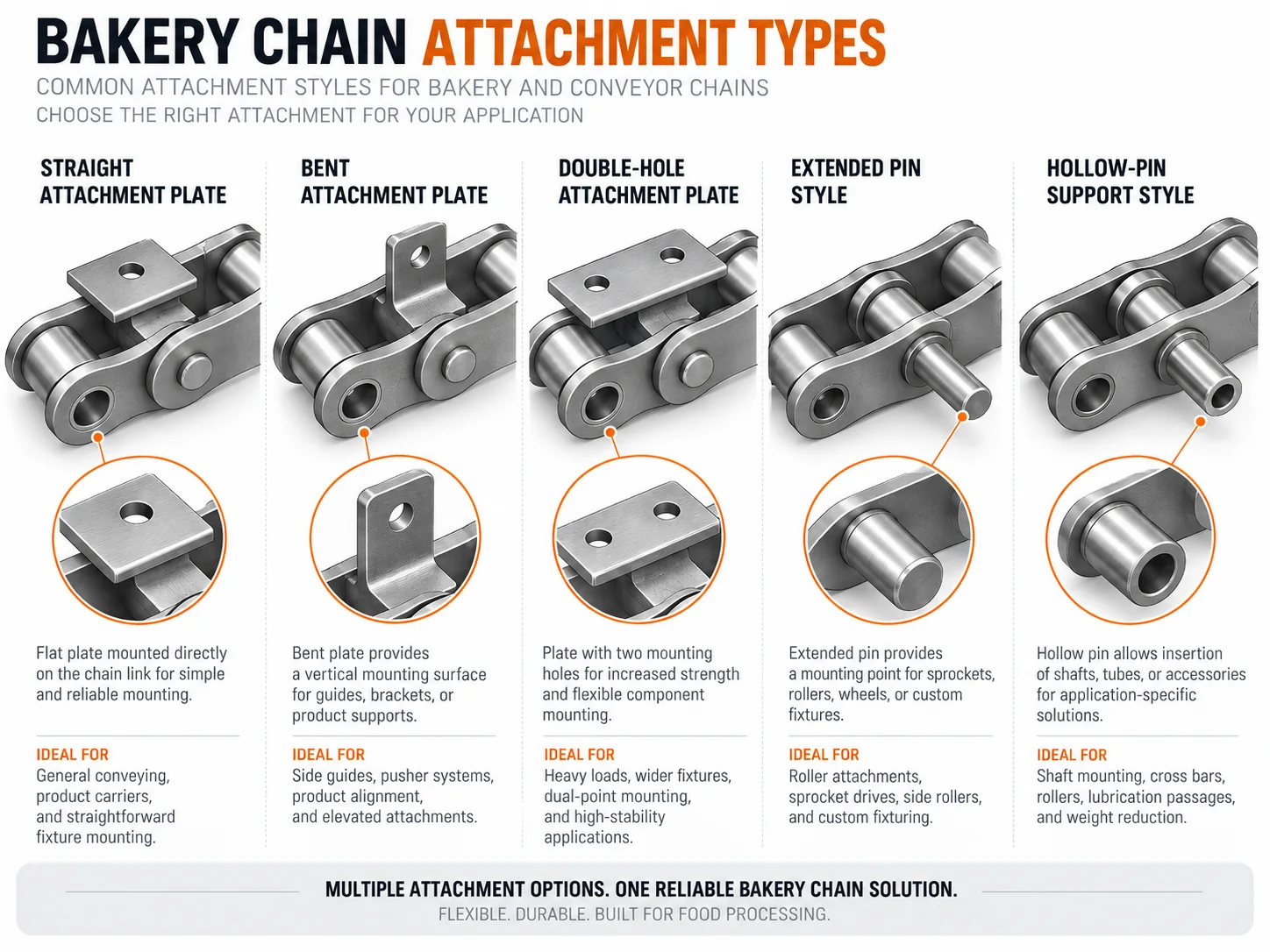
The main reason to keep this process structured is that relating attachment interval to chain pitch, machine index and carrier timing interacts with more than one component. A change that improves one symptom can shift load into another part of the mechanism. For example, correcting guide alignment may reduce side wear but also expose a take-up setting that was previously compensating for the misalignment. Record changes one at a time so the result can be interpreted.
For planned maintenance, compare the present condition with a baseline whenever one exists. If there is no baseline, create one during the next shutdown: photograph the sprockets and guide surfaces, record take-up position, measure a defined number of pitches, and note the chain’s location in indexed pan, tray and product-carrier conveyors. Repeating the same observations later is more informative than relying on general statements such as “the chain has stretched.”
Jeśli dostępny jest istniejący rysunek, należy sprawdzić, czy zainstalowany sprzęt nadal jest zgodny. Sprzęt piekarniczy często podlega modyfikacjom w trakcie eksploatacji: można naprawiać wózki, przesuwać prowadnice, wymieniać koła zębate i zmieniać odstępy między mocowaniami. Rysunek pozostaje użyteczny, ale weryfikacja w terenie zapobiega traktowaniu dokumentu historycznego jako dowodu aktualnej konfiguracji.
Procurement and engineering should use the same evidence package. The RFQ should not separate commercial quantity from technical context: repeated-spacing measurement, carrier drawing, sprocket data and line speed. This makes it possible to judge whether a standard series, a modified attachment or a custom replacement is the appropriate route without creating unnecessary back-and-forth.
Finally, treat the website as a preparation tool rather than the controlling product drawing. Measurements and diagrams narrow the family and help organize the RFQ; the released drawing defines the ordered configuration. That distinction is especially important where cyclic overload or mistimed carriers from an interval that is one pitch off could have more than one mechanical cause.
Use Conveyor Chain Attachment Spacing Guide as a machine-level question, not just a chain inspection. Compare the loaded and return runs, drive and tail ends, and any transfer or carrier transition in indexed pan, tray and product-carrier conveyors. Document whether cyclic overload or mistimed carriers from an interval that is one pitch off is distributed along the strand or repeats at one location. That pattern helps separate progressive joint wear from alignment, guide, sprocket or carrier problems that a new chain alone will not correct.
The working record should include chain pitch, attachment repeat, carrier length, sprocket index and parallel-strand synchronization. Mark which values are fixed by the existing machine and which values can be changed to improve service. The central engineering focus is relating attachment interval to chain pitch, machine index and carrier timing. When a legacy part number conflicts with field measurements, hold the RFQ until the installed interface and the controlled drawing can be reconciled.
A useful enquiry combines commercial quantity with the technical package: repeated-spacing measurement, carrier drawing, sprocket data and line speed. Also state whether the request is a direct replacement, a planned modification or a new machine design. The release objective is to measure several repeated intervals and verify them against the machine sequence. This reduces quote revisions and prevents a visually similar chain from being treated as interchangeable before geometry and duty have been checked.
Jeśli to możliwe, użyj starego numeru referencyjnego, ale zweryfikuj zainstalowaną geometrię i parametry. Modyfikacje maszyny, wcześniejsze wymiany lub zużycie mogą sprawić, że sam numer części będzie niekompletny.
Zastosuj pomiar wieloskokowy w praktycznej liczbie ogniw i zapisz metodę. Porównaj wynik z nominalnym skokiem i limitami konserwacji maszyny, zamiast polegać na pomiarze jednego sąsiedniego ogniwa.
W przypadku zużycia zębów, zahaczania, problemów z ustawieniem lub powtarzającego się przedwczesnego zużycia łańcucha, łańcuch i zębatka działają jak układ zazębiający.