Opptaksgeometri
Stigning, bredde, rulle/hylse, tapp, plate, totalbredde og festemønster.
Teknisk veiledning for bakerikjeden
Common Bakery Oven Chain Failure Modes is best answered by combining measured chain geometry, machine duty and the operating environment. This guide shows what to inspect, record and discuss before a replacement or new-chain decision.
Common Bakery Oven Chain Failure Modes should be evaluated from the actual conveyor. Start with chain pitch, transverse geometry, sprocket condition and any carrier attachment, then add temperature, moisture, washdown, load, speed and take-up information. The objective is not to identify a chain by appearance; it is to produce an RFQ that preserves the machine interface and makes application-dependent choices explicit.
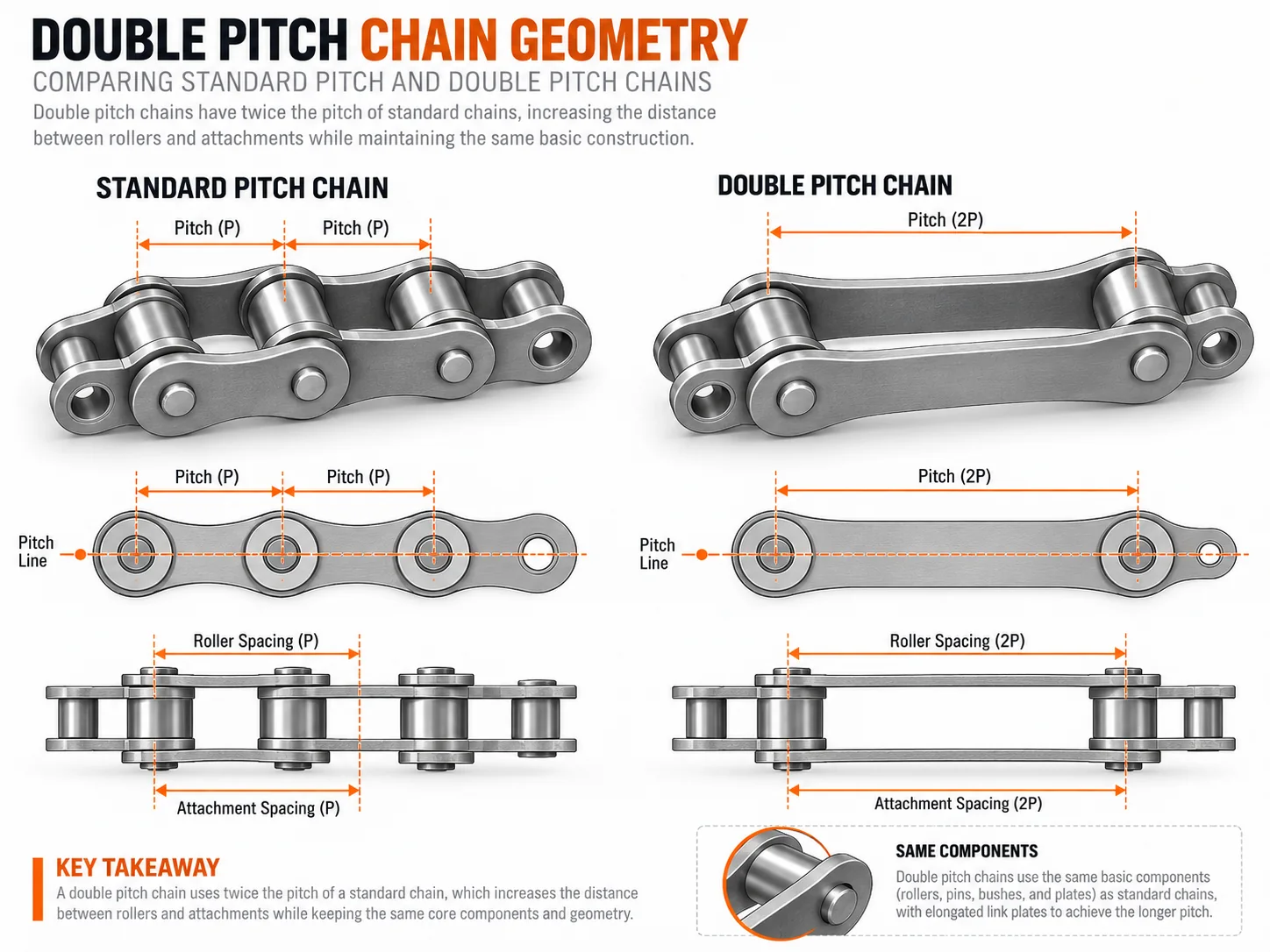
Mål flere egenskaper før du fjerner kjedet. Stigningen bestemmer det grunnleggende girforholdet, men innvendig bredde, rulle- eller bøssingdiameter, pinnediameter, platehøyde, totalbredde og festemål skiller konfigurasjoner som kan dele samme nominelle stigning.
For en slitt kjedetråd, mål den kumulative stigningslengden over flere lenker. Fotografer kjedet fra siden og enden, og inkluder tannhjulet der det er praktisk.
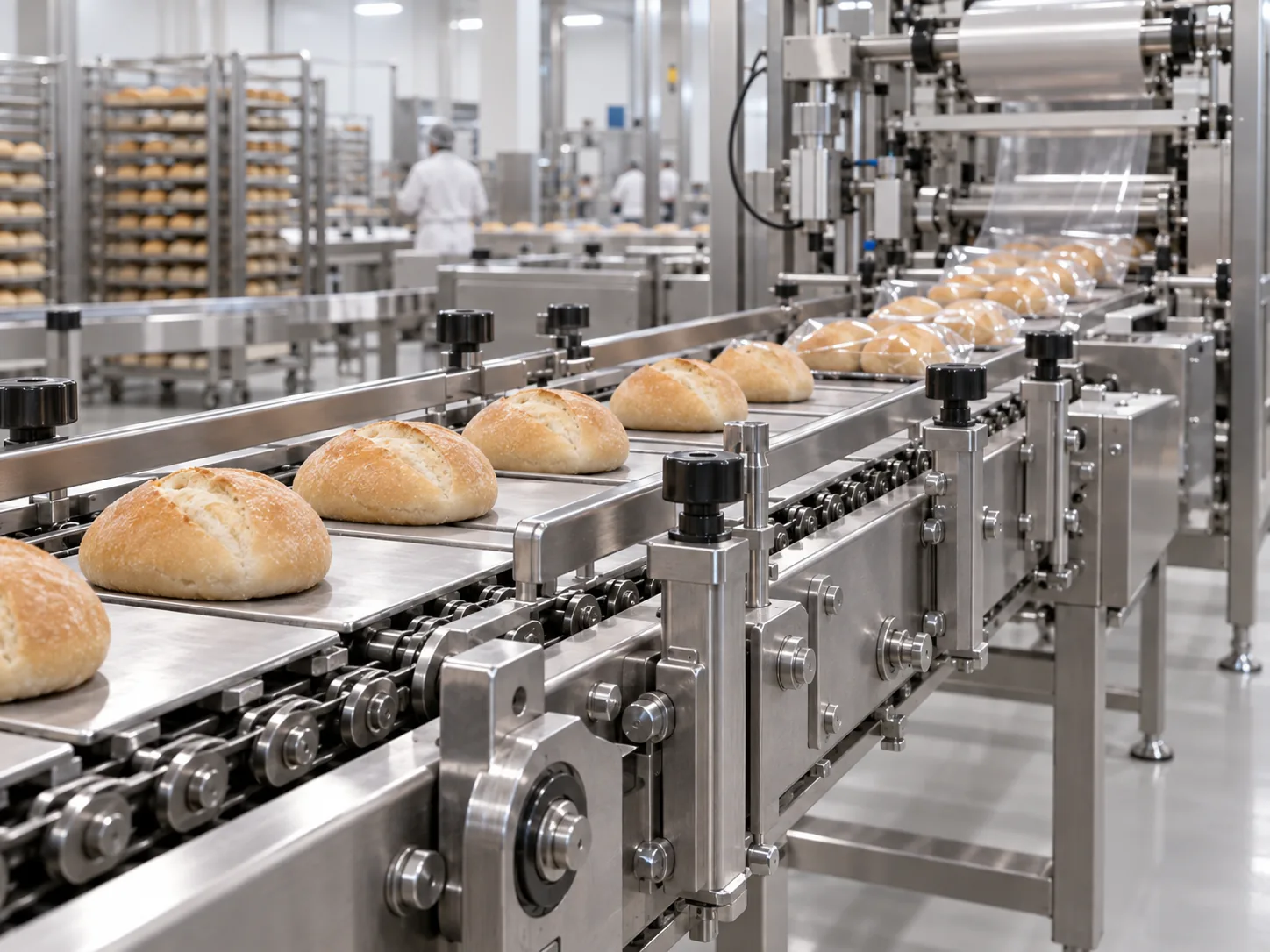
The same chain geometry can behave differently in a humid proofer, a hot oven, an ambient cooling section or a washdown area. For common bakery oven chain failure modes, document the exact machine zone, whether the chain carries product directly or moves pans/fixtures, and whether the joint sees heat, moisture, cleaning chemicals or abrasive residue.
Prosessdata bidrar til å bestemme hvilke egenskaper som er fastsatt ved utskiftbarhet, og hvilke egenskaper – som materiale, klaring eller produksjonsmetode for fester – som bør gjennomgås for applikasjonen.
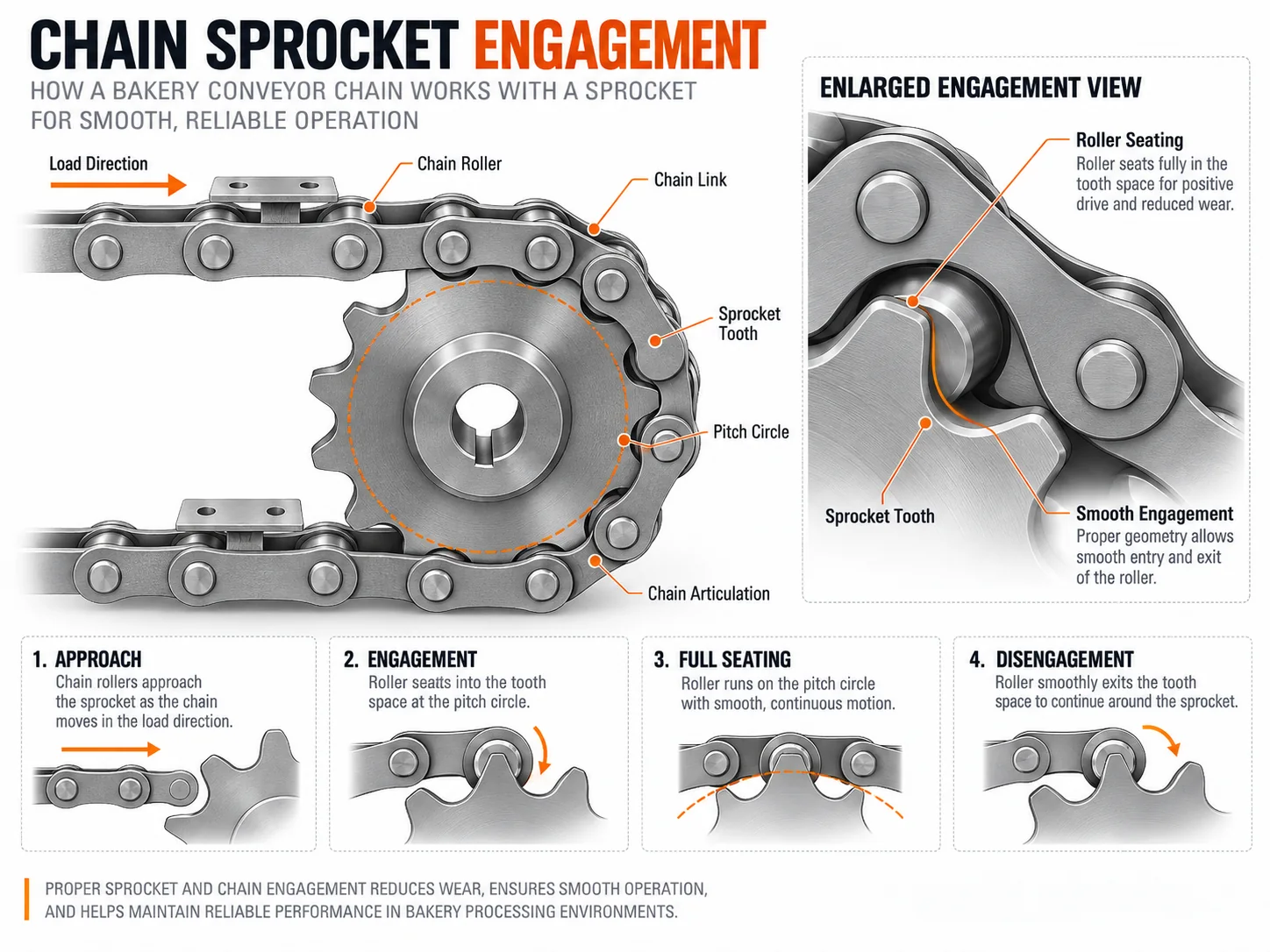
En kjede fungerer ikke uavhengig. Ruller eller hylser må gå jevnt inn i og ut av tannhjulets tannmellomrom, mens føringsskinner støtter tråden uten å tvinge den sidelengs. Krokede tenner, feiljustering av akselen, eksentriske tannhjul eller en stram føring kan føre til at en ny kjede slites raskt.
Inspiser hele kjedebanen gjennom én full krets. Hvis skaden gjentar seg på samme maskinsted, undersøk den lokale støtten, overføringen eller transportøren før du antar at selve kjedet er defekt.
Stigning, bredde, rulle/hylse, tapp, plate, totalbredde og festemønster.
Temperatur, fuktighet, nedvask, hastighet, last, produksjonstimer og starter.
Tannhjul, føringer, kjedesenter, opptak, justering og klaring mellom bærerhjulene.
Godkjenn den endelig bestilte geometrien, materialet og den applikasjonsavhengige konfigurasjonen før installasjon.
Spør hva som endret seg før problemet oppsto: produksjonshastighet, produkt- eller pannvekt, rengjøringssyklus, smøremiddel, temperatur, vedlikeholdsintervall eller utskiftede tannhjul. Trendinformasjon er mer verdifull enn et enkelt fotografi fordi det viser om slitasjen er jevn eller konsentrert.
Under rutinemessig inspeksjon, se etter stive skjøter, slitasje på ruller, boltbevegelse, sprukne eller bøyde fester, unormal sidekontakt og ujevn opptak. Hold vern og sikkerhetsprosedyrer på plass i henhold til maskineierens krav.
Inkluder de målte dimensjonene, maskin-/prosessnavn, bilder, tegning hvis tilgjengelig, antall eller nødvendig kjedelengde, festeintervall, kjedesenteravstand, informasjon om tannhjul, temperatur, nedvaskingstilstand, last og målleveringsvindu. Se gjennom veiledning for valg av bakerikjede og den oversikt over produktfamilien for neste beslutningstrinn.
Bruk den gamle referansen hvis tilgjengelig, men bekreft den installerte geometrien og oppgaven. Maskinmodifikasjoner, tidligere utskiftninger eller slitasje kan gjøre et delenummer alene ufullstendig.
Bruk en flertonemåling over et praktisk antall lenker og registrer metoden. Sammenlign den med nominell tone og maskinens vedlikeholdsgrenser i stedet for å stole på én måling av tilstøtende lenker.
Når det er tannslitasje, hekting, problemer med kjedejustering eller gjentatt for tidlig kjedeslitasje, fungerer kjedet og tannhjulet som et inngripende system.
For Common Bakery Oven Chain Failure Modes, begin with a measurement record that another engineer can reproduce. Note the measurement tool, the points used, and whether the chain was loaded or relaxed. A multi-pitch measurement is useful for detecting elongation, while transverse dimensions such as inside width and pin projection help identify the original construction even when the joints are worn.
Map the chain route on the machine before deciding that the strand itself is the only cause of a problem. Mark drive and tail sprockets, guides, return tracks, take-up positions, transfer points and carrier interfaces. Repeated scuffing at one location usually deserves a local alignment or clearance check rather than an automatic increase in chain tension.
Temperature data should distinguish normal running conditions from short peaks. Metal components expand as temperature rises, lubricants change viscosity, and product residue can alter the way joints move. A useful RFQ therefore states where temperature is measured, how long the chain remains in that zone and whether the conveyor cools completely during normal shutdowns.
Washdown information should describe frequency, water temperature, cleaning chemistry and whether the chain is rinsed and dried. Stainless steel can improve corrosion resistance, but material selection does not remove the need for suitable joint design, drainage, compatible lubrication and inspection. Cleaning practice is part of the engineering condition, not a separate housekeeping detail.
Where pans, trays or cross bars are fitted, the attachment interface should be treated as a load path. Record hole diameter, hole center distance, bend height, offset from the chain centerline and the repeated attachment interval. Also identify whether the carrier is rigidly fixed or allowed to articulate, because an over-constrained carrier can force parallel strands out of alignment.
Sprocket condition is especially important on a replacement project. Check tooth profile, visible hooking, eccentric wear, hub security and alignment to the chain track. A new chain can appear to stretch quickly when it is actually seating into worn tooth spaces. When sprockets are questionable, include clear side photographs and tooth count in the RFQ.
Take-up travel provides useful evidence about system condition. Record the present take-up position and any adjustment made during the service life of the chain. If the take-up is near its limit, measure cumulative pitch over several links before removing the chain so wear can be separated from a simple installation-length issue.
Lubrication decisions must account for temperature, contamination and food-production practices. The correct approach is application-specific: some joints require a lubricant that can reach the pin/bush bearing surfaces, while some process zones impose restrictions on where and how lubrication can be applied. State the existing method and any limitations rather than assuming a universal interval.
For a new machine, document expected product throughput separately from chain load. The mass carried by the chain includes pans, trays, carrier bars and fixtures in addition to the baked product. Acceleration, incline, transfer resistance and accumulation can create forces that are not obvious from product weight alone.
For an existing machine, photographs are most useful when they show context and detail together. Include one image of the entire conveyor section, one of the chain on the sprocket, one side view of several pitches, one end view showing transverse width and one close-up of the attachment. Add a ruler or caliper only where it does not hide the component being measured.
A procurement specification should separate dimensions that must match from characteristics that can be optimized. Pitch, chain centers and carrier mounting geometry may be fixed by the machine; material, surface treatment, joint clearance or attachment manufacturing method may have room for review. Making that distinction avoids unnecessary redesign while still allowing an improved configuration.
Before release, compare the proposed configuration with the actual installed envelope. Check nearby guards, sensor brackets, guide rails and transfer plates as well as the sprockets. The final production drawing is the controlling reference for dimensions and ordered options; website values are best used to prepare the discussion and identify the likely chain family.
For Common Bakery Oven Chain Failure Modes, begin with a measurement record that another engineer can reproduce. Note the measurement tool, the points used, and whether the chain was loaded or relaxed. A multi-pitch measurement is useful for detecting elongation, while transverse dimensions such as inside width and pin projection help identify the original construction even when the joints are worn.
Map the chain route on the machine before deciding that the strand itself is the only cause of a problem. Mark drive and tail sprockets, guides, return tracks, take-up positions, transfer points and carrier interfaces. Repeated scuffing at one location usually deserves a local alignment or clearance check rather than an automatic increase in chain tension.
Temperature data should distinguish normal running conditions from short peaks. Metal components expand as temperature rises, lubricants change viscosity, and product residue can alter the way joints move. A useful RFQ therefore states where temperature is measured, how long the chain remains in that zone and whether the conveyor cools completely during normal shutdowns.
Washdown information should describe frequency, water temperature, cleaning chemistry and whether the chain is rinsed and dried. Stainless steel can improve corrosion resistance, but material selection does not remove the need for suitable joint design, drainage, compatible lubrication and inspection. Cleaning practice is part of the engineering condition, not a separate housekeeping detail.
Where pans, trays or cross bars are fitted, the attachment interface should be treated as a load path. Record hole diameter, hole center distance, bend height, offset from the chain centerline and the repeated attachment interval. Also identify whether the carrier is rigidly fixed or allowed to articulate, because an over-constrained carrier can force parallel strands out of alignment.
Sprocket condition is especially important on a replacement project. Check tooth profile, visible hooking, eccentric wear, hub security and alignment to the chain track. A new chain can appear to stretch quickly when it is actually seating into worn tooth spaces. When sprockets are questionable, include clear side photographs and tooth count in the RFQ.
Take-up travel provides useful evidence about system condition. Record the present take-up position and any adjustment made during the service life of the chain. If the take-up is near its limit, measure cumulative pitch over several links before removing the chain so wear can be separated from a simple installation-length issue.
Lubrication decisions must account for temperature, contamination and food-production practices. The correct approach is application-specific: some joints require a lubricant that can reach the pin/bush bearing surfaces, while some process zones impose restrictions on where and how lubrication can be applied. State the existing method and any limitations rather than assuming a universal interval.
For a new machine, document expected product throughput separately from chain load. The mass carried by the chain includes pans, trays, carrier bars and fixtures in addition to the baked product. Acceleration, incline, transfer resistance and accumulation can create forces that are not obvious from product weight alone.
For an existing machine, photographs are most useful when they show context and detail together. Include one image of the entire conveyor section, one of the chain on the sprocket, one side view of several pitches, one end view showing transverse width and one close-up of the attachment. Add a ruler or caliper only where it does not hide the component being measured.
A procurement specification should separate dimensions that must match from characteristics that can be optimized. Pitch, chain centers and carrier mounting geometry may be fixed by the machine; material, surface treatment, joint clearance or attachment manufacturing method may have room for review. Making that distinction avoids unnecessary redesign while still allowing an improved configuration.
Before release, compare the proposed configuration with the actual installed envelope. Check nearby guards, sensor brackets, guide rails and transfer plates as well as the sprockets. The final production drawing is the controlling reference for dimensions and ordered options; website values are best used to prepare the discussion and identify the likely chain family.
For Common Bakery Oven Chain Failure Modes, begin with a measurement record that another engineer can reproduce. Note the measurement tool, the points used, and whether the chain was loaded or relaxed. A multi-pitch measurement is useful for detecting elongation, while transverse dimensions such as inside width and pin projection help identify the original construction even when the joints are worn.
Map the chain route on the machine before deciding that the strand itself is the only cause of a problem. Mark drive and tail sprockets, guides, return tracks, take-up positions, transfer points and carrier interfaces. Repeated scuffing at one location usually deserves a local alignment or clearance check rather than an automatic increase in chain tension.
Temperature data should distinguish normal running conditions from short peaks. Metal components expand as temperature rises, lubricants change viscosity, and product residue can alter the way joints move. A useful RFQ therefore states where temperature is measured, how long the chain remains in that zone and whether the conveyor cools completely during normal shutdowns.
Washdown information should describe frequency, water temperature, cleaning chemistry and whether the chain is rinsed and dried. Stainless steel can improve corrosion resistance, but material selection does not remove the need for suitable joint design, drainage, compatible lubrication and inspection. Cleaning practice is part of the engineering condition, not a separate housekeeping detail.
Where pans, trays or cross bars are fitted, the attachment interface should be treated as a load path. Record hole diameter, hole center distance, bend height, offset from the chain centerline and the repeated attachment interval. Also identify whether the carrier is rigidly fixed or allowed to articulate, because an over-constrained carrier can force parallel strands out of alignment.
Sprocket condition is especially important on a replacement project. Check tooth profile, visible hooking, eccentric wear, hub security and alignment to the chain track. A new chain can appear to stretch quickly when it is actually seating into worn tooth spaces. When sprockets are questionable, include clear side photographs and tooth count in the RFQ.