Leg de geometrie vast.
Steek, breedte, rol/bus, pen, plaat, totale breedte en bevestigingspatroon.
Technische handleiding voor bakkerijketens
Common Bakery Oven Chain Failure Modes is best answered by combining measured chain geometry, machine duty and the operating environment. This guide shows what to inspect, record and discuss before a replacement or new-chain decision.
Common Bakery Oven Chain Failure Modes should be evaluated from the actual conveyor. Start with chain pitch, transverse geometry, sprocket condition and any carrier attachment, then add temperature, moisture, washdown, load, speed and take-up information. The objective is not to identify a chain by appearance; it is to produce an RFQ that preserves the machine interface and makes application-dependent choices explicit.
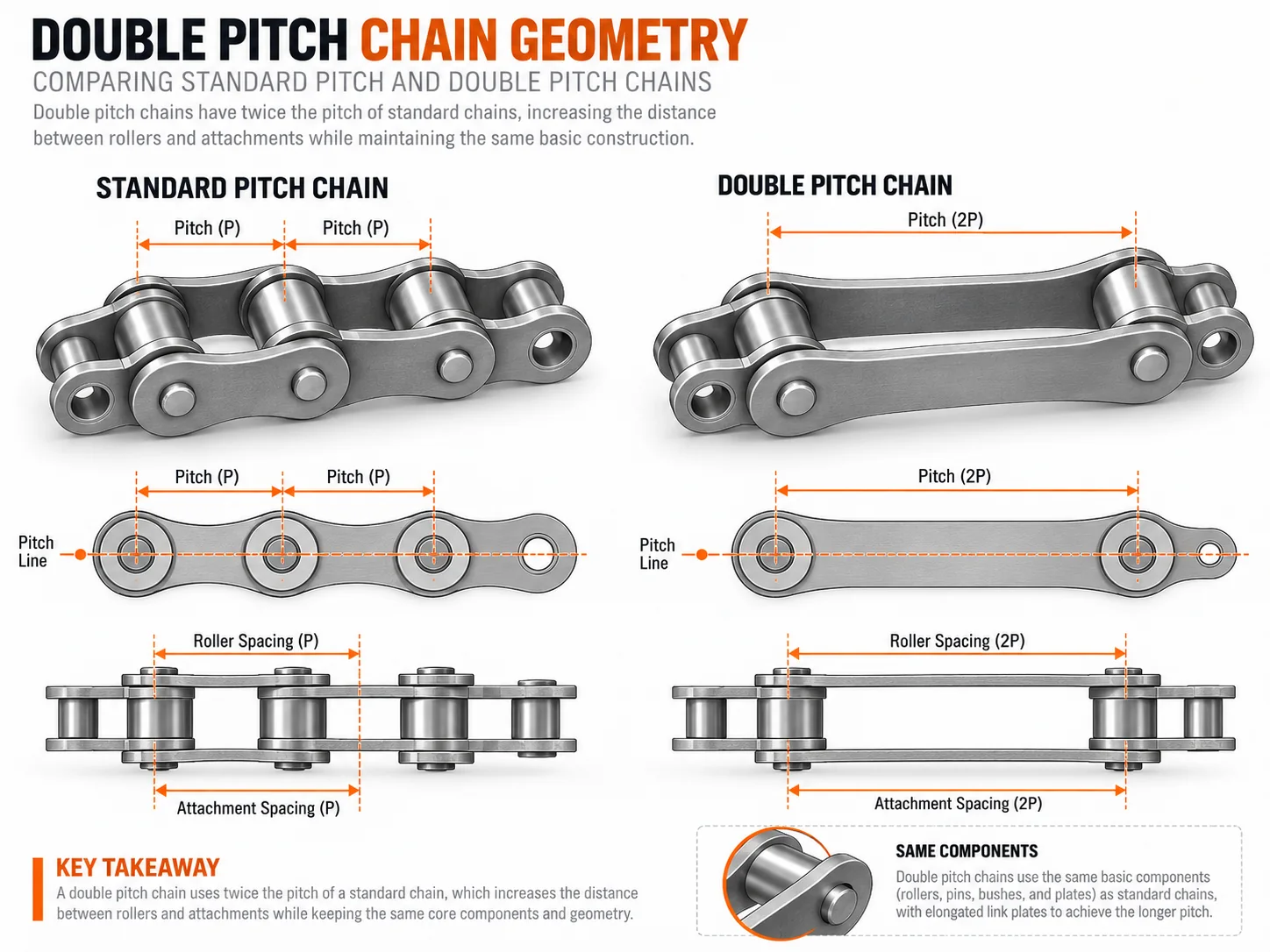
Meet verschillende kenmerken voordat u de ketting verwijdert. De steek bepaalt de basisverhouding van de overbrenging, maar de binnenbreedte, de diameter van de rol of bus, de diameter van de pen, de hoogte van de plaat, de totale breedte en de afmetingen van de bevestiging onderscheiden configuraties die dezelfde nominale steek kunnen hebben.
Om een versleten schakel te beoordelen, meet je de totale steek over meerdere schakels. Fotografeer de ketting vanaf de zijkant en de voorkant, en neem indien mogelijk ook het tandwiel mee op de foto.
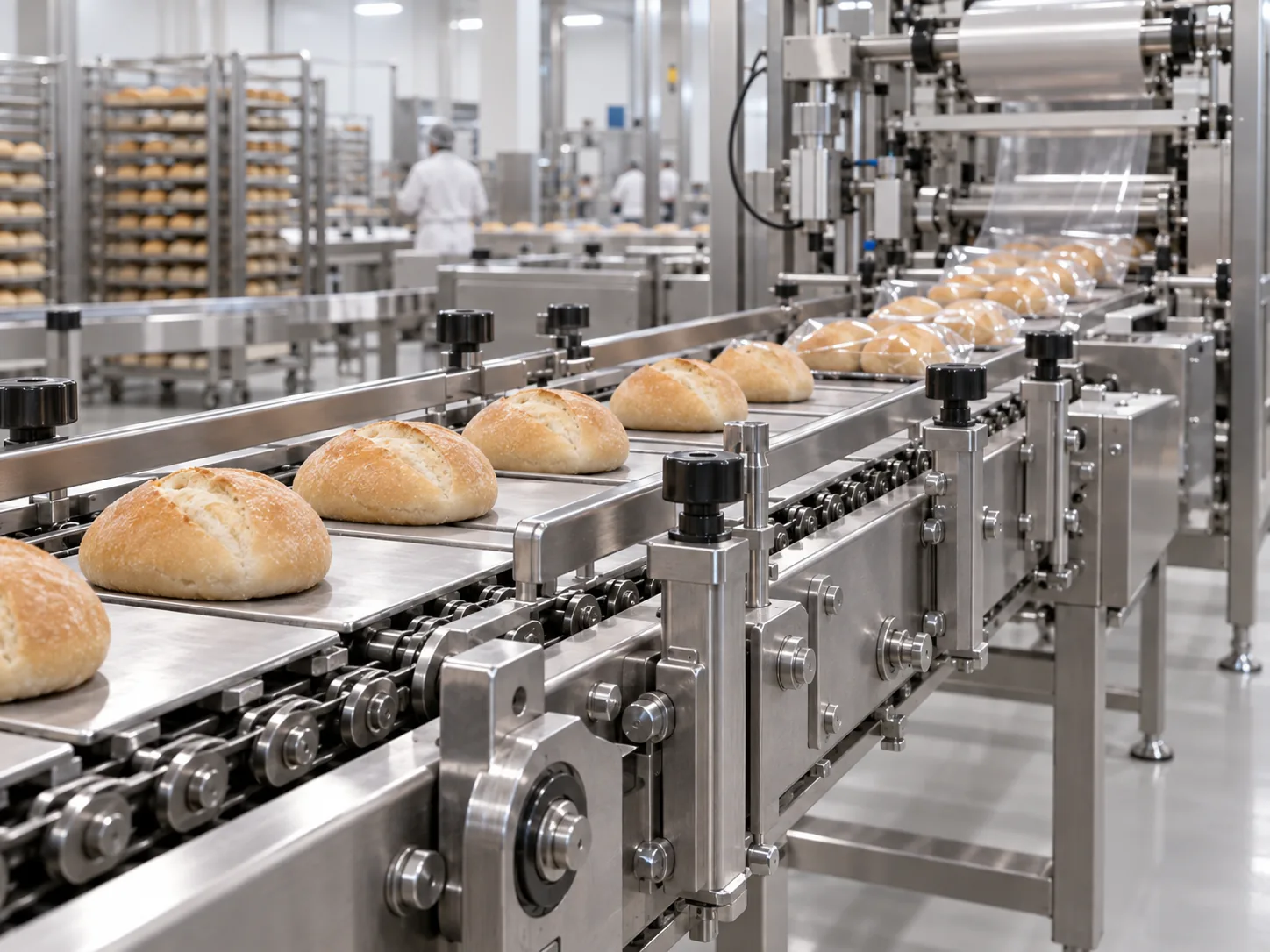
The same chain geometry can behave differently in a humid proofer, a hot oven, an ambient cooling section or a washdown area. For common bakery oven chain failure modes, document the exact machine zone, whether the chain carries product directly or moves pans/fixtures, and whether the joint sees heat, moisture, cleaning chemicals or abrasive residue.
Procesgegevens helpen bepalen welke eigenschappen vastliggen door uitwisselbaarheid en welke eigenschappen – zoals materiaal, speling of de productiemethode van de bevestiging – voor de toepassing moeten worden herzien.
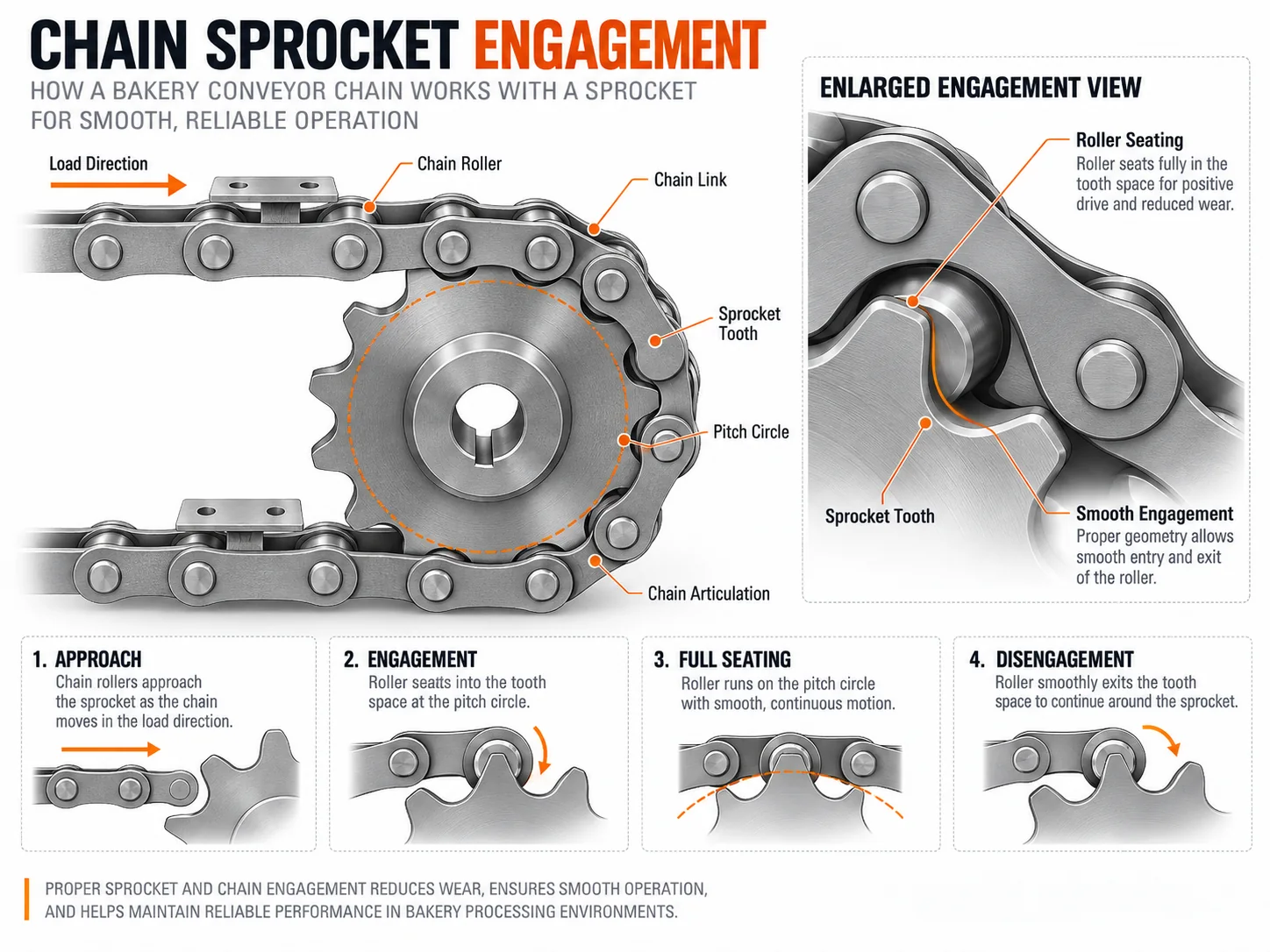
Een ketting werkt niet zelfstandig. Rollen of bussen moeten soepel in en uit de tandruimtes van de tandwielen bewegen, terwijl geleiderails de kettingdraad ondersteunen zonder deze zijwaarts te duwen. Gehaakte tanden, een verkeerde uitlijning van de as, excentrische tandwielen of een stroeve geleider kunnen ervoor zorgen dat een nieuwe ketting snel slijt.
Inspecteer het volledige traject over één complete kringloop. Als de schade zich herhaalt op dezelfde locatie in de machine, onderzoek dan de lokale ondersteuning, overdracht of drager voordat u ervan uitgaat dat de ketting zelf defect is.
Steek, breedte, rol/bus, pen, plaat, totale breedte en bevestigingspatroon.
Temperatuur, vochtigheid, reiniging, snelheid, belasting, productie-uren en -starts.
Tandwielen, geleiders, kettingcentra, spaninrichting, uitlijning en speling van de drager.
Keur de definitieve geometrie, het materiaal en de toepassingsafhankelijke configuratie goed vóór de installatie.
Vraag wat er veranderd is voordat het probleem zich voordeed: productiesnelheid, product- of pan-gewicht, reinigingscyclus, smeermiddel, temperatuur, onderhoudsinterval of vervangen tandwielen. Trendinformatie is waardevoller dan een enkele foto, omdat het laat zien of de slijtage gelijkmatig of geconcentreerd is.
Controleer tijdens de routine-inspectie op stroeve verbindingen, slijtage van de rollen, beweging van de pinnen, gebarsten of verbogen hulpstukken, abnormaal zijdelings contact en ongelijkmatige aanspanning. Zorg ervoor dat de afschermingen en veiligheidsprocedures conform de eisen van de machine-eigenaar worden nageleefd.
Vermeld de gemeten afmetingen, de naam van de machine/het proces, foto's, een tekening (indien beschikbaar), de hoeveelheid of de vereiste kettinglengte, de bevestigingsafstand, de afstand tussen de kettingcentra, informatie over de tandwielen, de temperatuur, de reinigingsconditie, de belasting en het beoogde leveringsvenster. Controleer de Gids voor het kiezen van een bakkerijketen en de productfamilieoverzicht voor de volgende beslissingsstap.
Gebruik indien mogelijk de oude referentie, maar controleer de geïnstalleerde geometrie en toepassing. Machineaanpassingen, eerdere vervangingen of slijtage kunnen ervoor zorgen dat een onderdeelnummer alleen onvolledig is.
Gebruik een meting over meerdere schakels en leg de methode vast. Vergelijk de meting met de nominale schakelafstand en de onderhoudslimieten van de machine, in plaats van te vertrouwen op één meting van een aangrenzende schakel.
Wanneer er sprake is van tandslijtage, haken, uitlijningsproblemen of herhaalde voortijdige slijtage van de ketting, dan werken de ketting en het tandwiel als een in elkaar grijpend systeem.
For Common Bakery Oven Chain Failure Modes, begin with a measurement record that another engineer can reproduce. Note the measurement tool, the points used, and whether the chain was loaded or relaxed. A multi-pitch measurement is useful for detecting elongation, while transverse dimensions such as inside width and pin projection help identify the original construction even when the joints are worn.
Map the chain route on the machine before deciding that the strand itself is the only cause of a problem. Mark drive and tail sprockets, guides, return tracks, take-up positions, transfer points and carrier interfaces. Repeated scuffing at one location usually deserves a local alignment or clearance check rather than an automatic increase in chain tension.
Temperature data should distinguish normal running conditions from short peaks. Metal components expand as temperature rises, lubricants change viscosity, and product residue can alter the way joints move. A useful RFQ therefore states where temperature is measured, how long the chain remains in that zone and whether the conveyor cools completely during normal shutdowns.
Washdown information should describe frequency, water temperature, cleaning chemistry and whether the chain is rinsed and dried. Stainless steel can improve corrosion resistance, but material selection does not remove the need for suitable joint design, drainage, compatible lubrication and inspection. Cleaning practice is part of the engineering condition, not a separate housekeeping detail.
Where pans, trays or cross bars are fitted, the attachment interface should be treated as a load path. Record hole diameter, hole center distance, bend height, offset from the chain centerline and the repeated attachment interval. Also identify whether the carrier is rigidly fixed or allowed to articulate, because an over-constrained carrier can force parallel strands out of alignment.
Sprocket condition is especially important on a replacement project. Check tooth profile, visible hooking, eccentric wear, hub security and alignment to the chain track. A new chain can appear to stretch quickly when it is actually seating into worn tooth spaces. When sprockets are questionable, include clear side photographs and tooth count in the RFQ.
Take-up travel provides useful evidence about system condition. Record the present take-up position and any adjustment made during the service life of the chain. If the take-up is near its limit, measure cumulative pitch over several links before removing the chain so wear can be separated from a simple installation-length issue.
Lubrication decisions must account for temperature, contamination and food-production practices. The correct approach is application-specific: some joints require a lubricant that can reach the pin/bush bearing surfaces, while some process zones impose restrictions on where and how lubrication can be applied. State the existing method and any limitations rather than assuming a universal interval.
For a new machine, document expected product throughput separately from chain load. The mass carried by the chain includes pans, trays, carrier bars and fixtures in addition to the baked product. Acceleration, incline, transfer resistance and accumulation can create forces that are not obvious from product weight alone.
For an existing machine, photographs are most useful when they show context and detail together. Include one image of the entire conveyor section, one of the chain on the sprocket, one side view of several pitches, one end view showing transverse width and one close-up of the attachment. Add a ruler or caliper only where it does not hide the component being measured.
A procurement specification should separate dimensions that must match from characteristics that can be optimized. Pitch, chain centers and carrier mounting geometry may be fixed by the machine; material, surface treatment, joint clearance or attachment manufacturing method may have room for review. Making that distinction avoids unnecessary redesign while still allowing an improved configuration.
Before release, compare the proposed configuration with the actual installed envelope. Check nearby guards, sensor brackets, guide rails and transfer plates as well as the sprockets. The final production drawing is the controlling reference for dimensions and ordered options; website values are best used to prepare the discussion and identify the likely chain family.
For Common Bakery Oven Chain Failure Modes, begin with a measurement record that another engineer can reproduce. Note the measurement tool, the points used, and whether the chain was loaded or relaxed. A multi-pitch measurement is useful for detecting elongation, while transverse dimensions such as inside width and pin projection help identify the original construction even when the joints are worn.
Map the chain route on the machine before deciding that the strand itself is the only cause of a problem. Mark drive and tail sprockets, guides, return tracks, take-up positions, transfer points and carrier interfaces. Repeated scuffing at one location usually deserves a local alignment or clearance check rather than an automatic increase in chain tension.
Temperature data should distinguish normal running conditions from short peaks. Metal components expand as temperature rises, lubricants change viscosity, and product residue can alter the way joints move. A useful RFQ therefore states where temperature is measured, how long the chain remains in that zone and whether the conveyor cools completely during normal shutdowns.
Washdown information should describe frequency, water temperature, cleaning chemistry and whether the chain is rinsed and dried. Stainless steel can improve corrosion resistance, but material selection does not remove the need for suitable joint design, drainage, compatible lubrication and inspection. Cleaning practice is part of the engineering condition, not a separate housekeeping detail.
Where pans, trays or cross bars are fitted, the attachment interface should be treated as a load path. Record hole diameter, hole center distance, bend height, offset from the chain centerline and the repeated attachment interval. Also identify whether the carrier is rigidly fixed or allowed to articulate, because an over-constrained carrier can force parallel strands out of alignment.
Sprocket condition is especially important on a replacement project. Check tooth profile, visible hooking, eccentric wear, hub security and alignment to the chain track. A new chain can appear to stretch quickly when it is actually seating into worn tooth spaces. When sprockets are questionable, include clear side photographs and tooth count in the RFQ.
Take-up travel provides useful evidence about system condition. Record the present take-up position and any adjustment made during the service life of the chain. If the take-up is near its limit, measure cumulative pitch over several links before removing the chain so wear can be separated from a simple installation-length issue.
Lubrication decisions must account for temperature, contamination and food-production practices. The correct approach is application-specific: some joints require a lubricant that can reach the pin/bush bearing surfaces, while some process zones impose restrictions on where and how lubrication can be applied. State the existing method and any limitations rather than assuming a universal interval.
For a new machine, document expected product throughput separately from chain load. The mass carried by the chain includes pans, trays, carrier bars and fixtures in addition to the baked product. Acceleration, incline, transfer resistance and accumulation can create forces that are not obvious from product weight alone.
For an existing machine, photographs are most useful when they show context and detail together. Include one image of the entire conveyor section, one of the chain on the sprocket, one side view of several pitches, one end view showing transverse width and one close-up of the attachment. Add a ruler or caliper only where it does not hide the component being measured.
A procurement specification should separate dimensions that must match from characteristics that can be optimized. Pitch, chain centers and carrier mounting geometry may be fixed by the machine; material, surface treatment, joint clearance or attachment manufacturing method may have room for review. Making that distinction avoids unnecessary redesign while still allowing an improved configuration.
Before release, compare the proposed configuration with the actual installed envelope. Check nearby guards, sensor brackets, guide rails and transfer plates as well as the sprockets. The final production drawing is the controlling reference for dimensions and ordered options; website values are best used to prepare the discussion and identify the likely chain family.
For Common Bakery Oven Chain Failure Modes, begin with a measurement record that another engineer can reproduce. Note the measurement tool, the points used, and whether the chain was loaded or relaxed. A multi-pitch measurement is useful for detecting elongation, while transverse dimensions such as inside width and pin projection help identify the original construction even when the joints are worn.
Map the chain route on the machine before deciding that the strand itself is the only cause of a problem. Mark drive and tail sprockets, guides, return tracks, take-up positions, transfer points and carrier interfaces. Repeated scuffing at one location usually deserves a local alignment or clearance check rather than an automatic increase in chain tension.
Temperature data should distinguish normal running conditions from short peaks. Metal components expand as temperature rises, lubricants change viscosity, and product residue can alter the way joints move. A useful RFQ therefore states where temperature is measured, how long the chain remains in that zone and whether the conveyor cools completely during normal shutdowns.
Washdown information should describe frequency, water temperature, cleaning chemistry and whether the chain is rinsed and dried. Stainless steel can improve corrosion resistance, but material selection does not remove the need for suitable joint design, drainage, compatible lubrication and inspection. Cleaning practice is part of the engineering condition, not a separate housekeeping detail.
Where pans, trays or cross bars are fitted, the attachment interface should be treated as a load path. Record hole diameter, hole center distance, bend height, offset from the chain centerline and the repeated attachment interval. Also identify whether the carrier is rigidly fixed or allowed to articulate, because an over-constrained carrier can force parallel strands out of alignment.
Sprocket condition is especially important on a replacement project. Check tooth profile, visible hooking, eccentric wear, hub security and alignment to the chain track. A new chain can appear to stretch quickly when it is actually seating into worn tooth spaces. When sprockets are questionable, include clear side photographs and tooth count in the RFQ.