记录几何
节距、宽度、滚轮/衬套、销钉、板、总宽度和连接方式。
烘焙连锁店技术指南
Common Bakery Oven Chain Failure Modes is best answered by combining measured chain geometry, machine duty and the operating environment. This guide shows what to inspect, record and discuss before a replacement or new-chain decision.
Common Bakery Oven Chain Failure Modes should be evaluated from the actual conveyor. Start with chain pitch, transverse geometry, sprocket condition and any carrier attachment, then add temperature, moisture, washdown, load, speed and take-up information. The objective is not to identify a chain by appearance; it is to produce an RFQ that preserves the machine interface and makes application-dependent choices explicit.
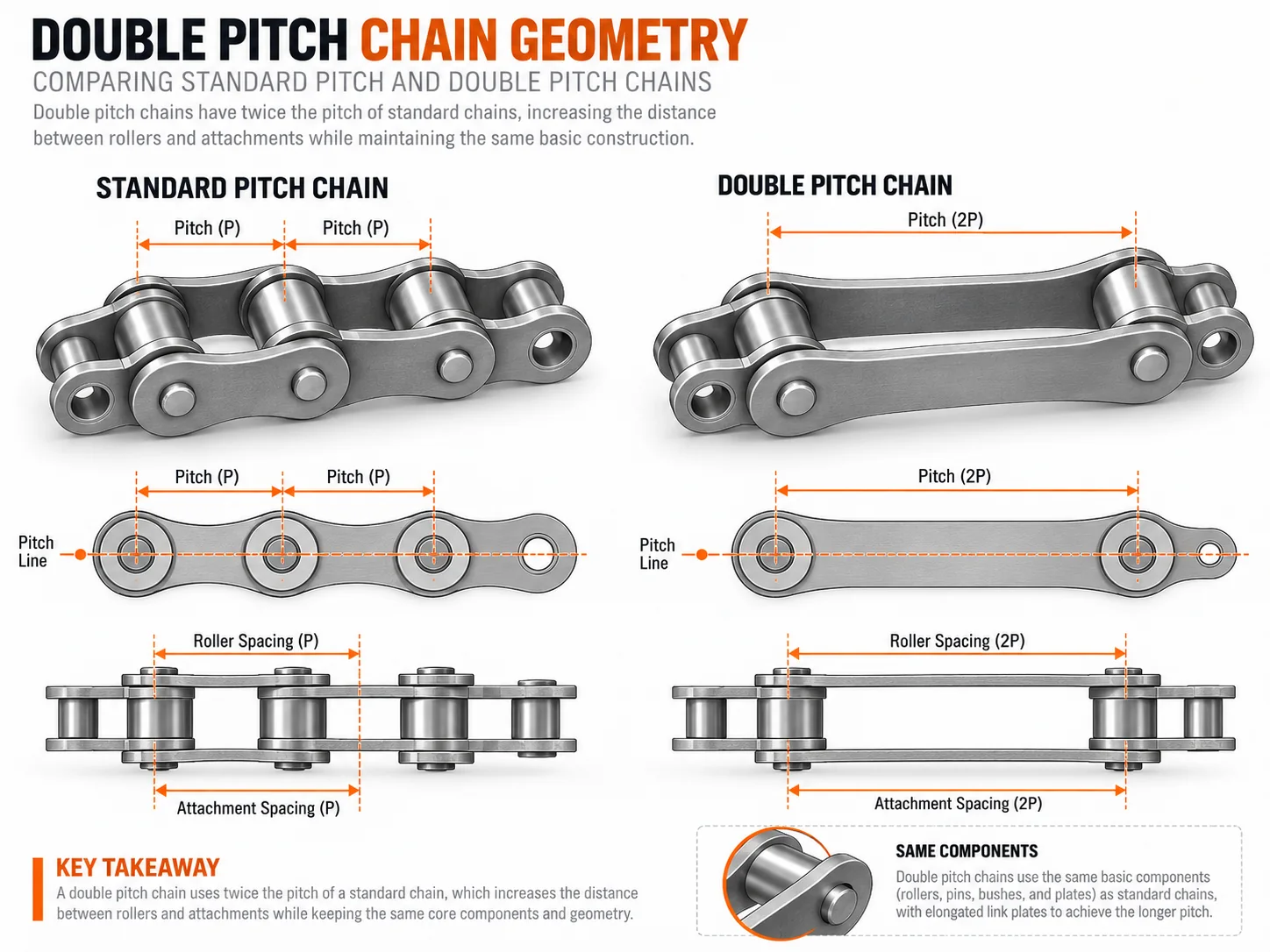
拆卸链条前,请测量以下几个特性。节距决定了基本的传动关系,而内宽、滚子或衬套直径、销轴直径、链板高度、总宽度和连接尺寸则区分了可能具有相同标称节距的不同配置。
对于磨损的链条,测量多个链节的累积节距。从侧面和末端拍摄链条照片,并在条件允许的情况下拍摄链轮。
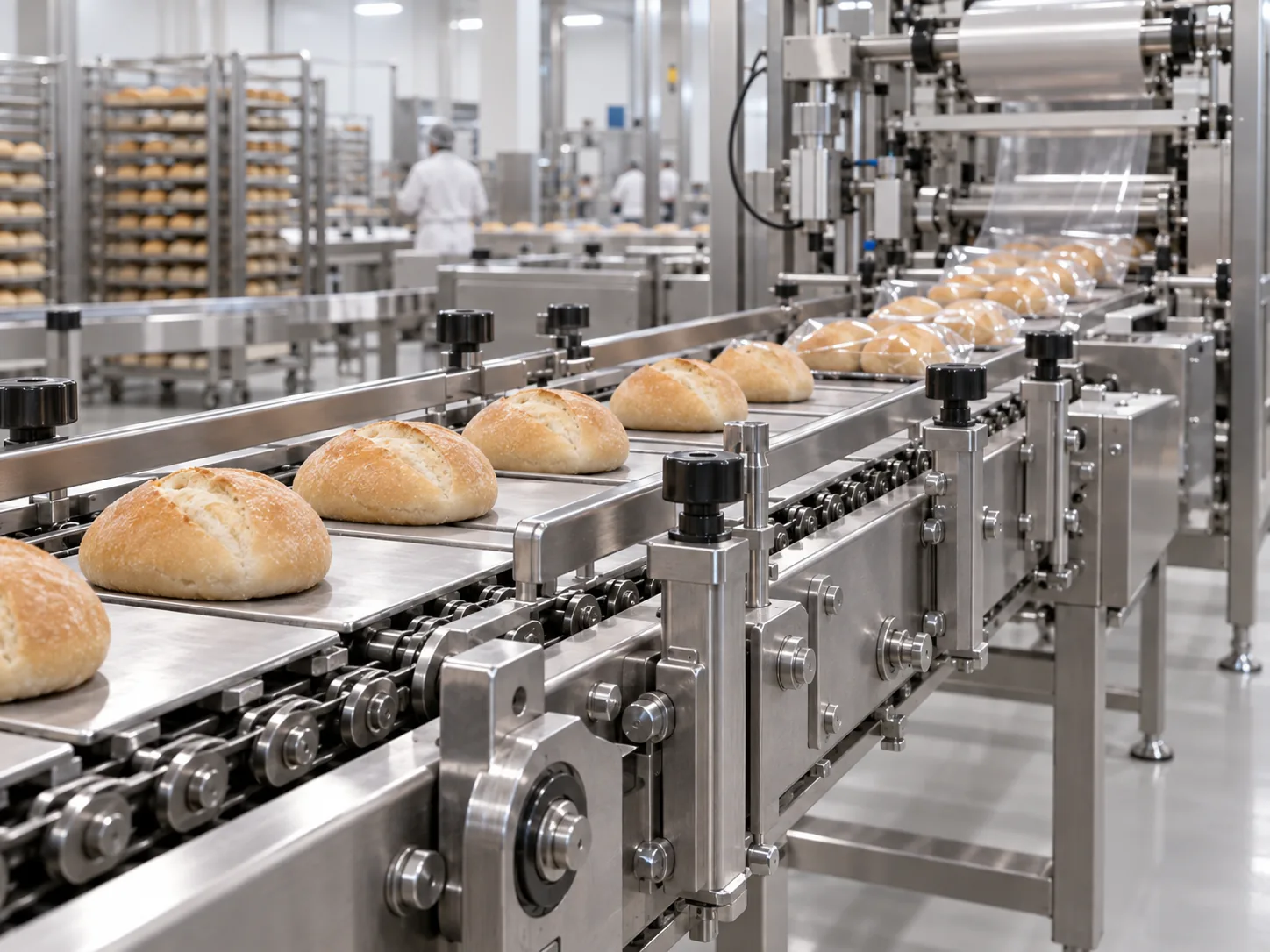
The same chain geometry can behave differently in a humid proofer, a hot oven, an ambient cooling section or a washdown area. For common bakery oven chain failure modes, document the exact machine zone, whether the chain carries product directly or moves pans/fixtures, and whether the joint sees heat, moisture, cleaning chemicals or abrasive residue.
工艺数据有助于确定哪些特性是可互换性的,以及哪些特性(例如材料、间隙或附件制造方法)应针对应用进行审查。
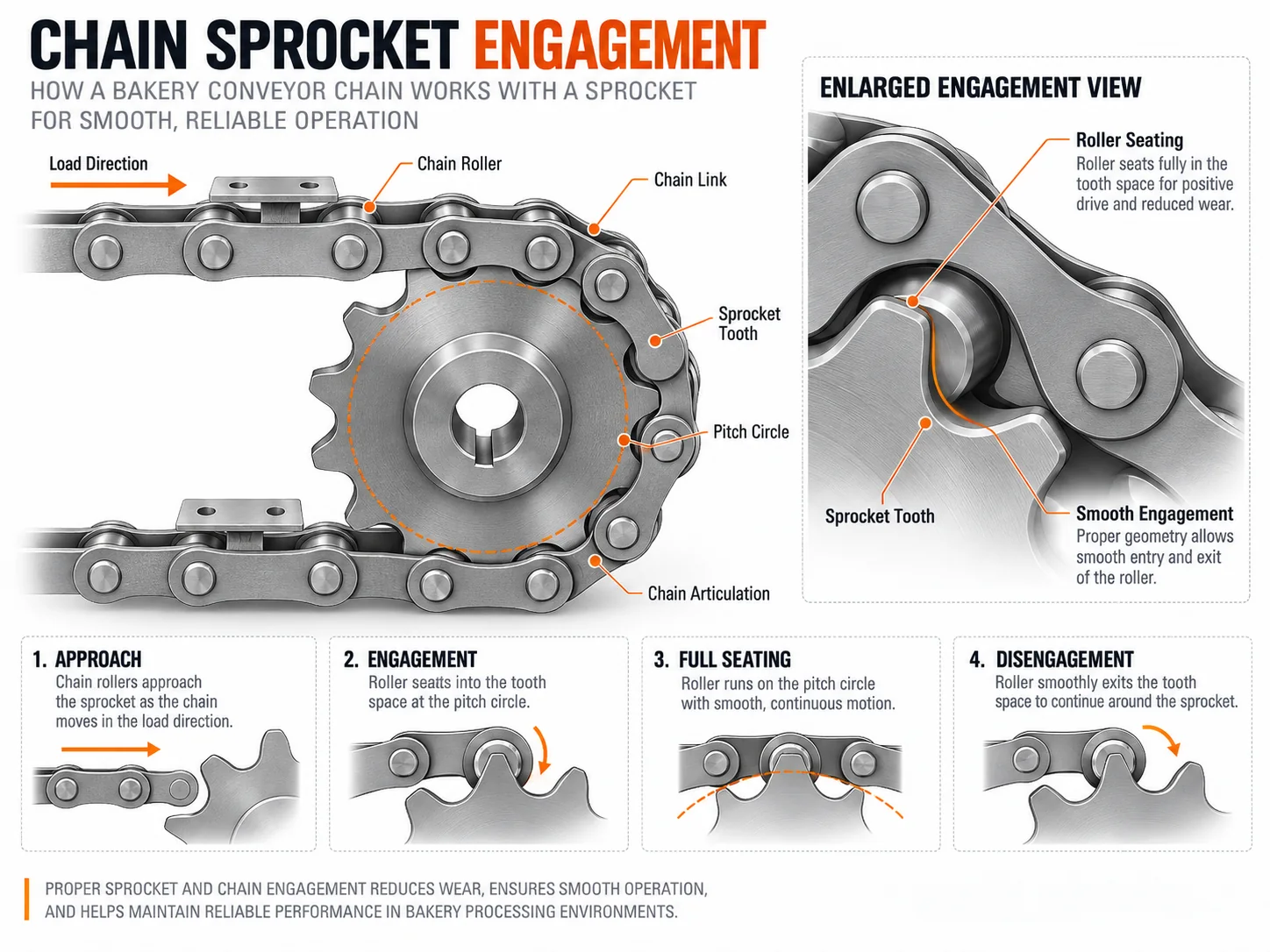
链条并非独立运转。滚子或衬套必须平稳地进出链轮齿槽,而导轨则支撑链条,防止其发生侧向位移。钩齿、轴不对中、偏心链轮或导轨过紧都会导致新链条快速磨损。
检查完整回路的整个路径。如果损坏在同一机器位置重复出现,请先检查当地的支撑结构、传送装置或载体,然后再断定链条本身存在缺陷。
节距、宽度、滚轮/衬套、销钉、板、总宽度和连接方式。
温度、湿度、冲洗、速度、负载、生产小时数和启动次数。
链轮、导轨、链条中心、张紧装置、对准装置和托架间隙。
安装前,请确认最终订购的几何形状、材料和应用相关的配置。
询问问题出现前发生了哪些变化:生产率、产品或锅具重量、清洗周期、润滑油、温度、维护周期或更换的链轮。趋势信息比单张照片更有价值,因为它能显示磨损是均匀的还是集中的。
日常检查时,应注意接头是否僵硬、滚轮磨损、销轴是否松动、附件是否开裂或弯曲、侧面接触是否异常以及卷取是否不均匀。根据机器所有者的要求,保持防护装置和安全规程到位。
如有旧参考信息,请使用旧参考信息,但务必核实已安装的几何形状和工作状态。机器改造、之前的零件替换或磨损都可能导致仅凭零件编号无法获得完整信息。
采用多节距测量法,测量多个节距,并记录测量结果。将测量结果与标称节距和机器维护限值进行比较,而不是仅依赖于单个相邻节距的测量结果。
当出现齿轮磨损、钩齿、对准问题或链条反复过早磨损时,链条和链轮会作为一个啮合系统工作。
For Common Bakery Oven Chain Failure Modes, begin with a measurement record that another engineer can reproduce. Note the measurement tool, the points used, and whether the chain was loaded or relaxed. A multi-pitch measurement is useful for detecting elongation, while transverse dimensions such as inside width and pin projection help identify the original construction even when the joints are worn.
Map the chain route on the machine before deciding that the strand itself is the only cause of a problem. Mark drive and tail sprockets, guides, return tracks, take-up positions, transfer points and carrier interfaces. Repeated scuffing at one location usually deserves a local alignment or clearance check rather than an automatic increase in chain tension.
Temperature data should distinguish normal running conditions from short peaks. Metal components expand as temperature rises, lubricants change viscosity, and product residue can alter the way joints move. A useful RFQ therefore states where temperature is measured, how long the chain remains in that zone and whether the conveyor cools completely during normal shutdowns.
Washdown information should describe frequency, water temperature, cleaning chemistry and whether the chain is rinsed and dried. Stainless steel can improve corrosion resistance, but material selection does not remove the need for suitable joint design, drainage, compatible lubrication and inspection. Cleaning practice is part of the engineering condition, not a separate housekeeping detail.
Where pans, trays or cross bars are fitted, the attachment interface should be treated as a load path. Record hole diameter, hole center distance, bend height, offset from the chain centerline and the repeated attachment interval. Also identify whether the carrier is rigidly fixed or allowed to articulate, because an over-constrained carrier can force parallel strands out of alignment.
Sprocket condition is especially important on a replacement project. Check tooth profile, visible hooking, eccentric wear, hub security and alignment to the chain track. A new chain can appear to stretch quickly when it is actually seating into worn tooth spaces. When sprockets are questionable, include clear side photographs and tooth count in the RFQ.
Take-up travel provides useful evidence about system condition. Record the present take-up position and any adjustment made during the service life of the chain. If the take-up is near its limit, measure cumulative pitch over several links before removing the chain so wear can be separated from a simple installation-length issue.
Lubrication decisions must account for temperature, contamination and food-production practices. The correct approach is application-specific: some joints require a lubricant that can reach the pin/bush bearing surfaces, while some process zones impose restrictions on where and how lubrication can be applied. State the existing method and any limitations rather than assuming a universal interval.
For a new machine, document expected product throughput separately from chain load. The mass carried by the chain includes pans, trays, carrier bars and fixtures in addition to the baked product. Acceleration, incline, transfer resistance and accumulation can create forces that are not obvious from product weight alone.
For an existing machine, photographs are most useful when they show context and detail together. Include one image of the entire conveyor section, one of the chain on the sprocket, one side view of several pitches, one end view showing transverse width and one close-up of the attachment. Add a ruler or caliper only where it does not hide the component being measured.
A procurement specification should separate dimensions that must match from characteristics that can be optimized. Pitch, chain centers and carrier mounting geometry may be fixed by the machine; material, surface treatment, joint clearance or attachment manufacturing method may have room for review. Making that distinction avoids unnecessary redesign while still allowing an improved configuration.
Before release, compare the proposed configuration with the actual installed envelope. Check nearby guards, sensor brackets, guide rails and transfer plates as well as the sprockets. The final production drawing is the controlling reference for dimensions and ordered options; website values are best used to prepare the discussion and identify the likely chain family.
For Common Bakery Oven Chain Failure Modes, begin with a measurement record that another engineer can reproduce. Note the measurement tool, the points used, and whether the chain was loaded or relaxed. A multi-pitch measurement is useful for detecting elongation, while transverse dimensions such as inside width and pin projection help identify the original construction even when the joints are worn.
Map the chain route on the machine before deciding that the strand itself is the only cause of a problem. Mark drive and tail sprockets, guides, return tracks, take-up positions, transfer points and carrier interfaces. Repeated scuffing at one location usually deserves a local alignment or clearance check rather than an automatic increase in chain tension.
Temperature data should distinguish normal running conditions from short peaks. Metal components expand as temperature rises, lubricants change viscosity, and product residue can alter the way joints move. A useful RFQ therefore states where temperature is measured, how long the chain remains in that zone and whether the conveyor cools completely during normal shutdowns.
Washdown information should describe frequency, water temperature, cleaning chemistry and whether the chain is rinsed and dried. Stainless steel can improve corrosion resistance, but material selection does not remove the need for suitable joint design, drainage, compatible lubrication and inspection. Cleaning practice is part of the engineering condition, not a separate housekeeping detail.
Where pans, trays or cross bars are fitted, the attachment interface should be treated as a load path. Record hole diameter, hole center distance, bend height, offset from the chain centerline and the repeated attachment interval. Also identify whether the carrier is rigidly fixed or allowed to articulate, because an over-constrained carrier can force parallel strands out of alignment.
Sprocket condition is especially important on a replacement project. Check tooth profile, visible hooking, eccentric wear, hub security and alignment to the chain track. A new chain can appear to stretch quickly when it is actually seating into worn tooth spaces. When sprockets are questionable, include clear side photographs and tooth count in the RFQ.
Take-up travel provides useful evidence about system condition. Record the present take-up position and any adjustment made during the service life of the chain. If the take-up is near its limit, measure cumulative pitch over several links before removing the chain so wear can be separated from a simple installation-length issue.
Lubrication decisions must account for temperature, contamination and food-production practices. The correct approach is application-specific: some joints require a lubricant that can reach the pin/bush bearing surfaces, while some process zones impose restrictions on where and how lubrication can be applied. State the existing method and any limitations rather than assuming a universal interval.
For a new machine, document expected product throughput separately from chain load. The mass carried by the chain includes pans, trays, carrier bars and fixtures in addition to the baked product. Acceleration, incline, transfer resistance and accumulation can create forces that are not obvious from product weight alone.
For an existing machine, photographs are most useful when they show context and detail together. Include one image of the entire conveyor section, one of the chain on the sprocket, one side view of several pitches, one end view showing transverse width and one close-up of the attachment. Add a ruler or caliper only where it does not hide the component being measured.
A procurement specification should separate dimensions that must match from characteristics that can be optimized. Pitch, chain centers and carrier mounting geometry may be fixed by the machine; material, surface treatment, joint clearance or attachment manufacturing method may have room for review. Making that distinction avoids unnecessary redesign while still allowing an improved configuration.
Before release, compare the proposed configuration with the actual installed envelope. Check nearby guards, sensor brackets, guide rails and transfer plates as well as the sprockets. The final production drawing is the controlling reference for dimensions and ordered options; website values are best used to prepare the discussion and identify the likely chain family.
For Common Bakery Oven Chain Failure Modes, begin with a measurement record that another engineer can reproduce. Note the measurement tool, the points used, and whether the chain was loaded or relaxed. A multi-pitch measurement is useful for detecting elongation, while transverse dimensions such as inside width and pin projection help identify the original construction even when the joints are worn.
Map the chain route on the machine before deciding that the strand itself is the only cause of a problem. Mark drive and tail sprockets, guides, return tracks, take-up positions, transfer points and carrier interfaces. Repeated scuffing at one location usually deserves a local alignment or clearance check rather than an automatic increase in chain tension.
Temperature data should distinguish normal running conditions from short peaks. Metal components expand as temperature rises, lubricants change viscosity, and product residue can alter the way joints move. A useful RFQ therefore states where temperature is measured, how long the chain remains in that zone and whether the conveyor cools completely during normal shutdowns.
Washdown information should describe frequency, water temperature, cleaning chemistry and whether the chain is rinsed and dried. Stainless steel can improve corrosion resistance, but material selection does not remove the need for suitable joint design, drainage, compatible lubrication and inspection. Cleaning practice is part of the engineering condition, not a separate housekeeping detail.
Where pans, trays or cross bars are fitted, the attachment interface should be treated as a load path. Record hole diameter, hole center distance, bend height, offset from the chain centerline and the repeated attachment interval. Also identify whether the carrier is rigidly fixed or allowed to articulate, because an over-constrained carrier can force parallel strands out of alignment.
Sprocket condition is especially important on a replacement project. Check tooth profile, visible hooking, eccentric wear, hub security and alignment to the chain track. A new chain can appear to stretch quickly when it is actually seating into worn tooth spaces. When sprockets are questionable, include clear side photographs and tooth count in the RFQ.