Geometri rekaman
Jarak antar gigi, lebar, rol/bantalan, pin, pelat, lebar keseluruhan, dan pola pemasangan.
Panduan Teknis Rantai Toko Roti
Corrosion Problems in Food Conveyor Chains is best answered by combining measured chain geometry, machine duty and the operating environment. This guide shows what to inspect, record and discuss before a replacement or new-chain decision.
Corrosion Problems in Food Conveyor Chains should be evaluated from the actual conveyor. Start with chain pitch, transverse geometry, sprocket condition and any carrier attachment, then add temperature, moisture, washdown, load, speed and take-up information. The objective is not to identify a chain by appearance; it is to produce an RFQ that preserves the machine interface and makes application-dependent choices explicit.
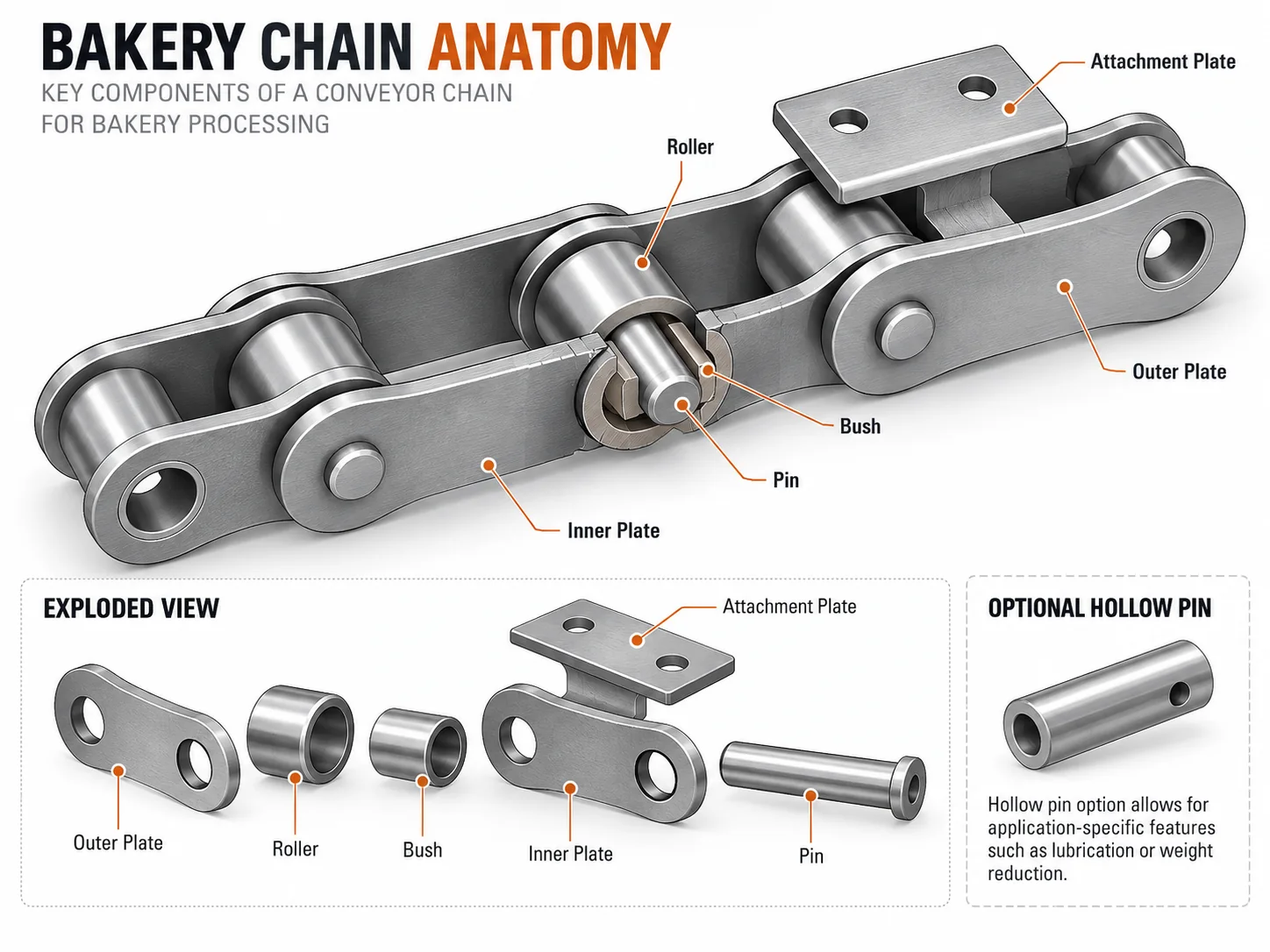
Ukurlah beberapa karakteristik sebelum melepas rantai. Jarak antar gigi menentukan hubungan roda gigi dasar, tetapi lebar bagian dalam, diameter rol atau bushing, diameter pin, tinggi pelat, lebar keseluruhan, dan dimensi pemasangan membedakan konfigurasi yang dapat memiliki jarak antar gigi nominal yang sama.
Untuk rantai yang sudah aus, ukur jarak antar mata rantai secara kumulatif di beberapa tautan. Foto rantai dari samping dan ujungnya, dan sertakan sproket jika memungkinkan.
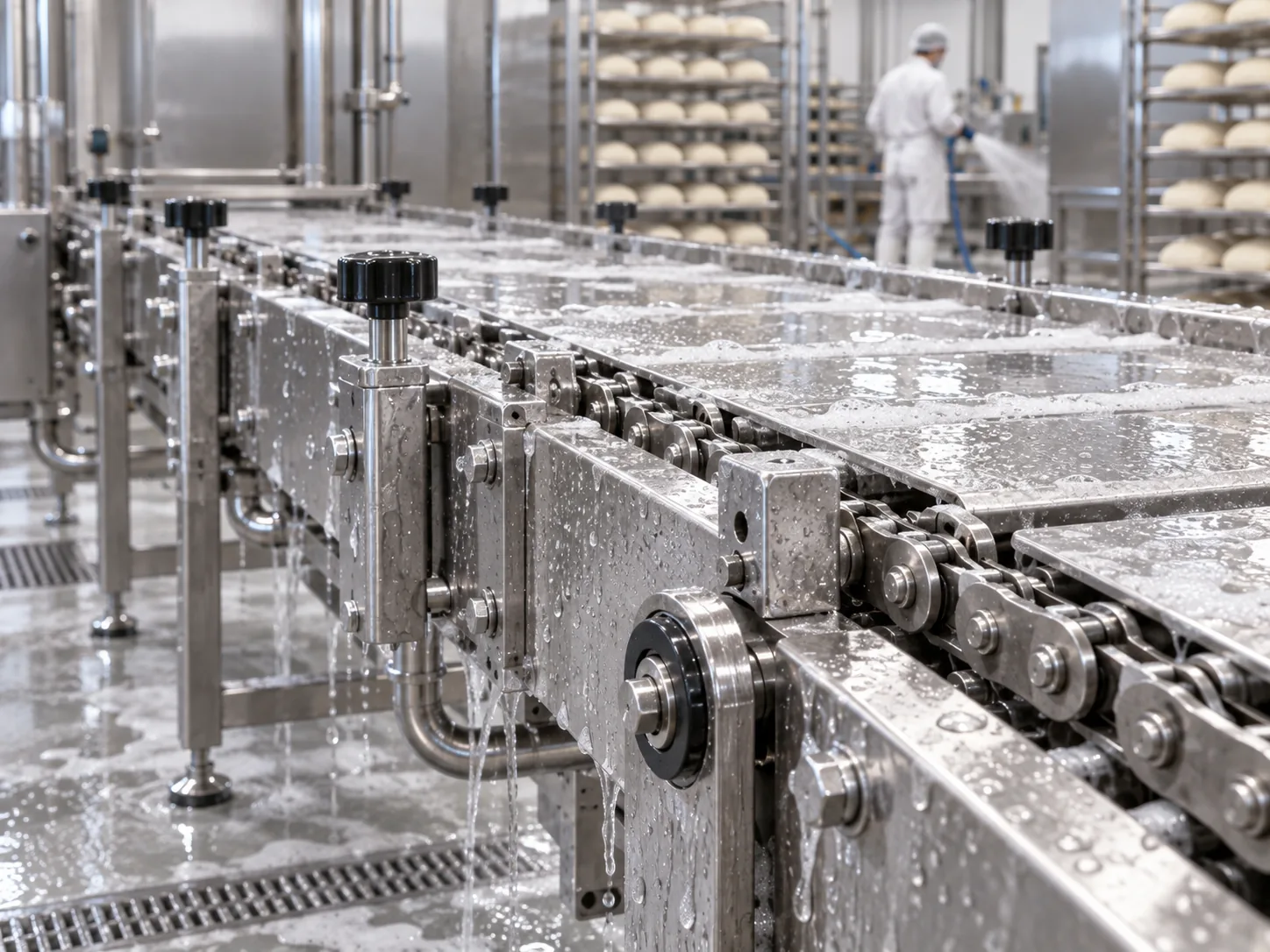
The same chain geometry can behave differently in a humid proofer, a hot oven, an ambient cooling section or a washdown area. For corrosion problems in food conveyor chains, document the exact machine zone, whether the chain carries product directly or moves pans/fixtures, and whether the joint sees heat, moisture, cleaning chemicals or abrasive residue.
Data proses membantu menentukan karakteristik mana yang tetap karena sifatnya yang dapat dipertukarkan dan karakteristik mana—seperti material, jarak bebas, atau metode pembuatan sambungan—yang perlu ditinjau ulang untuk aplikasi tersebut.
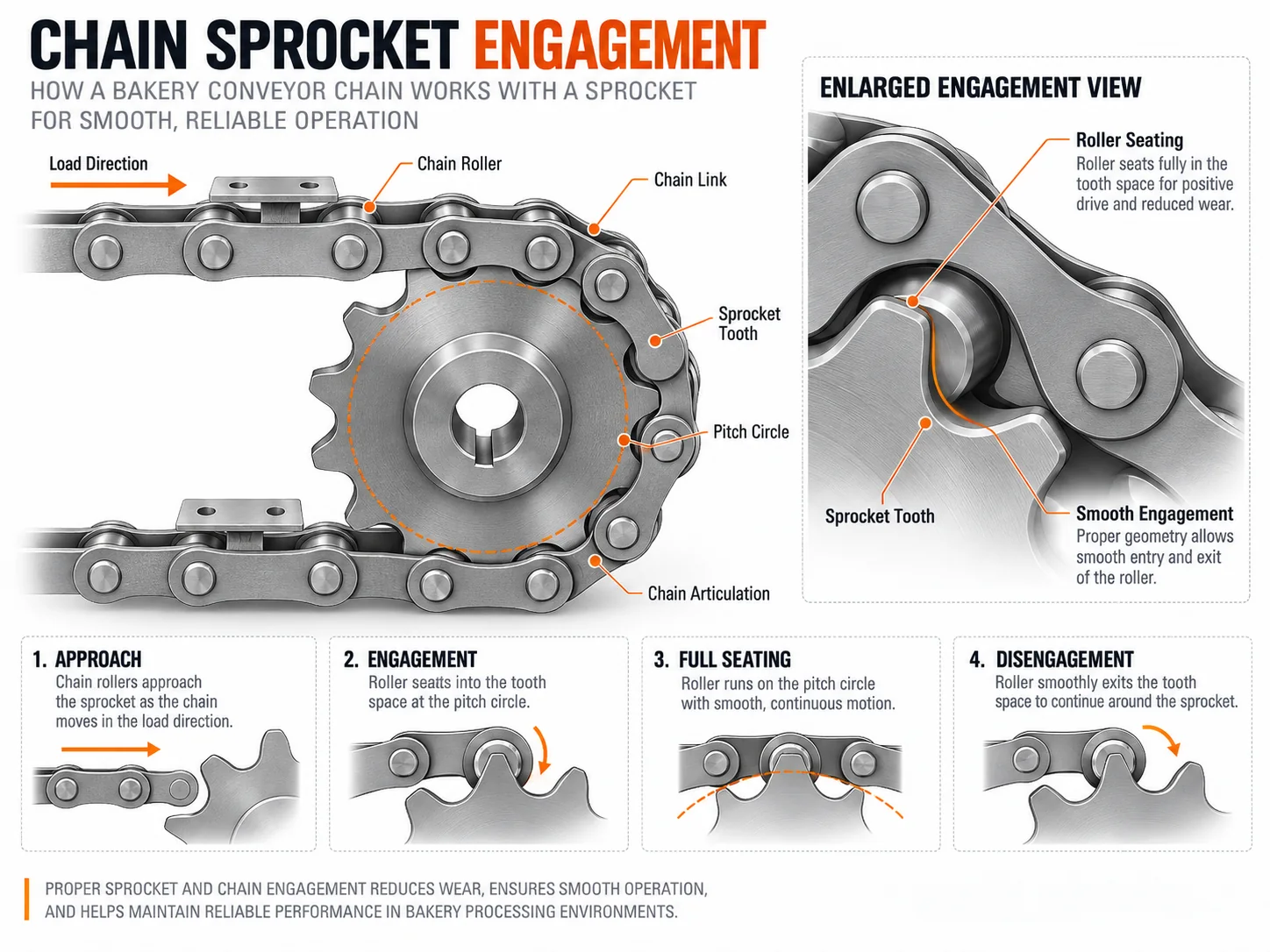
Rantai tidak beroperasi secara independen. Rol atau bantalan harus masuk dan keluar dari ruang gigi sproket dengan lancar, sementara jalur pemandu menopang untaian tanpa memaksanya ke samping. Gigi yang bengkok, ketidaksejajaran poros, sproket eksentrik, atau pemandu yang terlalu kencang dapat menyebabkan rantai baru cepat aus.
Periksa seluruh jalur melalui satu sirkuit penuh. Jika kerusakan berulang di lokasi mesin yang sama, selidiki dukungan, transfer, atau pengangkut lokal sebelum berasumsi bahwa rantai itu sendiri rusak.
Jarak antar gigi, lebar, rol/bantalan, pin, pelat, lebar keseluruhan, dan pola pemasangan.
Suhu, kelembapan, pencucian, kecepatan, beban, jam produksi, dan waktu mulai.
Sproket, pemandu, pusat rantai, pengencangan, penyelarasan, dan jarak bebas pembawa.
Setujui geometri, material, dan konfigurasi akhir yang bergantung pada aplikasi yang dipesan sebelum pemasangan.
Tanyakan apa yang berubah sebelum masalah muncul: tingkat produksi, berat produk atau wadah, siklus pembersihan, pelumas, suhu, interval perawatan, atau penggantian sprocket. Informasi tren lebih berharga daripada satu foto karena menunjukkan apakah keausan seragam atau terkonsentrasi.
Selama pemeriksaan rutin, perhatikan sambungan yang kaku, keausan rol, pergeseran pin, sambungan yang retak atau bengkok, kontak samping yang tidak normal, dan penarikan yang tidak merata. Pastikan pelindung dan prosedur keselamatan tetap terpasang sesuai dengan persyaratan pemilik mesin.
Sertakan dimensi terukur, nama mesin/proses, foto, gambar jika tersedia, jumlah atau panjang rantai yang dibutuhkan, interval pemasangan, jarak pusat rantai, informasi sproket, suhu, kondisi pencucian, beban, dan jendela waktu pengiriman yang ditargetkan. Tinjau panduan memilih jaringan toko roti dan Gambaran umum keluarga produk untuk langkah pengambilan keputusan selanjutnya.
Gunakan referensi lama jika tersedia, tetapi verifikasi geometri dan beban terpasang. Modifikasi mesin, penggantian sebelumnya, atau keausan dapat membuat nomor suku cadang saja tidak lengkap.
Gunakan pengukuran multi-pitch di sejumlah tautan yang praktis dan catat metodenya. Bandingkan dengan pitch nominal dan batas perawatan mesin, alih-alih hanya mengandalkan pengukuran satu tautan yang berdekatan.
Setiap kali terjadi keausan gigi, tersangkut, masalah kesejajaran, atau keausan rantai dini yang berulang. Rantai dan sproket bekerja sebagai sistem yang saling terkait.
For Corrosion Problems in Food Conveyor Chains, begin with a measurement record that another engineer can reproduce. Note the measurement tool, the points used, and whether the chain was loaded or relaxed. A multi-pitch measurement is useful for detecting elongation, while transverse dimensions such as inside width and pin projection help identify the original construction even when the joints are worn.
Map the chain route on the machine before deciding that the strand itself is the only cause of a problem. Mark drive and tail sprockets, guides, return tracks, take-up positions, transfer points and carrier interfaces. Repeated scuffing at one location usually deserves a local alignment or clearance check rather than an automatic increase in chain tension.
Temperature data should distinguish normal running conditions from short peaks. Metal components expand as temperature rises, lubricants change viscosity, and product residue can alter the way joints move. A useful RFQ therefore states where temperature is measured, how long the chain remains in that zone and whether the conveyor cools completely during normal shutdowns.
Washdown information should describe frequency, water temperature, cleaning chemistry and whether the chain is rinsed and dried. Stainless steel can improve corrosion resistance, but material selection does not remove the need for suitable joint design, drainage, compatible lubrication and inspection. Cleaning practice is part of the engineering condition, not a separate housekeeping detail.
Where pans, trays or cross bars are fitted, the attachment interface should be treated as a load path. Record hole diameter, hole center distance, bend height, offset from the chain centerline and the repeated attachment interval. Also identify whether the carrier is rigidly fixed or allowed to articulate, because an over-constrained carrier can force parallel strands out of alignment.
Sprocket condition is especially important on a replacement project. Check tooth profile, visible hooking, eccentric wear, hub security and alignment to the chain track. A new chain can appear to stretch quickly when it is actually seating into worn tooth spaces. When sprockets are questionable, include clear side photographs and tooth count in the RFQ.
Take-up travel provides useful evidence about system condition. Record the present take-up position and any adjustment made during the service life of the chain. If the take-up is near its limit, measure cumulative pitch over several links before removing the chain so wear can be separated from a simple installation-length issue.
Lubrication decisions must account for temperature, contamination and food-production practices. The correct approach is application-specific: some joints require a lubricant that can reach the pin/bush bearing surfaces, while some process zones impose restrictions on where and how lubrication can be applied. State the existing method and any limitations rather than assuming a universal interval.
For a new machine, document expected product throughput separately from chain load. The mass carried by the chain includes pans, trays, carrier bars and fixtures in addition to the baked product. Acceleration, incline, transfer resistance and accumulation can create forces that are not obvious from product weight alone.
For an existing machine, photographs are most useful when they show context and detail together. Include one image of the entire conveyor section, one of the chain on the sprocket, one side view of several pitches, one end view showing transverse width and one close-up of the attachment. Add a ruler or caliper only where it does not hide the component being measured.
A procurement specification should separate dimensions that must match from characteristics that can be optimized. Pitch, chain centers and carrier mounting geometry may be fixed by the machine; material, surface treatment, joint clearance or attachment manufacturing method may have room for review. Making that distinction avoids unnecessary redesign while still allowing an improved configuration.
Before release, compare the proposed configuration with the actual installed envelope. Check nearby guards, sensor brackets, guide rails and transfer plates as well as the sprockets. The final production drawing is the controlling reference for dimensions and ordered options; website values are best used to prepare the discussion and identify the likely chain family.
For Corrosion Problems in Food Conveyor Chains, begin with a measurement record that another engineer can reproduce. Note the measurement tool, the points used, and whether the chain was loaded or relaxed. A multi-pitch measurement is useful for detecting elongation, while transverse dimensions such as inside width and pin projection help identify the original construction even when the joints are worn.
Map the chain route on the machine before deciding that the strand itself is the only cause of a problem. Mark drive and tail sprockets, guides, return tracks, take-up positions, transfer points and carrier interfaces. Repeated scuffing at one location usually deserves a local alignment or clearance check rather than an automatic increase in chain tension.
Temperature data should distinguish normal running conditions from short peaks. Metal components expand as temperature rises, lubricants change viscosity, and product residue can alter the way joints move. A useful RFQ therefore states where temperature is measured, how long the chain remains in that zone and whether the conveyor cools completely during normal shutdowns.
Washdown information should describe frequency, water temperature, cleaning chemistry and whether the chain is rinsed and dried. Stainless steel can improve corrosion resistance, but material selection does not remove the need for suitable joint design, drainage, compatible lubrication and inspection. Cleaning practice is part of the engineering condition, not a separate housekeeping detail.
Where pans, trays or cross bars are fitted, the attachment interface should be treated as a load path. Record hole diameter, hole center distance, bend height, offset from the chain centerline and the repeated attachment interval. Also identify whether the carrier is rigidly fixed or allowed to articulate, because an over-constrained carrier can force parallel strands out of alignment.
Sprocket condition is especially important on a replacement project. Check tooth profile, visible hooking, eccentric wear, hub security and alignment to the chain track. A new chain can appear to stretch quickly when it is actually seating into worn tooth spaces. When sprockets are questionable, include clear side photographs and tooth count in the RFQ.
Take-up travel provides useful evidence about system condition. Record the present take-up position and any adjustment made during the service life of the chain. If the take-up is near its limit, measure cumulative pitch over several links before removing the chain so wear can be separated from a simple installation-length issue.
Lubrication decisions must account for temperature, contamination and food-production practices. The correct approach is application-specific: some joints require a lubricant that can reach the pin/bush bearing surfaces, while some process zones impose restrictions on where and how lubrication can be applied. State the existing method and any limitations rather than assuming a universal interval.
For a new machine, document expected product throughput separately from chain load. The mass carried by the chain includes pans, trays, carrier bars and fixtures in addition to the baked product. Acceleration, incline, transfer resistance and accumulation can create forces that are not obvious from product weight alone.
For an existing machine, photographs are most useful when they show context and detail together. Include one image of the entire conveyor section, one of the chain on the sprocket, one side view of several pitches, one end view showing transverse width and one close-up of the attachment. Add a ruler or caliper only where it does not hide the component being measured.
A procurement specification should separate dimensions that must match from characteristics that can be optimized. Pitch, chain centers and carrier mounting geometry may be fixed by the machine; material, surface treatment, joint clearance or attachment manufacturing method may have room for review. Making that distinction avoids unnecessary redesign while still allowing an improved configuration.
Before release, compare the proposed configuration with the actual installed envelope. Check nearby guards, sensor brackets, guide rails and transfer plates as well as the sprockets. The final production drawing is the controlling reference for dimensions and ordered options; website values are best used to prepare the discussion and identify the likely chain family.
For Corrosion Problems in Food Conveyor Chains, begin with a measurement record that another engineer can reproduce. Note the measurement tool, the points used, and whether the chain was loaded or relaxed. A multi-pitch measurement is useful for detecting elongation, while transverse dimensions such as inside width and pin projection help identify the original construction even when the joints are worn.
Map the chain route on the machine before deciding that the strand itself is the only cause of a problem. Mark drive and tail sprockets, guides, return tracks, take-up positions, transfer points and carrier interfaces. Repeated scuffing at one location usually deserves a local alignment or clearance check rather than an automatic increase in chain tension.
Temperature data should distinguish normal running conditions from short peaks. Metal components expand as temperature rises, lubricants change viscosity, and product residue can alter the way joints move. A useful RFQ therefore states where temperature is measured, how long the chain remains in that zone and whether the conveyor cools completely during normal shutdowns.
Washdown information should describe frequency, water temperature, cleaning chemistry and whether the chain is rinsed and dried. Stainless steel can improve corrosion resistance, but material selection does not remove the need for suitable joint design, drainage, compatible lubrication and inspection. Cleaning practice is part of the engineering condition, not a separate housekeeping detail.
Where pans, trays or cross bars are fitted, the attachment interface should be treated as a load path. Record hole diameter, hole center distance, bend height, offset from the chain centerline and the repeated attachment interval. Also identify whether the carrier is rigidly fixed or allowed to articulate, because an over-constrained carrier can force parallel strands out of alignment.
Sprocket condition is especially important on a replacement project. Check tooth profile, visible hooking, eccentric wear, hub security and alignment to the chain track. A new chain can appear to stretch quickly when it is actually seating into worn tooth spaces. When sprockets are questionable, include clear side photographs and tooth count in the RFQ.