기록된 형상
피치, 폭, 롤러/부시, 핀, 플레이트, 전체 폭 및 부착 패턴.
베이커리 체인 기술 가이드
Corrosion Problems in Food Conveyor Chains is best answered by combining measured chain geometry, machine duty and the operating environment. This guide shows what to inspect, record and discuss before a replacement or new-chain decision.
Corrosion Problems in Food Conveyor Chains should be evaluated from the actual conveyor. Start with chain pitch, transverse geometry, sprocket condition and any carrier attachment, then add temperature, moisture, washdown, load, speed and take-up information. The objective is not to identify a chain by appearance; it is to produce an RFQ that preserves the machine interface and makes application-dependent choices explicit.
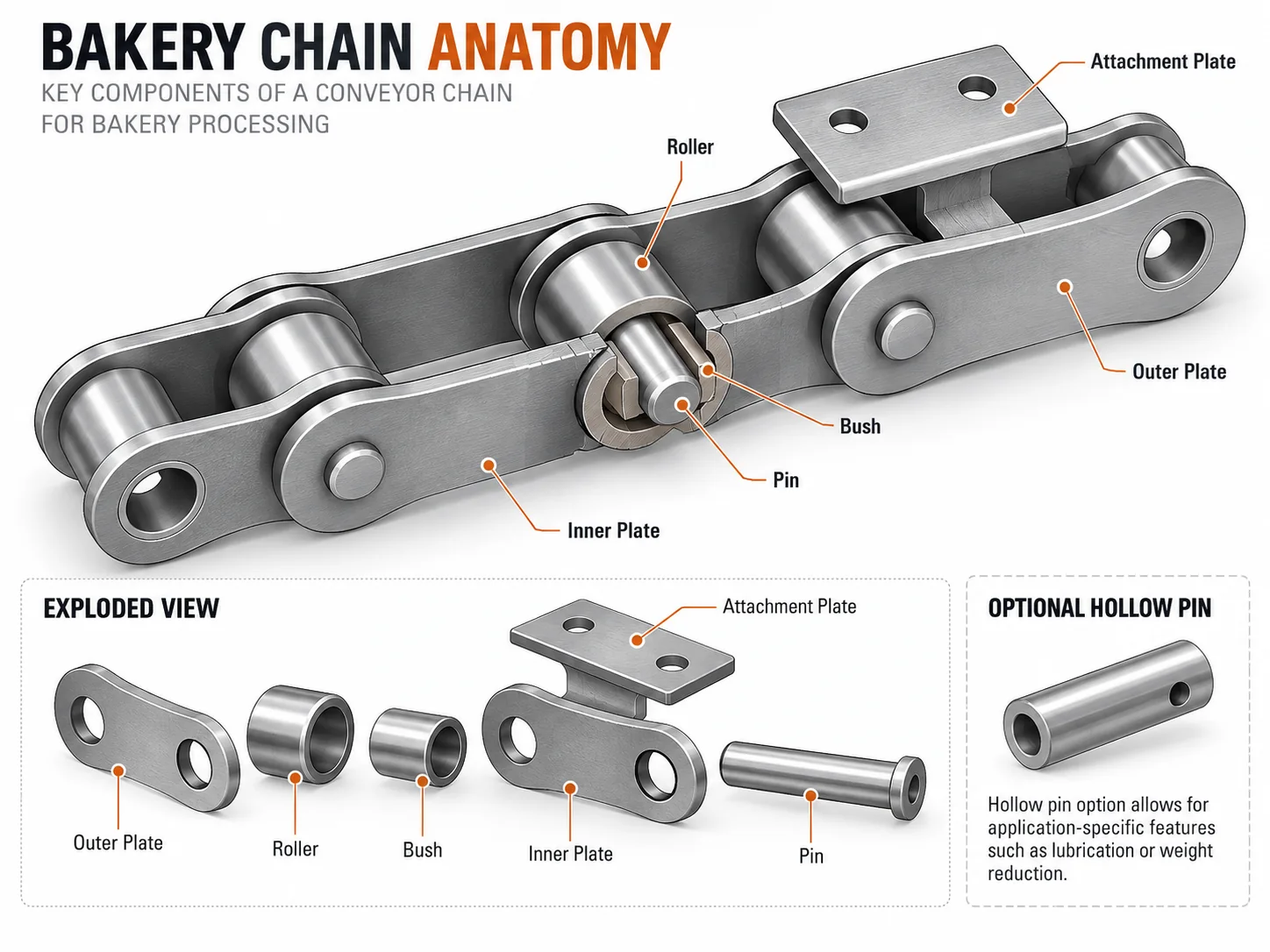
체인을 제거하기 전에 여러 가지 특성을 측정하십시오. 피치는 기본적인 기어 관계를 나타내지만, 내부 폭, 롤러 또는 부시 직경, 핀 직경, 플레이트 높이, 전체 폭 및 부착 치수는 동일한 공칭 피치를 공유할 수 있는 구성들을 구분하는 기준이 됩니다.
마모된 체인 가닥의 경우, 여러 링크에 걸쳐 누적 피치를 측정하십시오. 체인을 측면과 끝에서 촬영하고, 가능하면 스프로킷도 함께 촬영하십시오.
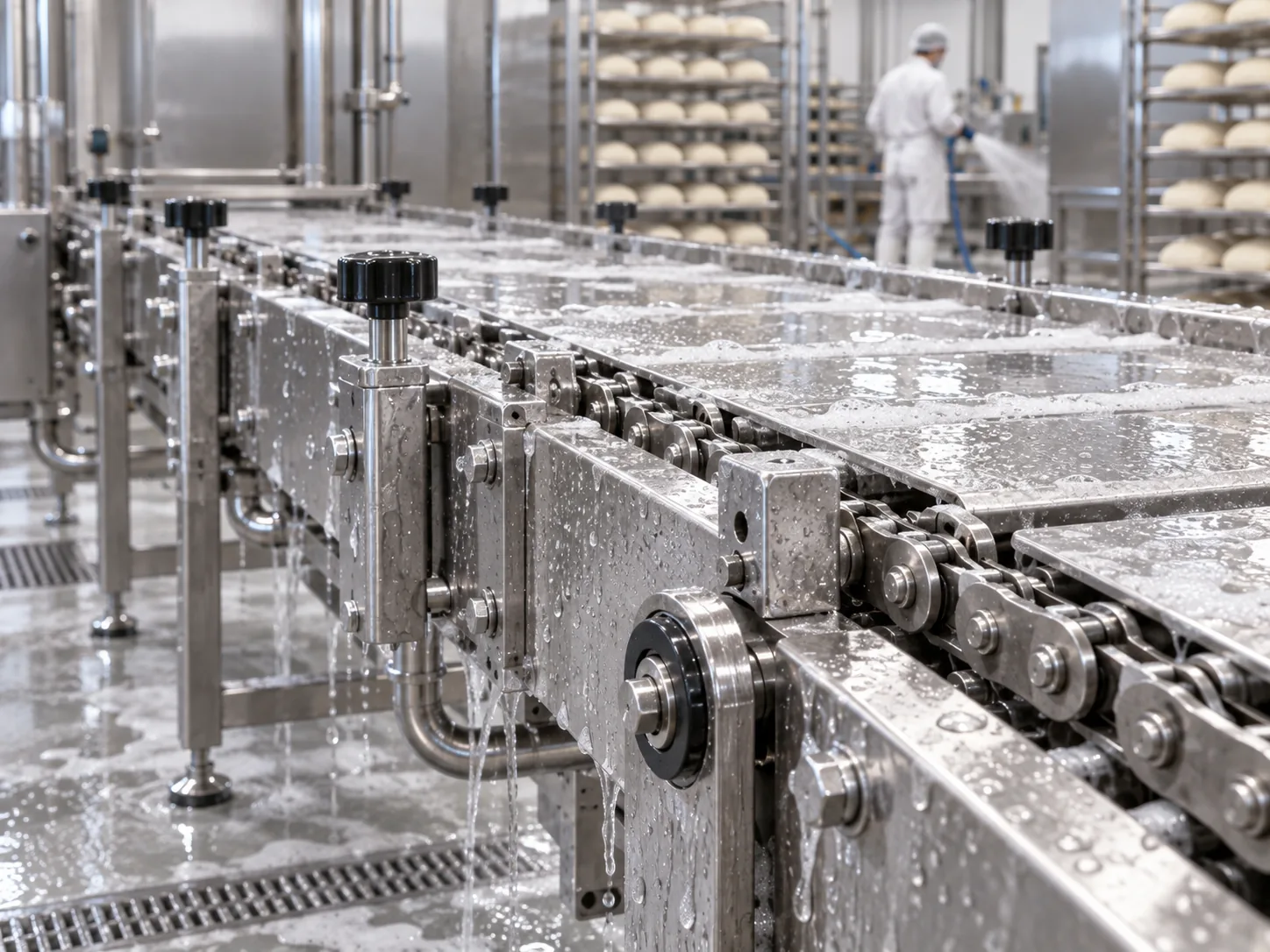
The same chain geometry can behave differently in a humid proofer, a hot oven, an ambient cooling section or a washdown area. For corrosion problems in food conveyor chains, document the exact machine zone, whether the chain carries product directly or moves pans/fixtures, and whether the joint sees heat, moisture, cleaning chemicals or abrasive residue.
공정 데이터는 호환성에 의해 고정되는 특성과 재질, 간극 또는 부착물 제조 방법과 같은 적용 분야에 대해 검토해야 하는 특성을 결정하는 데 도움이 됩니다.
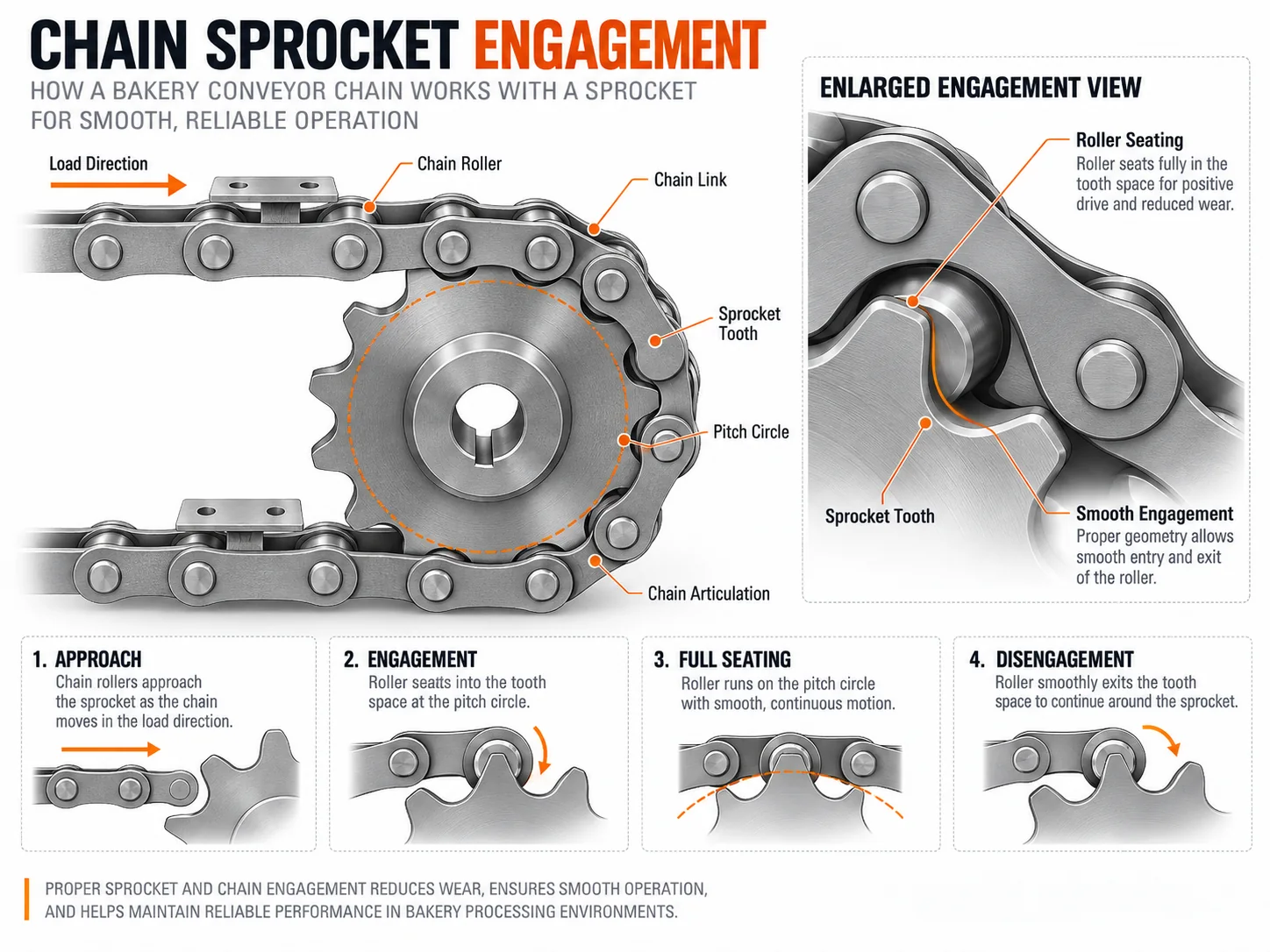
체인은 독립적으로 작동하지 않습니다. 롤러나 부싱은 스프로킷 톱니 사이를 부드럽게 드나들어야 하며, 가이드 트랙은 체인 가닥을 측면으로 쏠리지 않도록 지지해야 합니다. 톱니가 휘거나, 축이 정렬되지 않았거나, 스프로킷이 편심되었거나, 가이드가 너무 꽉 조여 있으면 새 체인이 빨리 마모될 수 있습니다.
전체 회로를 따라 전체 경로를 검사하십시오. 동일한 기계 위치에서 손상이 반복되는 경우, 체인 자체에 결함이 있다고 판단하기 전에 해당 위치의 지지대, 이송 장치 또는 운반 장치를 조사하십시오.
피치, 폭, 롤러/부시, 핀, 플레이트, 전체 폭 및 부착 패턴.
온도, 습도, 세척, 속도, 부하, 생산 시간 및 시작 횟수.
스프로킷, 가이드, 체인 중심, 장력 조절, 정렬 및 캐리어 간극.
설치 전에 최종 주문된 형상, 재질 및 용도별 구성을 승인하십시오.
문제가 발생하기 전에 무엇이 바뀌었는지 물어보세요. 생산 속도, 제품 또는 팬 무게, 세척 주기, 윤활유, 온도, 유지 보수 간격 또는 교체된 스프로킷 등을 확인하십시오. 마모가 균일하게 발생했는지 아니면 특정 부위에 집중되었는지 보여주기 때문에 단일 사진보다 추세 정보가 더 중요합니다.
정기 점검 시 관절의 뻑뻑함, 롤러 마모, 핀 움직임, 균열 또는 휨 현상이 있는 부착물, 비정상적인 측면 접촉 및 불균일한 장력 조절 등을 확인하십시오. 기계 소유자의 요구 사항에 따라 안전 가드 및 안전 절차를 유지하십시오.
측정된 치수, 기계/공정명, 사진, 가능한 경우 도면, 수량 또는 필요한 체인 길이, 부착 간격, 체인 중심 간격, 스프로킷 정보, 온도, 세척 조건, 하중 및 목표 납품 기간을 포함하십시오. 검토하십시오. 베이커리 체인 선택 가이드 그리고 제품군 개요 다음 결정 단계를 위해서입니다.
가능하다면 기존 참조 자료를 사용하되, 설치된 형상과 용도를 확인하십시오. 기계 개조, 이전 교체 부품 또는 마모로 인해 부품 번호만으로는 완전한 정보를 얻을 수 없을 수 있습니다.
실제 사용 가능한 링크 수에 걸쳐 다중 피치 측정을 수행하고 그 방법을 기록하십시오. 단일 인접 링크 측정값에 의존하는 대신, 이를 공칭 피치 및 기계 유지 보수 한계와 비교하십시오.
톱니 마모, 걸림, 정렬 문제 또는 체인의 반복적인 조기 마모가 발생할 때마다 체인과 스프로킷은 맞물림 시스템으로 작동합니다.
For Corrosion Problems in Food Conveyor Chains, begin with a measurement record that another engineer can reproduce. Note the measurement tool, the points used, and whether the chain was loaded or relaxed. A multi-pitch measurement is useful for detecting elongation, while transverse dimensions such as inside width and pin projection help identify the original construction even when the joints are worn.
Map the chain route on the machine before deciding that the strand itself is the only cause of a problem. Mark drive and tail sprockets, guides, return tracks, take-up positions, transfer points and carrier interfaces. Repeated scuffing at one location usually deserves a local alignment or clearance check rather than an automatic increase in chain tension.
Temperature data should distinguish normal running conditions from short peaks. Metal components expand as temperature rises, lubricants change viscosity, and product residue can alter the way joints move. A useful RFQ therefore states where temperature is measured, how long the chain remains in that zone and whether the conveyor cools completely during normal shutdowns.
Washdown information should describe frequency, water temperature, cleaning chemistry and whether the chain is rinsed and dried. Stainless steel can improve corrosion resistance, but material selection does not remove the need for suitable joint design, drainage, compatible lubrication and inspection. Cleaning practice is part of the engineering condition, not a separate housekeeping detail.
Where pans, trays or cross bars are fitted, the attachment interface should be treated as a load path. Record hole diameter, hole center distance, bend height, offset from the chain centerline and the repeated attachment interval. Also identify whether the carrier is rigidly fixed or allowed to articulate, because an over-constrained carrier can force parallel strands out of alignment.
Sprocket condition is especially important on a replacement project. Check tooth profile, visible hooking, eccentric wear, hub security and alignment to the chain track. A new chain can appear to stretch quickly when it is actually seating into worn tooth spaces. When sprockets are questionable, include clear side photographs and tooth count in the RFQ.
Take-up travel provides useful evidence about system condition. Record the present take-up position and any adjustment made during the service life of the chain. If the take-up is near its limit, measure cumulative pitch over several links before removing the chain so wear can be separated from a simple installation-length issue.
Lubrication decisions must account for temperature, contamination and food-production practices. The correct approach is application-specific: some joints require a lubricant that can reach the pin/bush bearing surfaces, while some process zones impose restrictions on where and how lubrication can be applied. State the existing method and any limitations rather than assuming a universal interval.
For a new machine, document expected product throughput separately from chain load. The mass carried by the chain includes pans, trays, carrier bars and fixtures in addition to the baked product. Acceleration, incline, transfer resistance and accumulation can create forces that are not obvious from product weight alone.
For an existing machine, photographs are most useful when they show context and detail together. Include one image of the entire conveyor section, one of the chain on the sprocket, one side view of several pitches, one end view showing transverse width and one close-up of the attachment. Add a ruler or caliper only where it does not hide the component being measured.
A procurement specification should separate dimensions that must match from characteristics that can be optimized. Pitch, chain centers and carrier mounting geometry may be fixed by the machine; material, surface treatment, joint clearance or attachment manufacturing method may have room for review. Making that distinction avoids unnecessary redesign while still allowing an improved configuration.
Before release, compare the proposed configuration with the actual installed envelope. Check nearby guards, sensor brackets, guide rails and transfer plates as well as the sprockets. The final production drawing is the controlling reference for dimensions and ordered options; website values are best used to prepare the discussion and identify the likely chain family.
For Corrosion Problems in Food Conveyor Chains, begin with a measurement record that another engineer can reproduce. Note the measurement tool, the points used, and whether the chain was loaded or relaxed. A multi-pitch measurement is useful for detecting elongation, while transverse dimensions such as inside width and pin projection help identify the original construction even when the joints are worn.
Map the chain route on the machine before deciding that the strand itself is the only cause of a problem. Mark drive and tail sprockets, guides, return tracks, take-up positions, transfer points and carrier interfaces. Repeated scuffing at one location usually deserves a local alignment or clearance check rather than an automatic increase in chain tension.
Temperature data should distinguish normal running conditions from short peaks. Metal components expand as temperature rises, lubricants change viscosity, and product residue can alter the way joints move. A useful RFQ therefore states where temperature is measured, how long the chain remains in that zone and whether the conveyor cools completely during normal shutdowns.
Washdown information should describe frequency, water temperature, cleaning chemistry and whether the chain is rinsed and dried. Stainless steel can improve corrosion resistance, but material selection does not remove the need for suitable joint design, drainage, compatible lubrication and inspection. Cleaning practice is part of the engineering condition, not a separate housekeeping detail.
Where pans, trays or cross bars are fitted, the attachment interface should be treated as a load path. Record hole diameter, hole center distance, bend height, offset from the chain centerline and the repeated attachment interval. Also identify whether the carrier is rigidly fixed or allowed to articulate, because an over-constrained carrier can force parallel strands out of alignment.
Sprocket condition is especially important on a replacement project. Check tooth profile, visible hooking, eccentric wear, hub security and alignment to the chain track. A new chain can appear to stretch quickly when it is actually seating into worn tooth spaces. When sprockets are questionable, include clear side photographs and tooth count in the RFQ.
Take-up travel provides useful evidence about system condition. Record the present take-up position and any adjustment made during the service life of the chain. If the take-up is near its limit, measure cumulative pitch over several links before removing the chain so wear can be separated from a simple installation-length issue.
Lubrication decisions must account for temperature, contamination and food-production practices. The correct approach is application-specific: some joints require a lubricant that can reach the pin/bush bearing surfaces, while some process zones impose restrictions on where and how lubrication can be applied. State the existing method and any limitations rather than assuming a universal interval.
For a new machine, document expected product throughput separately from chain load. The mass carried by the chain includes pans, trays, carrier bars and fixtures in addition to the baked product. Acceleration, incline, transfer resistance and accumulation can create forces that are not obvious from product weight alone.
For an existing machine, photographs are most useful when they show context and detail together. Include one image of the entire conveyor section, one of the chain on the sprocket, one side view of several pitches, one end view showing transverse width and one close-up of the attachment. Add a ruler or caliper only where it does not hide the component being measured.
A procurement specification should separate dimensions that must match from characteristics that can be optimized. Pitch, chain centers and carrier mounting geometry may be fixed by the machine; material, surface treatment, joint clearance or attachment manufacturing method may have room for review. Making that distinction avoids unnecessary redesign while still allowing an improved configuration.
Before release, compare the proposed configuration with the actual installed envelope. Check nearby guards, sensor brackets, guide rails and transfer plates as well as the sprockets. The final production drawing is the controlling reference for dimensions and ordered options; website values are best used to prepare the discussion and identify the likely chain family.
For Corrosion Problems in Food Conveyor Chains, begin with a measurement record that another engineer can reproduce. Note the measurement tool, the points used, and whether the chain was loaded or relaxed. A multi-pitch measurement is useful for detecting elongation, while transverse dimensions such as inside width and pin projection help identify the original construction even when the joints are worn.
Map the chain route on the machine before deciding that the strand itself is the only cause of a problem. Mark drive and tail sprockets, guides, return tracks, take-up positions, transfer points and carrier interfaces. Repeated scuffing at one location usually deserves a local alignment or clearance check rather than an automatic increase in chain tension.
Temperature data should distinguish normal running conditions from short peaks. Metal components expand as temperature rises, lubricants change viscosity, and product residue can alter the way joints move. A useful RFQ therefore states where temperature is measured, how long the chain remains in that zone and whether the conveyor cools completely during normal shutdowns.
Washdown information should describe frequency, water temperature, cleaning chemistry and whether the chain is rinsed and dried. Stainless steel can improve corrosion resistance, but material selection does not remove the need for suitable joint design, drainage, compatible lubrication and inspection. Cleaning practice is part of the engineering condition, not a separate housekeeping detail.
Where pans, trays or cross bars are fitted, the attachment interface should be treated as a load path. Record hole diameter, hole center distance, bend height, offset from the chain centerline and the repeated attachment interval. Also identify whether the carrier is rigidly fixed or allowed to articulate, because an over-constrained carrier can force parallel strands out of alignment.
Sprocket condition is especially important on a replacement project. Check tooth profile, visible hooking, eccentric wear, hub security and alignment to the chain track. A new chain can appear to stretch quickly when it is actually seating into worn tooth spaces. When sprockets are questionable, include clear side photographs and tooth count in the RFQ.