Matching only by pitch
Chains with the same pitch can have different widths, rollers and attachment geometry.
Engineering Guide
Proofer Chain vs Oven Chain turns the most important chain dimensions and duty questions into an RFQ-ready decision path.
Proofer Chain vs Oven Chain should begin with the machine, not a product name. Identify the conveyor zone, chain geometry, sprocket relationship, carrier interface and operating environment. A correct choice must fit mechanically and remain appropriate for the temperature, moisture, cleaning and load conditions of the bakery process.
Pitch controls sprocket engagement, but pitch alone does not establish interchangeability. Inside width, roller or bush diameter, pin diameter, plate profile, overall width and attachment geometry can differ among chains with the same nominal pitch. For parallel strands, chain centers and carrier bar geometry add another set of constraints.
Measure unworn features where possible and compare more than one link. When an old chain is elongated, cumulative pitch measurements can reveal wear while transverse dimensions still identify the original family.
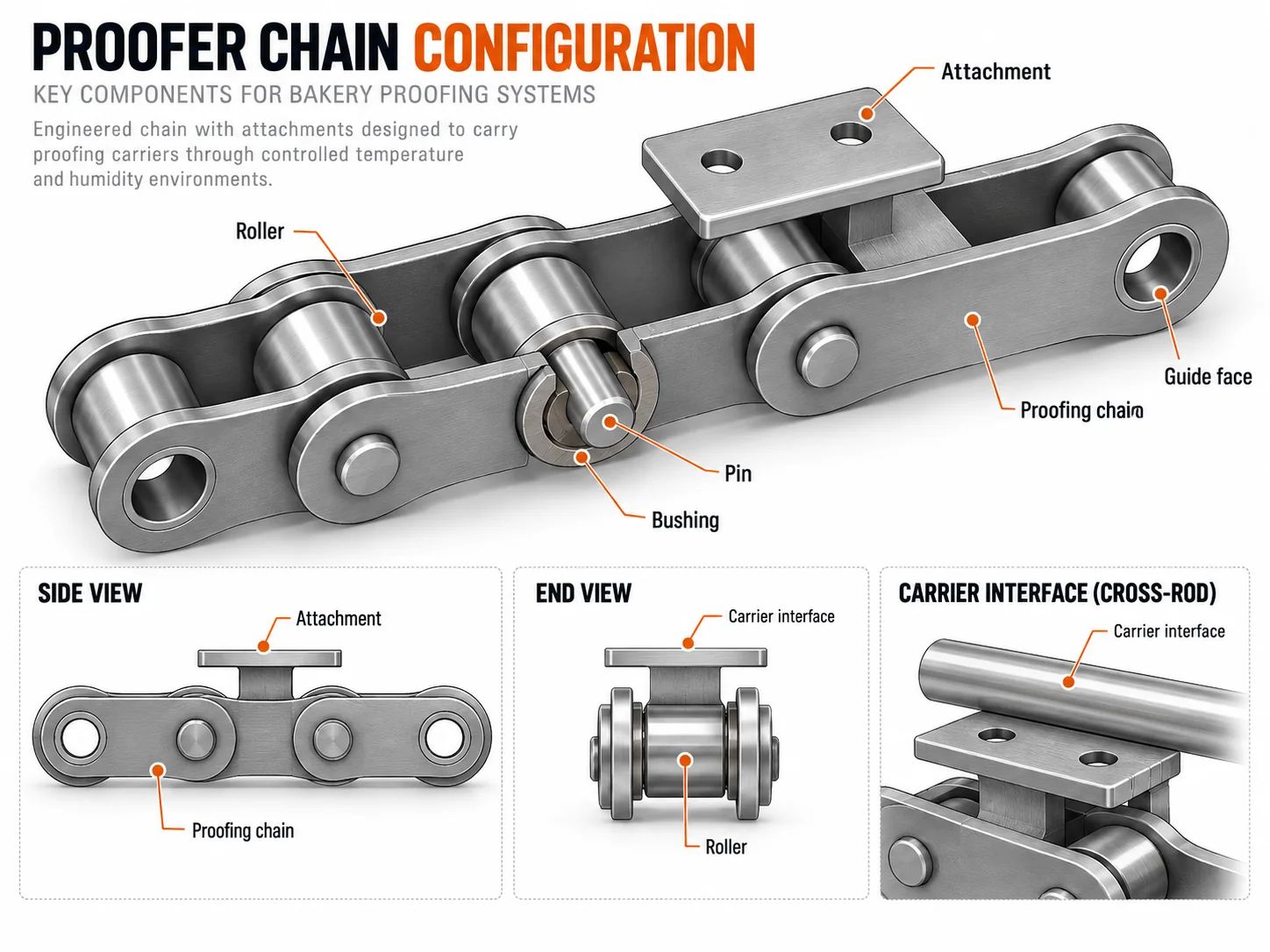
| Specification | Reference value |
|---|---|
| Pitch and sprocket | Must match the installed gearing relationship. |
| Inside width and roller/bush | Controls transverse fit, guide clearance and sprocket seating. |
| Pin and plate geometry | Affects joint construction and overall machine clearance. |
| Attachment interface | Must match hole pattern, offset, bend direction and interval. |
| Temperature and moisture | Influence material, clearance, lubrication and inspection plan. |
| Load and speed | Define the duty that the chain and supporting machine must accommodate. |
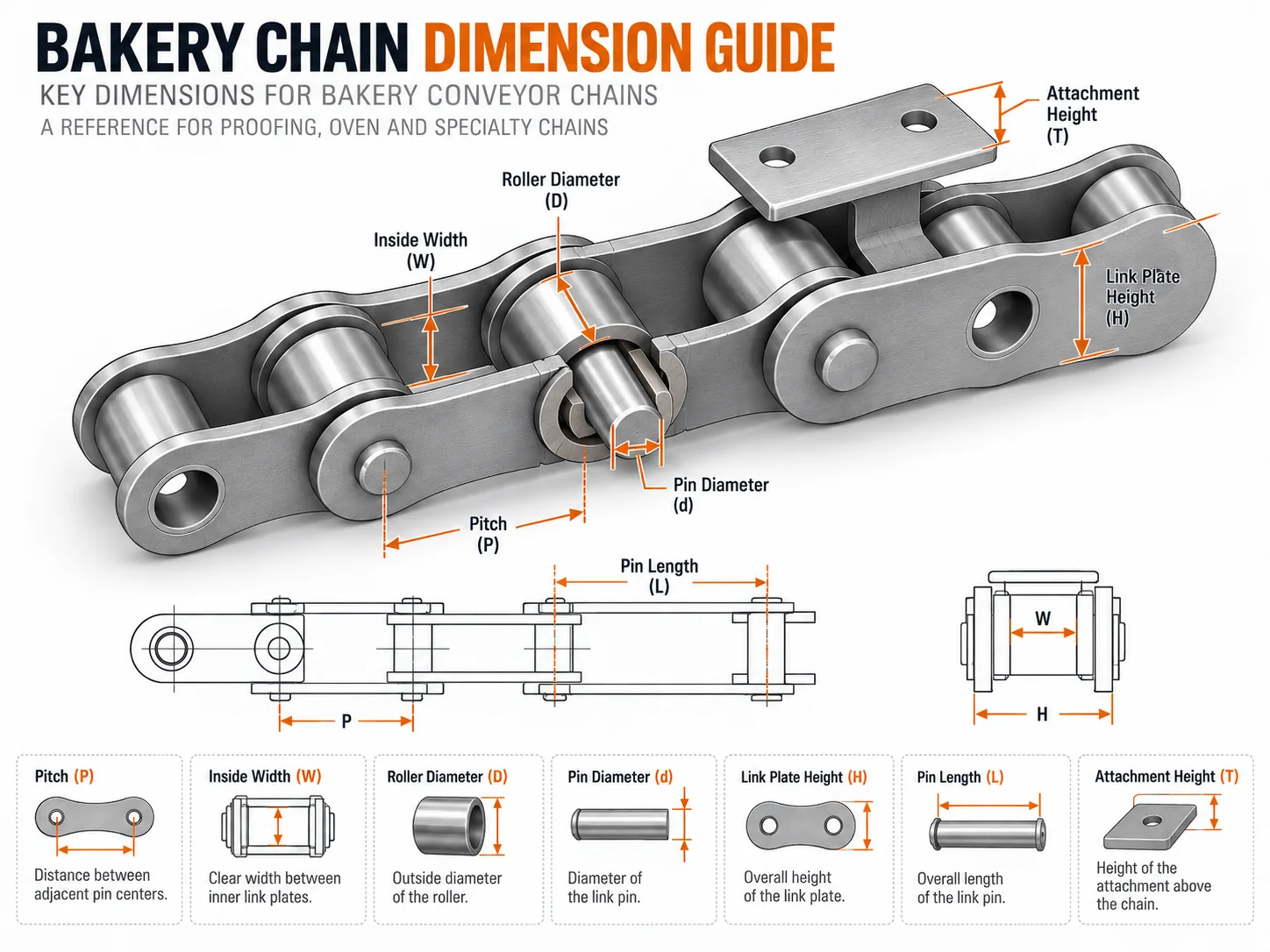
Clean a representative chain section before measuring. Record pitch between pin centers, inside width between inner plates, roller or bush diameter, pin diameter and overall pin length. Photograph the side and end of the chain beside a scale. Then record every attachment dimension separately rather than assuming it follows the base chain standard.
If the conveyor uses two or more parallel strands, measure chain-center spacing and check whether the carrier locks the strands into a fixed relationship. Include sprocket tooth count, shaft diameter and any available sprocket drawing.
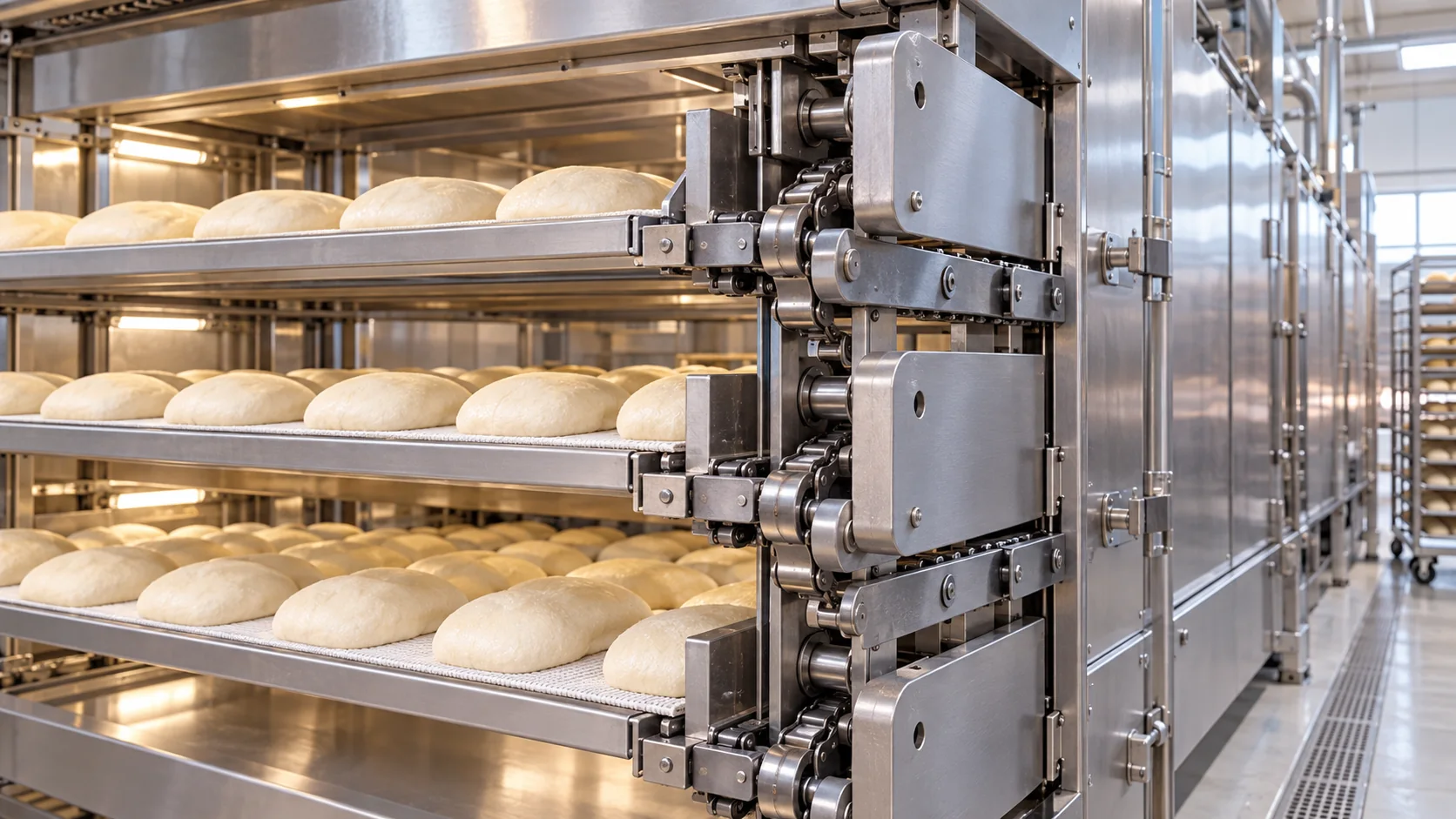
Describe the real duty rather than choosing broad labels such as “food grade” or “high temperature” without context. State continuous and peak temperature, humidity, condensate, washdown frequency, cleaning chemicals, abrasive crumbs or flour, production hours, starts per hour, conveyor speed and carried mass. If a process transitions from a wet zone to a hot zone, note both.
These details allow material and clearance decisions to be reviewed without making assumptions that could be unsafe or expensive.
Chains with the same pitch can have different widths, rollers and attachment geometry.
A new chain on severely worn teeth can engage poorly and wear rapidly.
Attachment offset and hole pattern are load-carrying interfaces and must be dimensioned.
Humidity, heat, washdown and cleaning chemistry may point to different configurations.
This page is about proofer versus oven duty: separate humidity-driven proofing requirements from thermal oven requirements. Keep that decision separate from later material, commercial or installation choices so the evidence stays easy to review.
The working checklist is temperature cycle, humidity, clearance, material and carrier path. Note the measuring method and datum points, and identify which values came from an existing drawing versus direct measurement of a worn chain.
A chain decision should be cross-checked against sprockets, guides, take-up and carrier hardware. Local wear or misalignment can create symptoms that are wrongly attributed to chain size or material.
Use website dimensions and diagrams to prepare the discussion, then confirm the ordered configuration on the final drawing. Application-dependent clearances, materials and performance ratings should not be inferred from appearance.
| Check | Why it matters | What to send or verify |
|---|---|---|
| What is fixed? | Identify machine dimensions and interfaces that cannot change without redesign. | Mark these directly on the drawing or measurement sheet. |
| What can be optimized? | Separate material, clearance, roller or attachment options that can be reviewed for the actual duty. | State operating conditions and preferred maintenance practice. |
| What is uncertain? | Flag any dimension taken from a worn area, hidden interface or incomplete legacy drawing. | Add photographs, alternate measurements or a physical sample. |
| What closes the decision? | Verify sprocket engagement, carrier fit, machine envelope and required quantity before release. | Approve one controlled drawing revision for the order. |
Capture temperature cycle, humidity, clearance, material and carrier path with the measurement location and machine state noted. Add context photographs so a dimension is not separated from the interface it controls.
For proofer versus oven duty, the goal is to separate humidity-driven proofing requirements from thermal oven requirements. Mark fixed interchange requirements separately from selectable material, attachment or maintenance options.
State the required quantity, chain length where known, delivery documentation and whether the job is a direct replacement or modification. Do not turn an unverified legacy part number into a guaranteed cross-reference.
Close the handoff with one controlled drawing revision covering the chain geometry and the critical machine interface. That drawing, not a web-page illustration, should define the ordered configuration.
For proofer versus oven duty, one pitch or one width is rarely enough. Capture temperature cycle, humidity, clearance, material and carrier path and relate those values to the sprocket and carrier interface before calling two chains interchangeable.
Noise, tightness, corrosion or apparent stretch can be produced by more than one mechanism. Use the location and operating state of the symptom to decide what to inspect next instead of immediately changing tension, material or chain size.
The guide is intended to separate humidity-driven proofing requirements from thermal oven requirements. Final dimensions and ordered options should be confirmed on a controlled drawing tied to the quotation. That prevents an explanatory diagram or family-level value from being mistaken for a released manufacturing requirement.
Use this guide to prepare measurements, photos and operating data, then compare the result with our bakery chain product families. If the installed chain is non-standard, send a sample section or dimensioned drawing.