记录几何
节距、宽度、滚轮/衬套、销钉、板、总宽度和连接方式。
烘焙连锁店技术指南
Hollow Pin Chain Cross-Rod Design Basics is best answered by combining measured chain geometry, machine duty and the operating environment. This guide shows what to inspect, record and discuss before a replacement or new-chain decision.
Hollow Pin Chain Cross-Rod Design Basics should be evaluated from the actual conveyor. Start with chain pitch, transverse geometry, sprocket condition and any carrier attachment, then add temperature, moisture, washdown, load, speed and take-up information. The objective is not to identify a chain by appearance; it is to produce an RFQ that preserves the machine interface and makes application-dependent choices explicit.
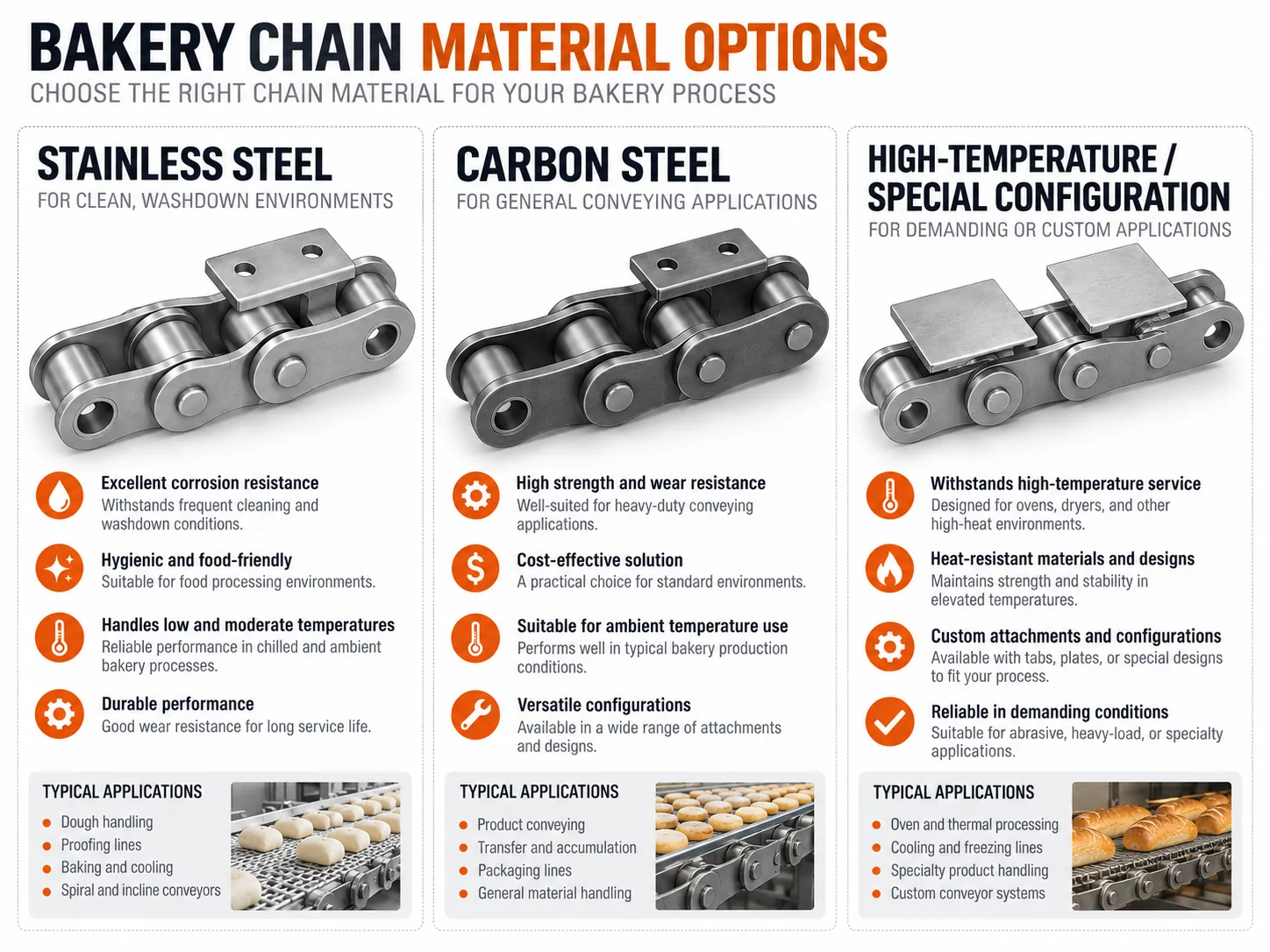
拆卸链条前,请测量以下几个特性。节距决定了基本的传动关系,而内宽、滚子或衬套直径、销轴直径、链板高度、总宽度和连接尺寸则区分了可能具有相同标称节距的不同配置。
对于磨损的链条,测量多个链节的累积节距。从侧面和末端拍摄链条照片,并在条件允许的情况下拍摄链轮。

The same chain geometry can behave differently in a humid proofer, a hot oven, an ambient cooling section or a washdown area. For hollow pin chain cross-rod design basics, document the exact machine zone, whether the chain carries product directly or moves pans/fixtures, and whether the joint sees heat, moisture, cleaning chemicals or abrasive residue.
工艺数据有助于确定哪些特性是可互换性的,以及哪些特性(例如材料、间隙或附件制造方法)应针对应用进行审查。
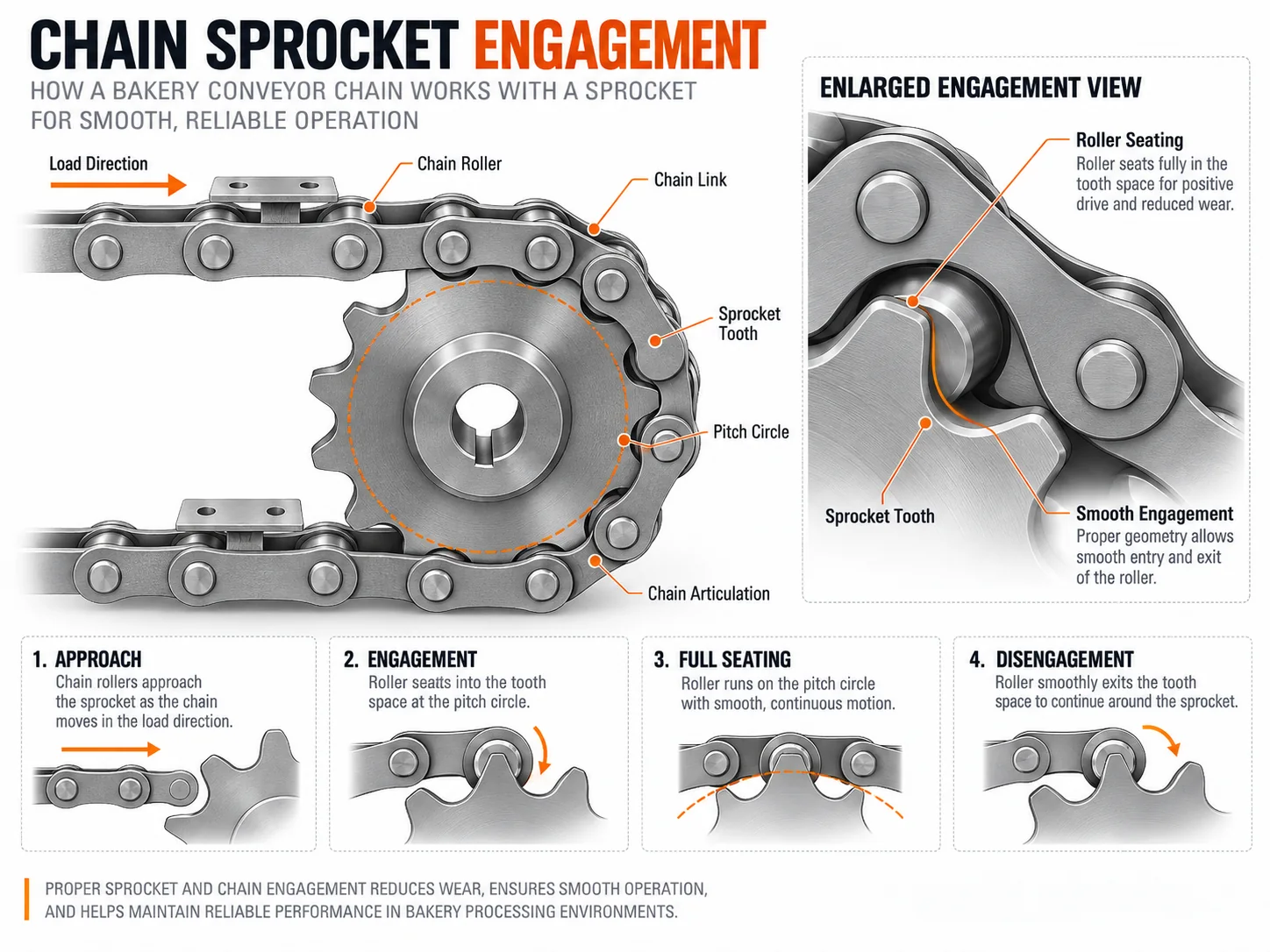
链条并非独立运转。滚子或衬套必须平稳地进出链轮齿槽,而导轨则支撑链条,防止其发生侧向位移。钩齿、轴不对中、偏心链轮或导轨过紧都会导致新链条快速磨损。
检查完整回路的整个路径。如果损坏在同一机器位置重复出现,请先检查当地的支撑结构、传送装置或载体,然后再断定链条本身存在缺陷。
节距、宽度、滚轮/衬套、销钉、板、总宽度和连接方式。
温度、湿度、冲洗、速度、负载、生产小时数和启动次数。
链轮、导轨、链条中心、张紧装置、对准装置和托架间隙。
安装前,请确认最终订购的几何形状、材料和应用相关的配置。
询问问题出现前发生了哪些变化:生产率、产品或锅具重量、清洗周期、润滑油、温度、维护周期或更换的链轮。趋势信息比单张照片更有价值,因为它能显示磨损是均匀的还是集中的。
日常检查时,应注意接头是否僵硬、滚轮磨损、销轴是否松动、附件是否开裂或弯曲、侧面接触是否异常以及卷取是否不均匀。根据机器所有者的要求,保持防护装置和安全规程到位。
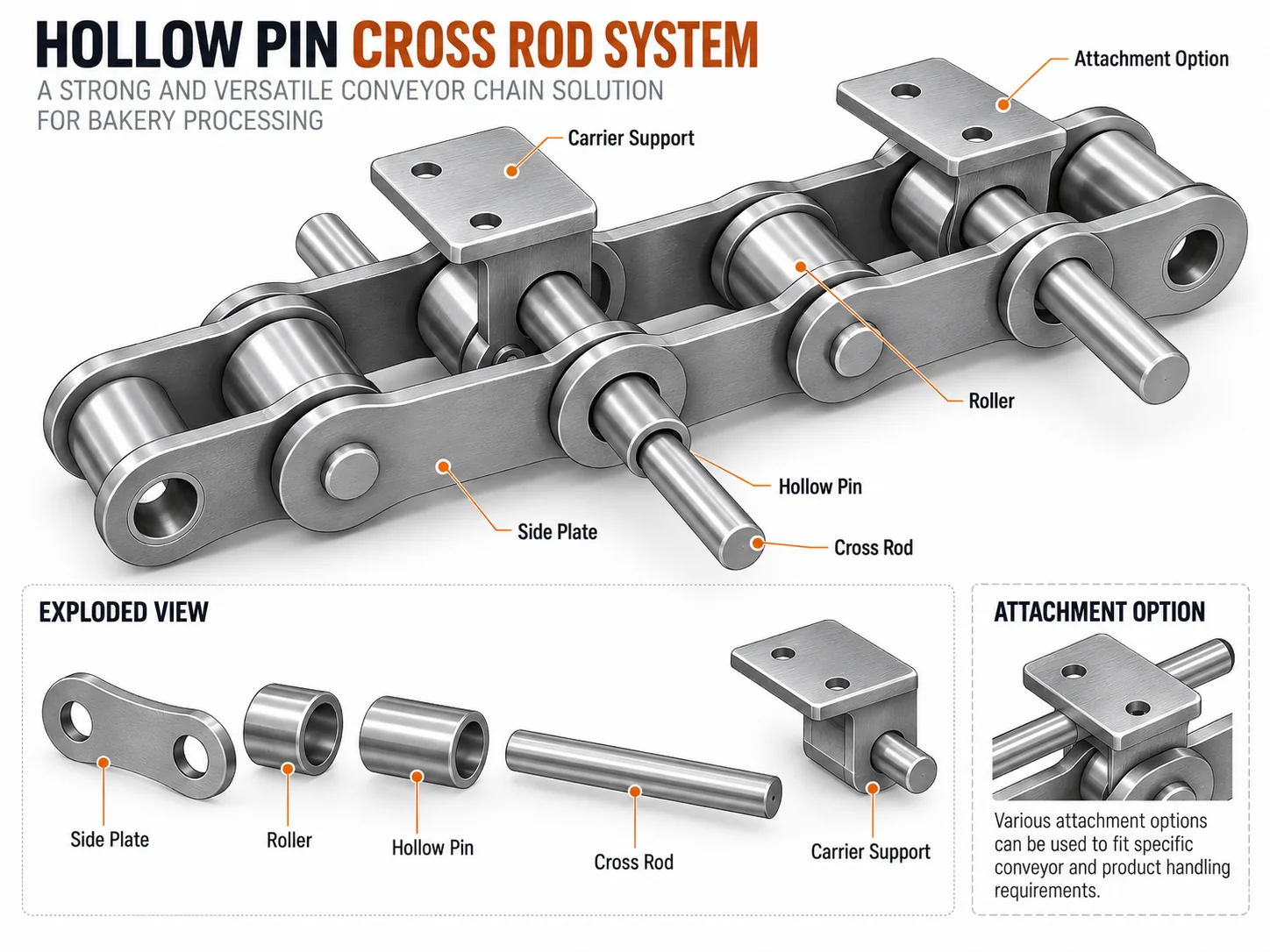
A useful diagnosis starts with evidence that can be repeated by a second person. designing the cross-rod connection so it transfers load without locking the chain joint. Record pin bore, rod diameter, clearance, retention, strand spacing and rod bending span. When the chain is worn, note which readings may be influenced by joint clearance or deformation, and prefer multi-pitch or multi-point measurements over one isolated dimension.
The chain does not operate by itself. In parallel-strand proofing and tray carriers, inspect the sprockets, guides, return path, take-up and carrier interface at the same time. The symptom to watch is rod fretting, binding, uneven strand load or difficult disassembly. A local problem that repeats at one machine position often points to alignment, clearance or mating-hardware issues rather than a uniform chain problem.
The practical decision is to control rod fit and retention while leaving the chain free to articulate across the full route. That prevents a common error: changing chain tension, material or size before the root constraint has been identified. Use the chain drawing and the machine envelope together, because a configuration that looks correct in isolation can still interfere with a guard, transfer plate, sensor bracket or carrier.
请描述运行周期,而不要仅使用“高温”、“潮湿”或“食品级”等单一形容词。在相关情况下,请说明正常温度和峰值温度、湿度或清洁环境、转速、启停情况以及润滑限制。这些细节决定了在基本几何形状保持不变的情况下,间隙、材料或维护方法是否需要更改。
| 查看 | 为什么这很重要 | 发送或验证哪些内容 |
|---|---|---|
| 鉴别 | Confirm pin bore, rod diameter, clearance, retention, strand spacing and rod bending span. Use a measurement sequence that can be repeated after removal so the installed and bench readings can be compared. | 带尺寸标注的草图、按比例缩放的照片以及任何旧图纸或零件编号。 |
| 路线位置 | Map where the chain runs through parallel-strand proofing and tray carriers. Mark the exact location of rod fretting, binding, uneven strand load or difficult disassembly instead of reporting the condition only as a whole-line problem. | 背景照片显示了传送带部分、驱动/尾部位置和返回路径。 |
| 配合部件 | 检查齿形、滚子座、轴/链轮对准情况、导向接触情况和张紧储备。这些部件的磨损痕迹可能与链条选择问题相似。 | 链轮齿数和照片、导轨布局和当前张紧位置。 |
| 加载路径 | Identify how product carriers, pans, rods or fixtures transfer load into the chain. For this topic, the key focus is designing the cross-rod connection so it transfers load without locking the chain joint. | 已知载体图纸、连接间隔、链中心间距和支撑质量/力。 |
| 环境 | 按机器区域记录温度、湿度、冲洗、污染和润滑限制。区分持续暴露与短时峰值或清洁事件。 | 运行状况概述及维护/润滑规范。 |
| 发布 | The final engineering action is to control rod fit and retention while leaving the chain free to articulate across the full route. The approved drawing should distinguish fixed interchange dimensions from selectable options. | rod and pin dimensions, carrier load, strand centers, retention concept and environment. |
A uniform change along the whole strand suggests a different mechanism from damage concentrated at one sprocket, guide or transfer. For Hollow Pin Chain Cross-Rod Design Basics, compare left/right sides and loaded/return paths. The distribution of wear can reveal whether the driver is joint wear, side loading, contamination, thermal change or a carrier that is forcing the chain out of its natural path.
Increasing tension can temporarily change noise or tracking without correcting the underlying cause. If the observed issue is rod fretting, binding, uneven strand load or difficult disassembly, first confirm alignment, take-up geometry and articulation. Excessive tension can add bearing load and make a marginal guide or attachment problem worse.
烘焙设备会在生产、清洁和停机状态之间切换。例如,链条在冷却时可能活动自如,加热后则会变得紧绷;或者在生产过程中运转顺畅,但在反复潮湿停机后会发生腐蚀。记录故障出现时的状态,以便选择的纠正措施能够应对实际的工作周期。
For an unknown chain, one close-up is not enough. Pair a complete machine-zone image with side and end views of several pitches, a sprocket-engagement photo and a clear attachment/carrier view. Place a scale only where it does not hide the feature being measured. This photo set makes designing the cross-rod connection so it transfers load without locking the chain joint easier to evaluate remotely.
Record pin bore, rod diameter, clearance, retention, strand spacing and rod bending span, chain centers, sprocket tooth count and the carrier interface before changing components.
Describe what happens in parallel-strand proofing and tray carriers, including temperature or moisture changes, speed, load and cleaning/lubrication constraints.
Document where rod fretting, binding, uneven strand load or difficult disassembly appears. Compare drive, tail, loaded run, return run and transfer points rather than averaging the entire conveyor.
Include rod and pin dimensions, carrier load, strand centers, retention concept and environment. State the required quantity or chain length and any documentation needed with the order.
Review pitch, widths, pin/roller geometry, attachments and material notes on one controlled drawing revision. For Hollow Pin Chain Cross-Rod Design Basics, the release decision should explicitly address designing the cross-rod connection so it transfers load without locking the chain joint.
安装后,至少要运行一个完整的循环,检查链轮的进出间隙和托架间隙,并按照机器制造商的步骤重新检查张紧情况。不应使用新链条来弥补磨损或错位的硬件。
The main reason to keep this process structured is that designing the cross-rod connection so it transfers load without locking the chain joint interacts with more than one component. A change that improves one symptom can shift load into another part of the mechanism. For example, correcting guide alignment may reduce side wear but also expose a take-up setting that was previously compensating for the misalignment. Record changes one at a time so the result can be interpreted.
For planned maintenance, compare the present condition with a baseline whenever one exists. If there is no baseline, create one during the next shutdown: photograph the sprockets and guide surfaces, record take-up position, measure a defined number of pitches, and note the chain’s location in parallel-strand proofing and tray carriers. Repeating the same observations later is more informative than relying on general statements such as “the chain has stretched.”
如有现有图纸,请核实已安装的硬件是否仍与图纸相符。烘焙设备在其使用寿命期间经常会进行改造:托架可能需要维修,导轨可能需要移动,链轮可能需要更换,附件更换周期也可能需要调整。图纸仍然有用,但现场核实可以防止将历史文件视为当前配置的证明。
Procurement and engineering should use the same evidence package. The RFQ should not separate commercial quantity from technical context: rod and pin dimensions, carrier load, strand centers, retention concept and environment. This makes it possible to judge whether a standard series, a modified attachment or a custom replacement is the appropriate route without creating unnecessary back-and-forth.
Finally, treat the website as a preparation tool rather than the controlling product drawing. Measurements and diagrams narrow the family and help organize the RFQ; the released drawing defines the ordered configuration. That distinction is especially important where rod fretting, binding, uneven strand load or difficult disassembly could have more than one mechanical cause.
Use Hollow Pin Chain Cross-Rod Design Basics as a machine-level question, not just a chain inspection. Compare the loaded and return runs, drive and tail ends, and any transfer or carrier transition in parallel-strand proofing and tray carriers. Document whether rod fretting, binding, uneven strand load or difficult disassembly is distributed along the strand or repeats at one location. That pattern helps separate progressive joint wear from alignment, guide, sprocket or carrier problems that a new chain alone will not correct.
The working record should include pin bore, rod diameter, clearance, retention, strand spacing and rod bending span. Mark which values are fixed by the existing machine and which values can be changed to improve service. The central engineering focus is designing the cross-rod connection so it transfers load without locking the chain joint. When a legacy part number conflicts with field measurements, hold the RFQ until the installed interface and the controlled drawing can be reconciled.
A useful enquiry combines commercial quantity with the technical package: rod and pin dimensions, carrier load, strand centers, retention concept and environment. Also state whether the request is a direct replacement, a planned modification or a new machine design. The release objective is to control rod fit and retention while leaving the chain free to articulate across the full route. This reduces quote revisions and prevents a visually similar chain from being treated as interchangeable before geometry and duty have been checked.
如有旧参考信息,请使用旧参考信息,但务必核实已安装的几何形状和工作状态。机器改造、之前的零件替换或磨损都可能导致仅凭零件编号无法获得完整信息。
采用多节距测量法,测量多个节距,并记录测量结果。将测量结果与标称节距和机器维护限值进行比较,而不是仅依赖于单个相邻节距的测量结果。
当出现齿轮磨损、钩齿、对准问题或链条反复过早磨损时,链条和链轮会作为一个啮合系统工作。