Leg de geometrie vast.
Steek, breedte, rol/bus, pen, plaat, totale breedte en bevestigingspatroon.
Technische handleiding voor bakkerijketens
Custom Attachments for Tray Conveyors is best answered by combining measured chain geometry, machine duty and the operating environment. This guide shows what to inspect, record and discuss before a replacement or new-chain decision.
Custom Attachments for Tray Conveyors should be evaluated from the actual conveyor. Start with chain pitch, transverse geometry, sprocket condition and any carrier attachment, then add temperature, moisture, washdown, load, speed and take-up information. The objective is not to identify a chain by appearance; it is to produce an RFQ that preserves the machine interface and makes application-dependent choices explicit.
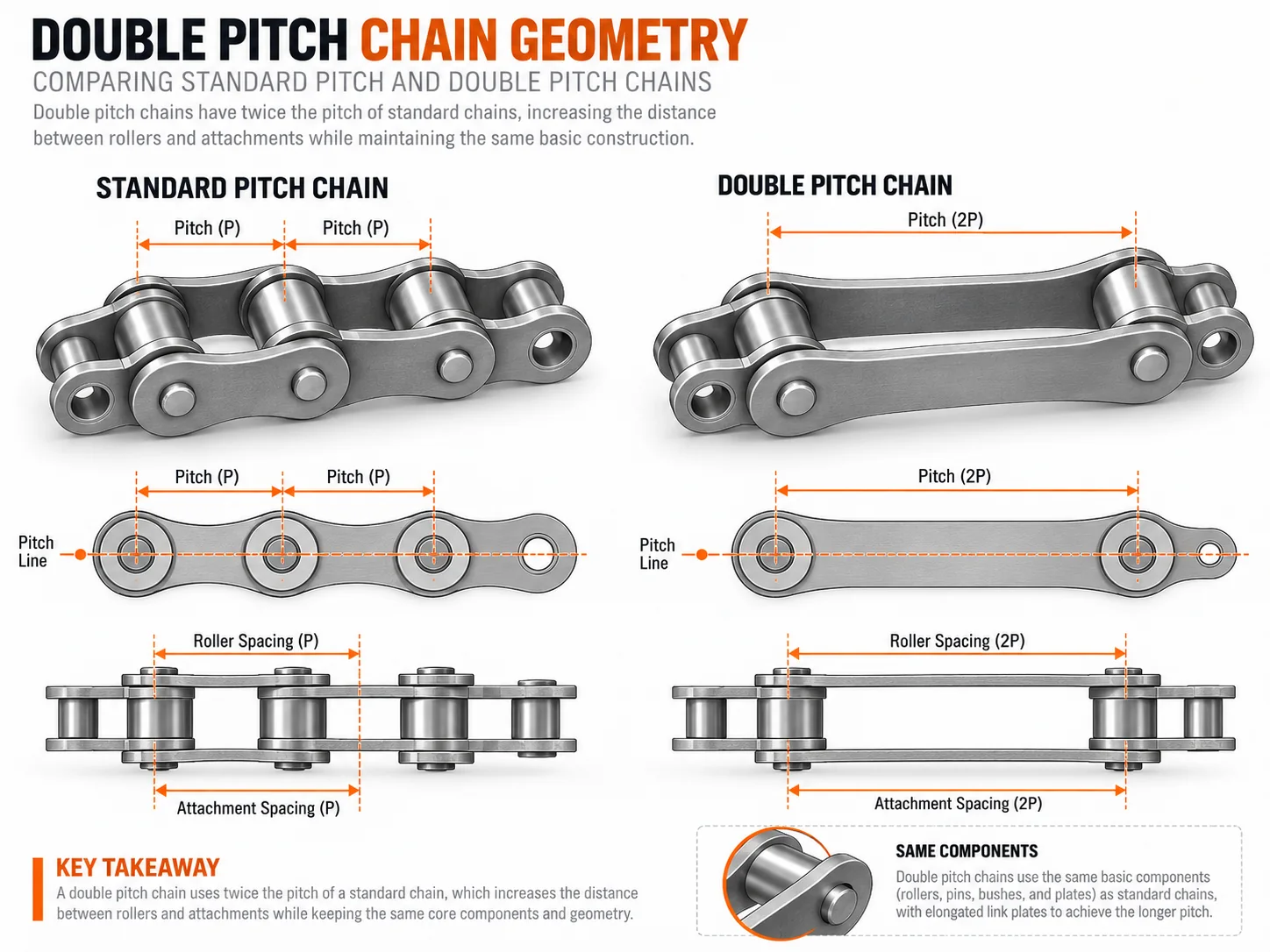
Meet verschillende kenmerken voordat u de ketting verwijdert. De steek bepaalt de basisverhouding van de overbrenging, maar de binnenbreedte, de diameter van de rol of bus, de diameter van de pen, de hoogte van de plaat, de totale breedte en de afmetingen van de bevestiging onderscheiden configuraties die dezelfde nominale steek kunnen hebben.
Om een versleten schakel te beoordelen, meet je de totale steek over meerdere schakels. Fotografeer de ketting vanaf de zijkant en de voorkant, en neem indien mogelijk ook het tandwiel mee op de foto.
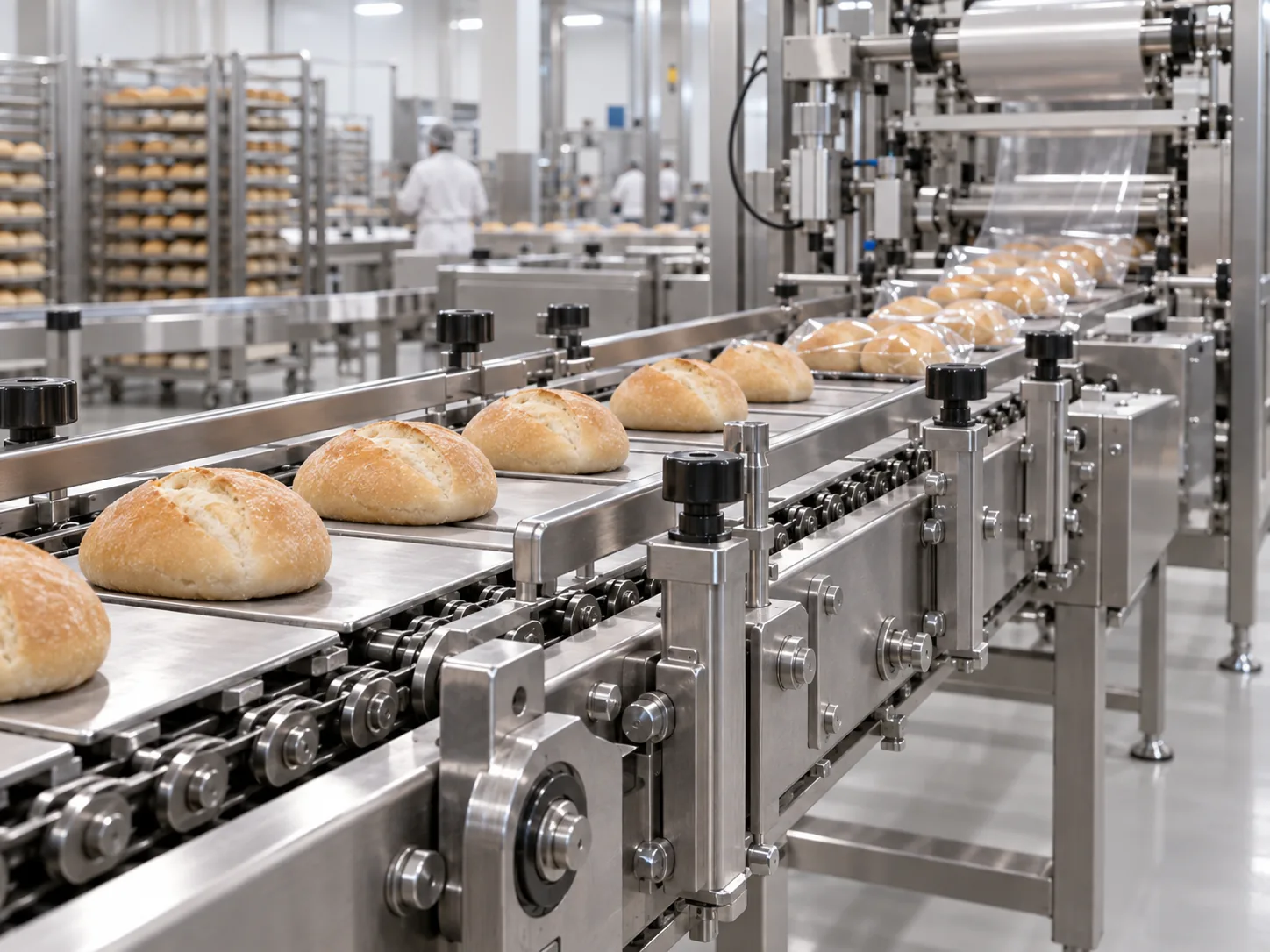
The same chain geometry can behave differently in a humid proofer, a hot oven, an ambient cooling section or a washdown area. For custom attachments for tray conveyors, document the exact machine zone, whether the chain carries product directly or moves pans/fixtures, and whether the joint sees heat, moisture, cleaning chemicals or abrasive residue.
Procesgegevens helpen bepalen welke eigenschappen vastliggen door uitwisselbaarheid en welke eigenschappen – zoals materiaal, speling of de productiemethode van de bevestiging – voor de toepassing moeten worden herzien.
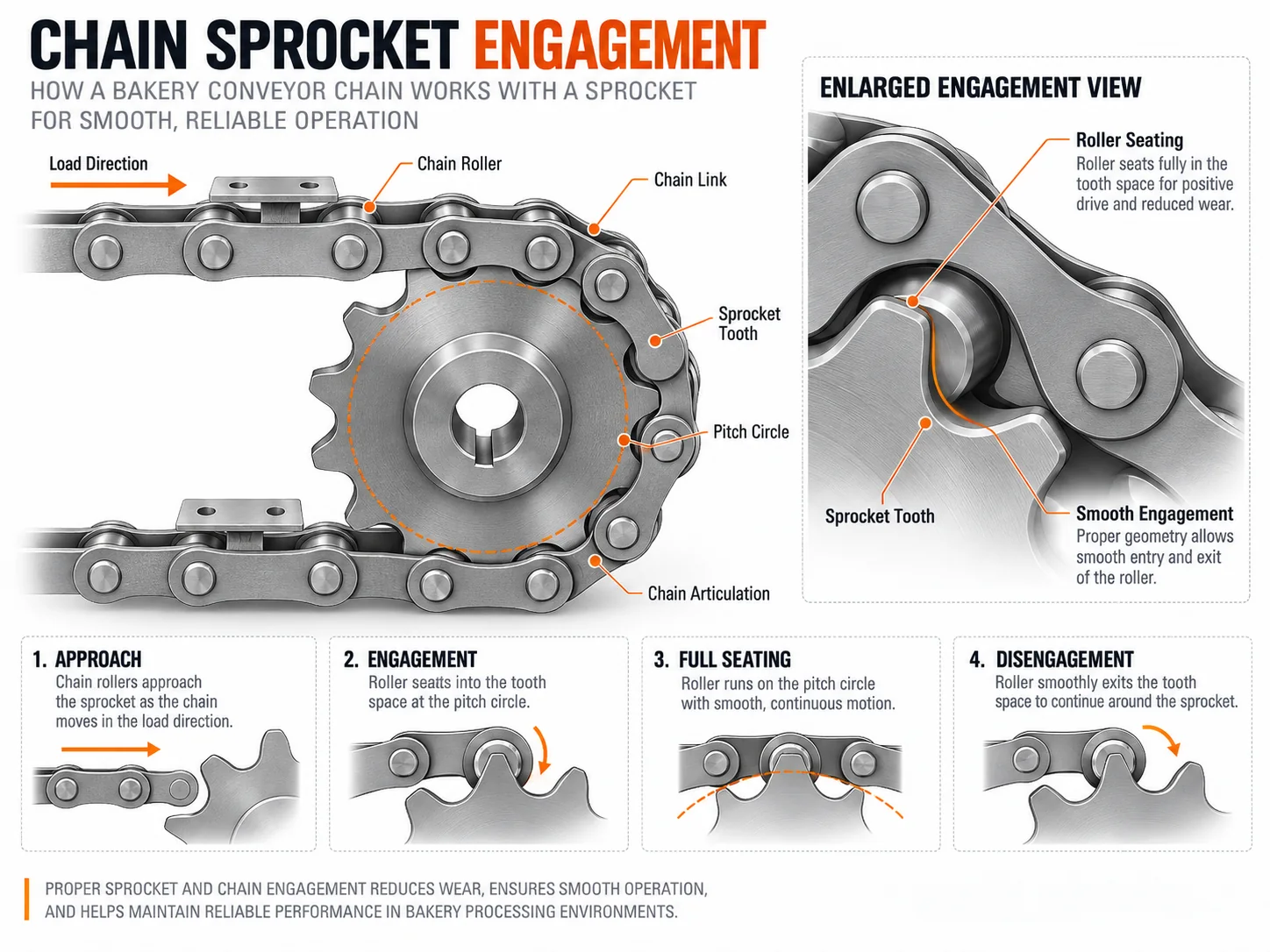
Een ketting werkt niet zelfstandig. Rollen of bussen moeten soepel in en uit de tandruimtes van de tandwielen bewegen, terwijl geleiderails de kettingdraad ondersteunen zonder deze zijwaarts te duwen. Gehaakte tanden, een verkeerde uitlijning van de as, excentrische tandwielen of een stroeve geleider kunnen ervoor zorgen dat een nieuwe ketting snel slijt.
Inspecteer het volledige traject over één complete kringloop. Als de schade zich herhaalt op dezelfde locatie in de machine, onderzoek dan de lokale ondersteuning, overdracht of drager voordat u ervan uitgaat dat de ketting zelf defect is.
Steek, breedte, rol/bus, pen, plaat, totale breedte en bevestigingspatroon.
Temperatuur, vochtigheid, reiniging, snelheid, belasting, productie-uren en -starts.
Tandwielen, geleiders, kettingcentra, spaninrichting, uitlijning en speling van de drager.
Keur de definitieve geometrie, het materiaal en de toepassingsafhankelijke configuratie goed vóór de installatie.
Vraag wat er veranderd is voordat het probleem zich voordeed: productiesnelheid, product- of pan-gewicht, reinigingscyclus, smeermiddel, temperatuur, onderhoudsinterval of vervangen tandwielen. Trendinformatie is waardevoller dan een enkele foto, omdat het laat zien of de slijtage gelijkmatig of geconcentreerd is.
Controleer tijdens de routine-inspectie op stroeve verbindingen, slijtage van de rollen, beweging van de pinnen, gebarsten of verbogen hulpstukken, abnormaal zijdelings contact en ongelijkmatige aanspanning. Zorg ervoor dat de afschermingen en veiligheidsprocedures conform de eisen van de machine-eigenaar worden nageleefd.
Vermeld de gemeten afmetingen, de naam van de machine/het proces, foto's, een tekening (indien beschikbaar), de hoeveelheid of de vereiste kettinglengte, de bevestigingsafstand, de afstand tussen de kettingcentra, informatie over de tandwielen, de temperatuur, de reinigingsconditie, de belasting en het beoogde leveringsvenster. Controleer de Gids voor het kiezen van een bakkerijketen en de productfamilieoverzicht voor de volgende beslissingsstap.
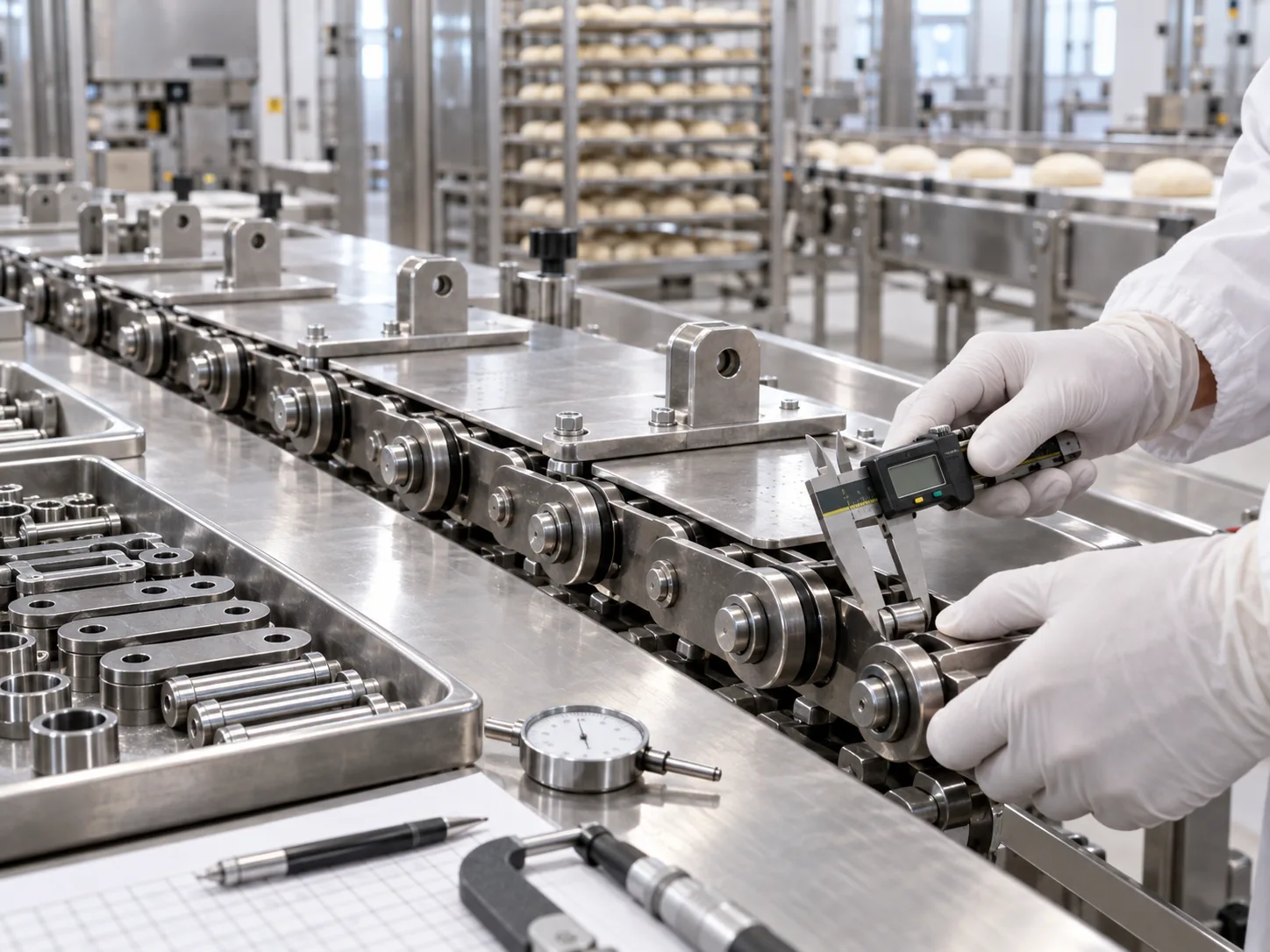
A useful diagnosis starts with evidence that can be repeated by a second person. translating tray support requirements into manufacturable attachment geometry. Record tray envelope, mounting holes, bend radii, plate thickness, offset, interval and chain centers. When the chain is worn, note which readings may be influenced by joint clearance or deformation, and prefer multi-pitch or multi-point measurements over one isolated dimension.
The chain does not operate by itself. In custom tray conveyors and OEM bakery equipment, inspect the sprockets, guides, return path, take-up and carrier interface at the same time. The symptom to watch is fatigue at bends, inaccessible fasteners or tray interference. A local problem that repeats at one machine position often points to alignment, clearance or mating-hardware issues rather than a uniform chain problem.
The practical decision is to freeze the tray interface first, then review attachment manufacture, chain articulation and service access together. That prevents a common error: changing chain tension, material or size before the root constraint has been identified. Use the chain drawing and the machine envelope together, because a configuration that looks correct in isolation can still interfere with a guard, transfer plate, sensor bracket or carrier.
Beschrijf de bedrijfscyclus in plaats van een enkel bijvoeglijk naamwoord zoals 'heet', 'nat' of 'voedselveilig'. Vermeld de normale en piektemperatuur waar relevant, blootstelling aan vocht of reiniging, snelheid, start-/stopgedrag en beperkingen met betrekking tot smering. Deze details bepalen of spelingen, materialen of onderhoudsprocedures moeten worden aangepast, terwijl de basisgeometrie gelijk blijft.
| Rekening | Waarom het belangrijk is | Wat moet ik versturen of verifiëren? |
|---|---|---|
| Identificatie | Confirm tray envelope, mounting holes, bend radii, plate thickness, offset, interval and chain centers. Use a measurement sequence that can be repeated after removal so the installed and bench readings can be compared. | Een schets met afmetingen, foto's op schaal en eventuele oude tekeningen of artikelnummers. |
| Routepositie | Map where the chain runs through custom tray conveyors and OEM bakery equipment. Mark the exact location of fatigue at bends, inaccessible fasteners or tray interference instead of reporting the condition only as a whole-line problem. | Contextfoto met het transportbandgedeelte, de aandrijf-/achteraanrijposities en het retourpad. |
| Aansluitende onderdelen | Controleer het tandprofiel, de rolzitting, de uitlijning van de as/tandwiel, het contact met de geleider en de spanreserve. Deze onderdelen kunnen slijtagepatronen veroorzaken die een probleem met de kettingselectie nabootsen. | Aantal tandwieltanden en foto's, geleidingslay-out en huidige opwikkelpositie. |
| Laadpad | Identify how product carriers, pans, rods or fixtures transfer load into the chain. For this topic, the key focus is translating tray support requirements into manufacturable attachment geometry. | Tekening van de drager, bevestigingsinterval, afstand tussen de kettingharten en ondersteunde massa/kracht indien bekend. |
| Omgeving | Registreer temperatuur, luchtvochtigheid, reinigingscycli, vervuiling en smeerbeperkingen per machinezone. Maak onderscheid tussen continue blootstelling en korte pieken of reinigingsmomenten. | Overzicht van de bedrijfsomstandigheden en de onderhouds-/smeerprocedures. |
| Uitgave | The final engineering action is to freeze the tray interface first, then review attachment manufacture, chain articulation and service access together. The approved drawing should distinguish fixed interchange dimensions from selectable options. | tray CAD/drawing, chain dimensions, loads, cycle rate, temperature and cleaning routine. |
A uniform change along the whole strand suggests a different mechanism from damage concentrated at one sprocket, guide or transfer. For Custom Attachments for Tray Conveyors, compare left/right sides and loaded/return paths. The distribution of wear can reveal whether the driver is joint wear, side loading, contamination, thermal change or a carrier that is forcing the chain out of its natural path.
Increasing tension can temporarily change noise or tracking without correcting the underlying cause. If the observed issue is fatigue at bends, inaccessible fasteners or tray interference, first confirm alignment, take-up geometry and articulation. Excessive tension can add bearing load and make a marginal guide or attachment problem worse.
Bakkerijapparatuur kan zich in verschillende productie-, reinigings- en stilstandsfasen bevinden. Een ketting kan bijvoorbeeld soepel bewegen wanneer deze koud is en stroef worden wanneer deze warm is, of vrij lopen tijdens de productie maar corroderen na herhaaldelijk stilvallen in natte omstandigheden. Registreer de fase waarin het probleem zich voordoet, zodat de gekozen corrigerende maatregel de werkelijke bedrijfscyclus aanpakt.
For an unknown chain, one close-up is not enough. Pair a complete machine-zone image with side and end views of several pitches, a sprocket-engagement photo and a clear attachment/carrier view. Place a scale only where it does not hide the feature being measured. This photo set makes translating tray support requirements into manufacturable attachment geometry easier to evaluate remotely.
Record tray envelope, mounting holes, bend radii, plate thickness, offset, interval and chain centers, chain centers, sprocket tooth count and the carrier interface before changing components.
Describe what happens in custom tray conveyors and OEM bakery equipment, including temperature or moisture changes, speed, load and cleaning/lubrication constraints.
Document where fatigue at bends, inaccessible fasteners or tray interference appears. Compare drive, tail, loaded run, return run and transfer points rather than averaging the entire conveyor.
Include tray CAD/drawing, chain dimensions, loads, cycle rate, temperature and cleaning routine. State the required quantity or chain length and any documentation needed with the order.
Review pitch, widths, pin/roller geometry, attachments and material notes on one controlled drawing revision. For Custom Attachments for Tray Conveyors, the release decision should explicitly address translating tray support requirements into manufacturable attachment geometry.
Na de installatie dient u ten minste één volledige omwenteling te observeren, de in- en uitgang van het tandwiel en de speling van de drager te controleren en de kettingspanning opnieuw te controleren volgens de procedure van de machinefabrikant. Een nieuwe ketting mag niet worden gebruikt ter compensatie van versleten of verkeerd uitgelijnde onderdelen.
The main reason to keep this process structured is that translating tray support requirements into manufacturable attachment geometry interacts with more than one component. A change that improves one symptom can shift load into another part of the mechanism. For example, correcting guide alignment may reduce side wear but also expose a take-up setting that was previously compensating for the misalignment. Record changes one at a time so the result can be interpreted.
For planned maintenance, compare the present condition with a baseline whenever one exists. If there is no baseline, create one during the next shutdown: photograph the sprockets and guide surfaces, record take-up position, measure a defined number of pitches, and note the chain’s location in custom tray conveyors and OEM bakery equipment. Repeating the same observations later is more informative than relying on general statements such as “the chain has stretched.”
Als er een bestaande tekening beschikbaar is, controleer dan of de geïnstalleerde hardware er nog steeds mee overeenkomt. Bakkerijapparatuur wordt vaak aangepast gedurende de levensduur: dragers kunnen worden gerepareerd, geleiderails verplaatst, tandwielen vervangen en de tussenruimte tussen de bevestigingspunten gewijzigd. De tekening blijft nuttig, maar een controle in het veld voorkomt dat een historisch document als bewijs van de huidige configuratie wordt beschouwd.
Procurement and engineering should use the same evidence package. The RFQ should not separate commercial quantity from technical context: tray CAD/drawing, chain dimensions, loads, cycle rate, temperature and cleaning routine. This makes it possible to judge whether a standard series, a modified attachment or a custom replacement is the appropriate route without creating unnecessary back-and-forth.
Finally, treat the website as a preparation tool rather than the controlling product drawing. Measurements and diagrams narrow the family and help organize the RFQ; the released drawing defines the ordered configuration. That distinction is especially important where fatigue at bends, inaccessible fasteners or tray interference could have more than one mechanical cause.
Use Custom Attachments for Tray Conveyors as a machine-level question, not just a chain inspection. Compare the loaded and return runs, drive and tail ends, and any transfer or carrier transition in custom tray conveyors and OEM bakery equipment. Document whether fatigue at bends, inaccessible fasteners or tray interference is distributed along the strand or repeats at one location. That pattern helps separate progressive joint wear from alignment, guide, sprocket or carrier problems that a new chain alone will not correct.
The working record should include tray envelope, mounting holes, bend radii, plate thickness, offset, interval and chain centers. Mark which values are fixed by the existing machine and which values can be changed to improve service. The central engineering focus is translating tray support requirements into manufacturable attachment geometry. When a legacy part number conflicts with field measurements, hold the RFQ until the installed interface and the controlled drawing can be reconciled.
A useful enquiry combines commercial quantity with the technical package: tray CAD/drawing, chain dimensions, loads, cycle rate, temperature and cleaning routine. Also state whether the request is a direct replacement, a planned modification or a new machine design. The release objective is to freeze the tray interface first, then review attachment manufacture, chain articulation and service access together. This reduces quote revisions and prevents a visually similar chain from being treated as interchangeable before geometry and duty have been checked.
Gebruik indien mogelijk de oude referentie, maar controleer de geïnstalleerde geometrie en toepassing. Machineaanpassingen, eerdere vervangingen of slijtage kunnen ervoor zorgen dat een onderdeelnummer alleen onvolledig is.
Gebruik een meting over meerdere schakels en leg de methode vast. Vergelijk de meting met de nominale schakelafstand en de onderhoudslimieten van de machine, in plaats van te vertrouwen op één meting van een aangrenzende schakel.
Wanneer er sprake is van tandslijtage, haken, uitlijningsproblemen of herhaalde voortijdige slijtage van de ketting, dan werken de ketting en het tandwiel als een in elkaar grijpend systeem.