Geometria di registrazione
Passo, larghezza, rullo/boccola, perno, piastra, larghezza complessiva e schema di fissaggio.
Guida tecnica per le catene di panetterie
Material Selection for Bakery Conveyor Components is best answered by combining measured chain geometry, machine duty and the operating environment. This guide shows what to inspect, record and discuss before a replacement or new-chain decision.
Material Selection for Bakery Conveyor Components should be evaluated from the actual conveyor. Start with chain pitch, transverse geometry, sprocket condition and any carrier attachment, then add temperature, moisture, washdown, load, speed and take-up information. The objective is not to identify a chain by appearance; it is to produce an RFQ that preserves the machine interface and makes application-dependent choices explicit.
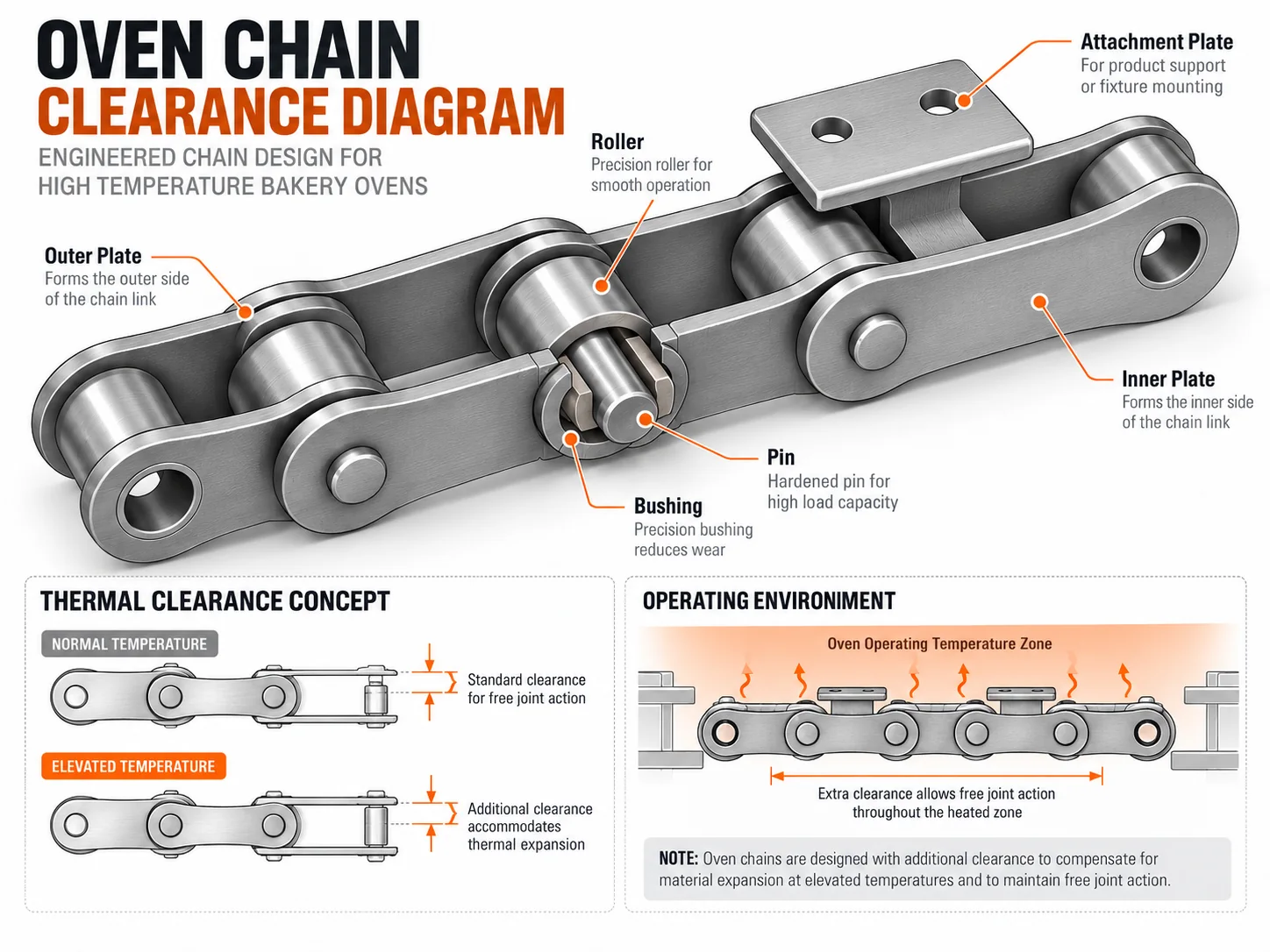
Prima di rimuovere la catena, è necessario misurare diverse caratteristiche. Il passo definisce il rapporto di trasmissione di base, mentre la larghezza interna, il diametro del rullo o della boccola, il diametro del perno, l'altezza della piastra, la larghezza complessiva e le dimensioni di fissaggio distinguono le configurazioni che possono condividere lo stesso passo nominale.
Per valutare l'usura di una catena, misurare il passo cumulativo su più maglie. Fotografare la catena lateralmente e dall'estremità, includendo il pignone se possibile.
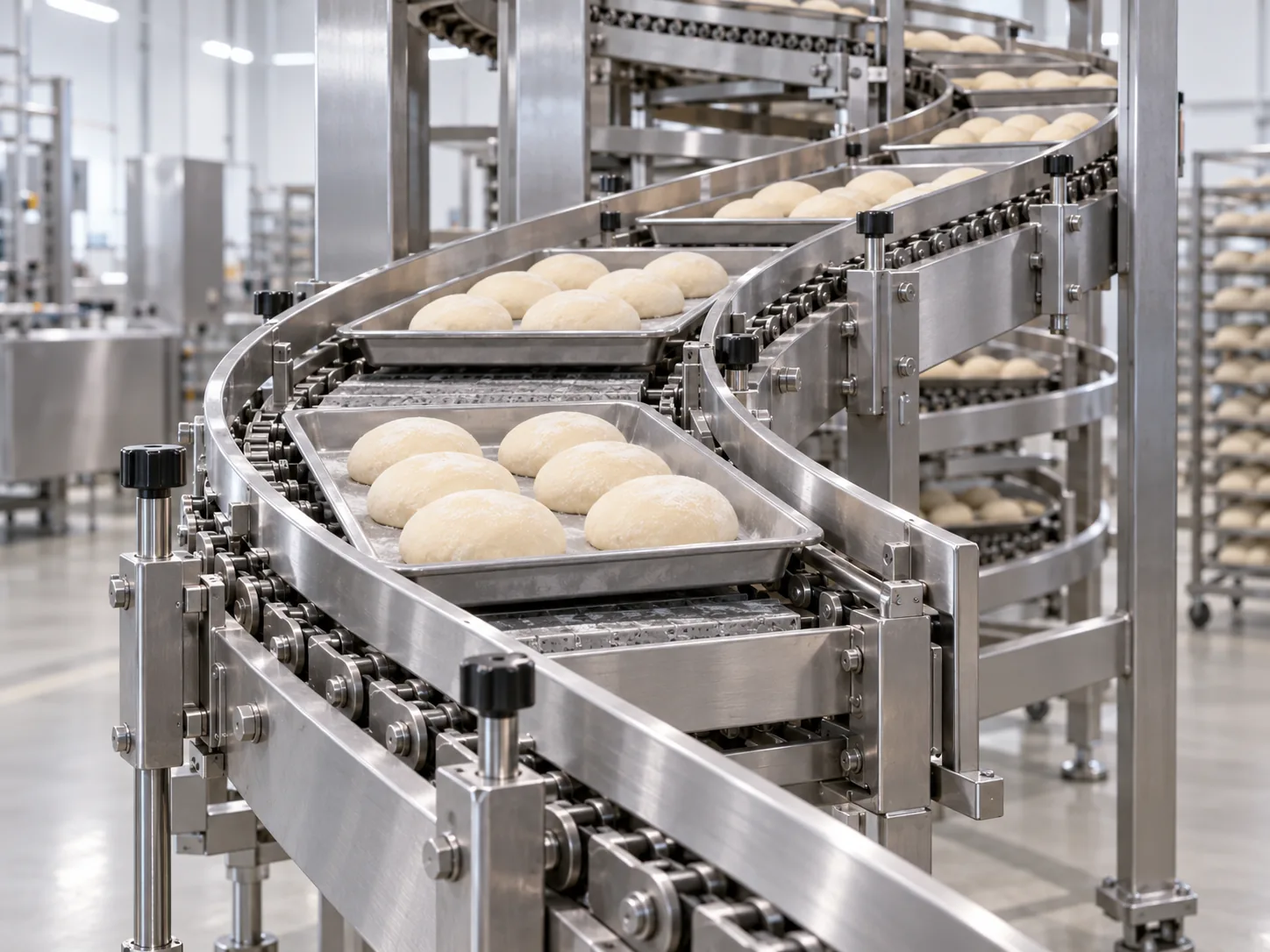
The same chain geometry can behave differently in a humid proofer, a hot oven, an ambient cooling section or a washdown area. For material selection for bakery conveyor components, document the exact machine zone, whether the chain carries product directly or moves pans/fixtures, and whether the joint sees heat, moisture, cleaning chemicals or abrasive residue.
I dati di processo aiutano a determinare quali caratteristiche sono fisse per intercambiabilità e quali caratteristiche, come il materiale, il gioco o il metodo di fabbricazione dell'attacco, devono essere riviste per l'applicazione.
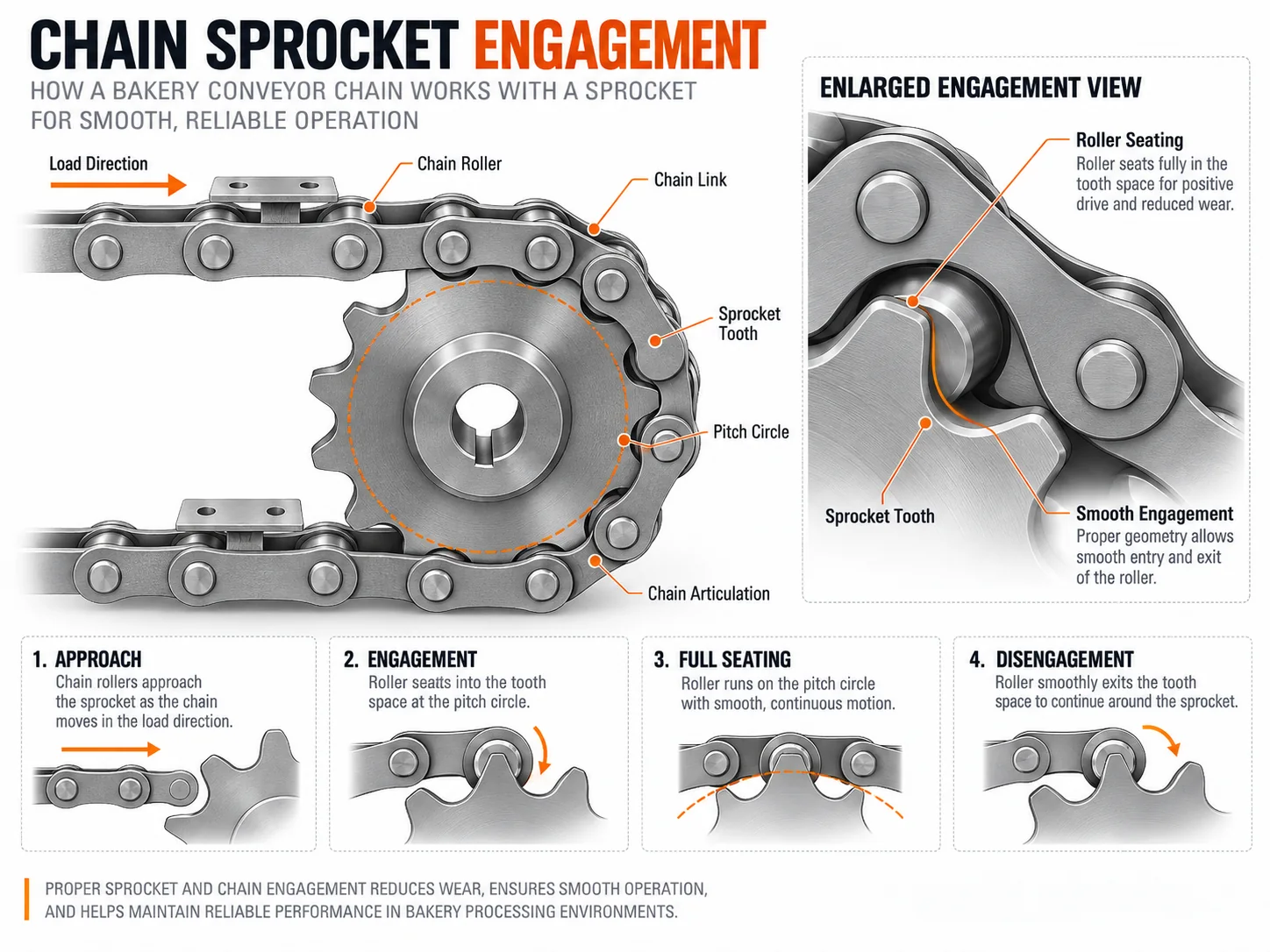
Una catena non funziona in modo indipendente. Rulli o boccole devono entrare e uscire agevolmente dagli spazi dei denti della ruota dentata, mentre le guide sostengono il filo senza forzarlo lateralmente. Denti uncinati, disallineamento dell'albero, ruote dentate eccentriche o una guida troppo stretta possono causare una rapida usura di una catena nuova.
Ispezionare l'intero percorso attraverso un circuito completo. Se il danno si ripete nello stesso punto della macchina, esaminare il supporto, il trasferimento o il trasportatore locali prima di presumere che la catena stessa sia difettosa.
Passo, larghezza, rullo/boccola, perno, piastra, larghezza complessiva e schema di fissaggio.
Temperatura, umidità, lavaggio, velocità, carico, ore di produzione e avvii.
Pignoni, guide, centri catena, tendicatena, allineamento e giochi del portacatena.
Prima dell'installazione, approvare la geometria finale, i materiali e la configurazione specifica per l'applicazione.
Chiedete cosa è cambiato prima che si presentasse il problema: velocità di produzione, peso del prodotto o della vasca, ciclo di pulizia, lubrificante, temperatura, intervallo di manutenzione o ingranaggi sostituiti. Le informazioni sulle tendenze sono più preziose di una singola fotografia perché mostrano se l'usura è uniforme o concentrata.
Durante le ispezioni di routine, verificare la presenza di giunzioni rigide, usura dei rulli, movimento dei perni, attacchi incrinati o piegati, contatti laterali anomali e avvolgimento irregolare. Mantenere le protezioni e le procedure di sicurezza in vigore secondo le indicazioni del proprietario della macchina.
Includere le dimensioni misurate, il nome della macchina/processo, le foto, il disegno se disponibile, la quantità o la lunghezza della catena richiesta, l'intervallo di fissaggio, la spaziatura tra i centri della catena, le informazioni sul pignone, la temperatura, le condizioni di lavaggio, il carico e la finestra di consegna prevista. Rivedere il Guida alla selezione delle catene di panetterie e il Panoramica della famiglia di prodotti per la prossima fase decisionale.
A useful diagnosis starts with evidence that can be repeated by a second person. matching material to the function of pins, bushes, rollers, plates, attachments and surrounding guides. Record contact stress, sliding/rolling wear, temperature, corrosion exposure, geometry and maintenance. When the chain is worn, note which readings may be influenced by joint clearance or deformation, and prefer multi-pitch or multi-point measurements over one isolated dimension.
The chain does not operate by itself. In bakery conveyors with mixed mechanical and environmental demands, inspect the sprockets, guides, return path, take-up and carrier interface at the same time. The symptom to watch is one material choice solving corrosion but creating wear or galling elsewhere. A local problem that repeats at one machine position often points to alignment, clearance or mating-hardware issues rather than a uniform chain problem.
The practical decision is to evaluate each component interface and its failure mode instead of specifying a single material generically. That prevents a common error: changing chain tension, material or size before the root constraint has been identified. Use the chain drawing and the machine envelope together, because a configuration that looks correct in isolation can still interfere with a guard, transfer plate, sensor bracket or carrier.
Descrivete il ciclo operativo anziché utilizzare un singolo aggettivo come "caldo", "umido" o "per uso alimentare". Indicate la temperatura normale e quella di picco, ove pertinente, l'esposizione all'umidità o alla pulizia, la velocità, il comportamento di avvio/arresto e i limiti di lubrificazione. Questi dettagli sono fondamentali per determinare se è necessario modificare le tolleranze, i materiali o le procedure di manutenzione, pur mantenendo invariata la geometria di base.
| Controllo | Perché è importante | Cosa inviare o verificare |
|---|---|---|
| Identificazione | Confirm contact stress, sliding/rolling wear, temperature, corrosion exposure, geometry and maintenance. Use a measurement sequence that can be repeated after removal so the installed and bench readings can be compared. | Schizzo quotato, foto in scala e qualsiasi disegno preesistente o codice articolo. |
| Posizione del percorso | Map where the chain runs through bakery conveyors with mixed mechanical and environmental demands. Mark the exact location of one material choice solving corrosion but creating wear or galling elsewhere instead of reporting the condition only as a whole-line problem. | Foto di contesto che mostra la sezione del nastro trasportatore, le posizioni di azionamento/coda e il percorso di ritorno. |
| Parti di accoppiamento | Controllare il profilo del dente, la sede del rullo, l'allineamento albero/pignone, il contatto di guida e la riserva di tensionamento. Queste parti possono creare modelli di usura che simulano un problema di selezione della catena. | Conteggio e foto dei denti della ruota dentata, schema di guida e posizione attuale del tenditore. |
| Percorso di caricamento | Identify how product carriers, pans, rods or fixtures transfer load into the chain. For this topic, the key focus is matching material to the function of pins, bushes, rollers, plates, attachments and surrounding guides. | Disegno del supporto, intervallo di fissaggio, spaziatura tra i centri delle catene e massa/forza supportata, ove noti. |
| Ambiente | Registrare temperatura, umidità, lavaggi, contaminazione e restrizioni di lubrificazione per ciascuna zona della macchina. Distinguere l'esposizione continua dai picchi brevi o dagli interventi di pulizia. | Riepilogo delle condizioni operative e delle procedure di manutenzione e lubrificazione. |
| Pubblicazione | The final engineering action is to evaluate each component interface and its failure mode instead of specifying a single material generically. The approved drawing should distinguish fixed interchange dimensions from selectable options. | component function, duty, environment, drawing and required material documentation. |
A uniform change along the whole strand suggests a different mechanism from damage concentrated at one sprocket, guide or transfer. For Material Selection for Bakery Conveyor Components, compare left/right sides and loaded/return paths. The distribution of wear can reveal whether the driver is joint wear, side loading, contamination, thermal change or a carrier that is forcing the chain out of its natural path.
Increasing tension can temporarily change noise or tracking without correcting the underlying cause. If the observed issue is one material choice solving corrosion but creating wear or galling elsewhere, first confirm alignment, take-up geometry and articulation. Excessive tension can add bearing load and make a marginal guide or attachment problem worse.
Le attrezzature da forno possono passare da uno stato di produzione a uno di pulizia e a uno di arresto. Una catena può funzionare normalmente a freddo e bloccarsi quando viene riscaldata, oppure scorrere liberamente durante la produzione ma corrodersi dopo ripetuti arresti dovuti all'umidità. Registrare lo stato in cui si verifica il sintomo in modo che l'azione correttiva selezionata sia mirata al reale ciclo di lavoro.
For an unknown chain, one close-up is not enough. Pair a complete machine-zone image with side and end views of several pitches, a sprocket-engagement photo and a clear attachment/carrier view. Place a scale only where it does not hide the feature being measured. This photo set makes matching material to the function of pins, bushes, rollers, plates, attachments and surrounding guides easier to evaluate remotely.
Record contact stress, sliding/rolling wear, temperature, corrosion exposure, geometry and maintenance, chain centers, sprocket tooth count and the carrier interface before changing components.
Describe what happens in bakery conveyors with mixed mechanical and environmental demands, including temperature or moisture changes, speed, load and cleaning/lubrication constraints.
Document where one material choice solving corrosion but creating wear or galling elsewhere appears. Compare drive, tail, loaded run, return run and transfer points rather than averaging the entire conveyor.
Include component function, duty, environment, drawing and required material documentation. State the required quantity or chain length and any documentation needed with the order.
Review pitch, widths, pin/roller geometry, attachments and material notes on one controlled drawing revision. For Material Selection for Bakery Conveyor Components, the release decision should explicitly address matching material to the function of pins, bushes, rollers, plates, attachments and surrounding guides.
Dopo l'installazione, osservare almeno un giro completo, verificare l'ingresso/uscita del pignone e il gioco del portacatena, e ricontrollare il tensionamento secondo la procedura del costruttore della macchina. Non utilizzare una catena nuova per compensare componenti usurati o disallineati.
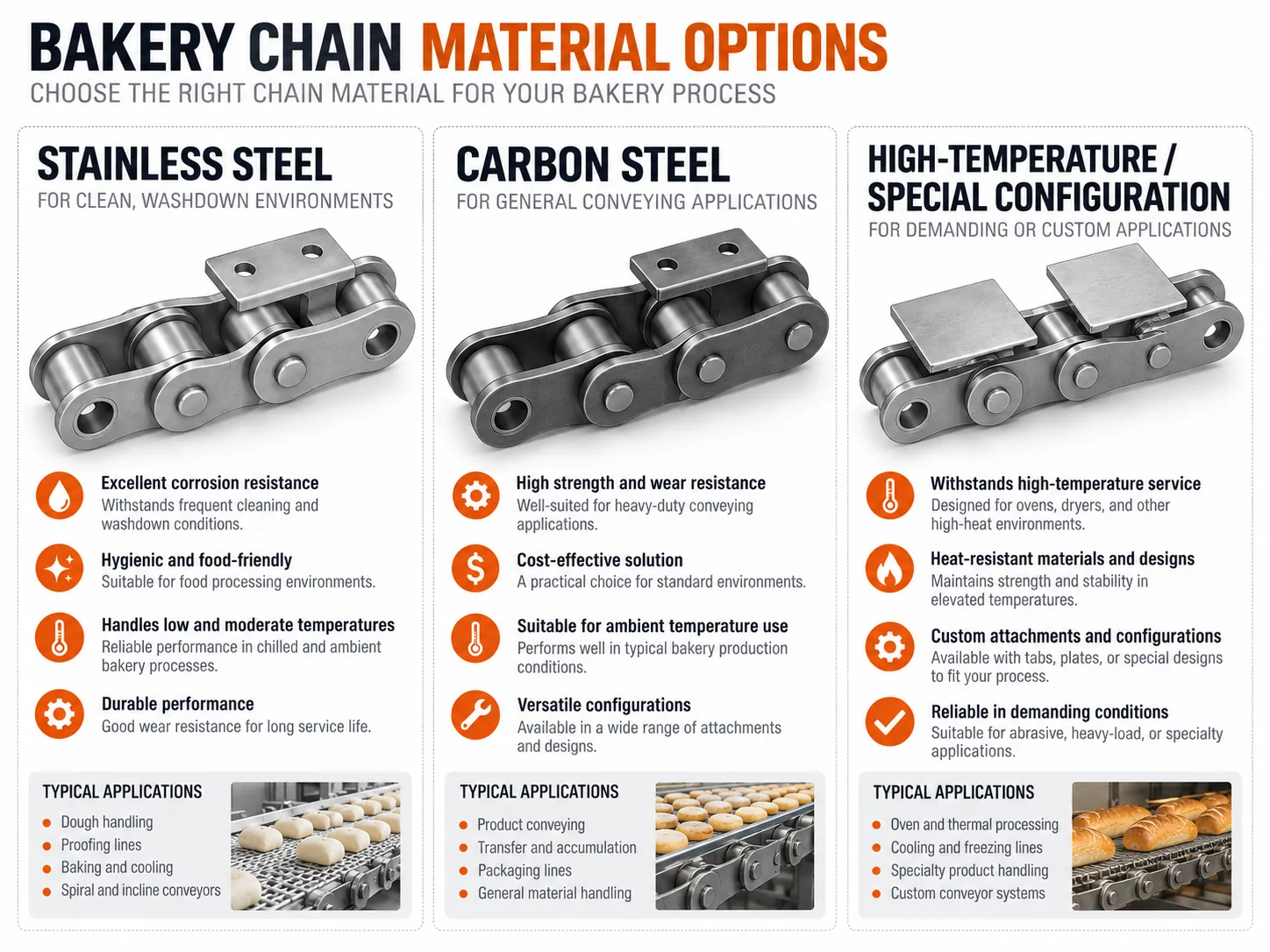
The main reason to keep this process structured is that matching material to the function of pins, bushes, rollers, plates, attachments and surrounding guides interacts with more than one component. A change that improves one symptom can shift load into another part of the mechanism. For example, correcting guide alignment may reduce side wear but also expose a take-up setting that was previously compensating for the misalignment. Record changes one at a time so the result can be interpreted.
For planned maintenance, compare the present condition with a baseline whenever one exists. If there is no baseline, create one during the next shutdown: photograph the sprockets and guide surfaces, record take-up position, measure a defined number of pitches, and note the chain’s location in bakery conveyors with mixed mechanical and environmental demands. Repeating the same observations later is more informative than relying on general statements such as “the chain has stretched.”
Quando è disponibile un disegno esistente, verificare che l'hardware installato corrisponda ancora a esso. Le attrezzature per panifici vengono spesso modificate nel corso della loro vita utile: i supporti possono essere riparati, le guide spostate, le ruote dentate sostituite e gli intervalli di fissaggio modificati. Il disegno rimane utile, ma la verifica sul campo impedisce che un documento storico venga considerato prova della configurazione attuale.
Procurement and engineering should use the same evidence package. The RFQ should not separate commercial quantity from technical context: component function, duty, environment, drawing and required material documentation. This makes it possible to judge whether a standard series, a modified attachment or a custom replacement is the appropriate route without creating unnecessary back-and-forth.
Finally, treat the website as a preparation tool rather than the controlling product drawing. Measurements and diagrams narrow the family and help organize the RFQ; the released drawing defines the ordered configuration. That distinction is especially important where one material choice solving corrosion but creating wear or galling elsewhere could have more than one mechanical cause.
Use Material Selection for Bakery Conveyor Components as a machine-level question, not just a chain inspection. Compare the loaded and return runs, drive and tail ends, and any transfer or carrier transition in bakery conveyors with mixed mechanical and environmental demands. Document whether one material choice solving corrosion but creating wear or galling elsewhere is distributed along the strand or repeats at one location. That pattern helps separate progressive joint wear from alignment, guide, sprocket or carrier problems that a new chain alone will not correct.
The working record should include contact stress, sliding/rolling wear, temperature, corrosion exposure, geometry and maintenance. Mark which values are fixed by the existing machine and which values can be changed to improve service. The central engineering focus is matching material to the function of pins, bushes, rollers, plates, attachments and surrounding guides. When a legacy part number conflicts with field measurements, hold the RFQ until the installed interface and the controlled drawing can be reconciled.
A useful enquiry combines commercial quantity with the technical package: component function, duty, environment, drawing and required material documentation. Also state whether the request is a direct replacement, a planned modification or a new machine design. The release objective is to evaluate each component interface and its failure mode instead of specifying a single material generically. This reduces quote revisions and prevents a visually similar chain from being treated as interchangeable before geometry and duty have been checked.
Se disponibile, utilizzare il vecchio riferimento, ma verificare la geometria e il funzionamento installati. Modifiche alla macchina, precedenti sostituzioni o usura possono rendere incompleto un codice articolo.
Utilizzare una misurazione a passo multiplo su un numero pratico di collegamenti e registrare il metodo. Confrontare il risultato con il passo nominale e i limiti di manutenzione della macchina, anziché affidarsi a una singola misurazione su un collegamento adiacente.
Ogni qualvolta si verificano usura dei denti, agganci, problemi di allineamento o ripetuta usura prematura della catena. La catena e il pignone lavorano come un sistema di ingranaggi.