Géométrie des enregistrements
Pas, largeur, rouleau/bague, goupille, plaque, largeur totale et schéma de fixation.
Guide technique des chaînes de boulangeries
When Should a Bakery Oven Chain Be Replaced is best answered by combining measured chain geometry, machine duty and the operating environment. This guide shows what to inspect, record and discuss before a replacement or new-chain decision.
When Should a Bakery Oven Chain Be Replaced should be evaluated from the actual conveyor. Start with chain pitch, transverse geometry, sprocket condition and any carrier attachment, then add temperature, moisture, washdown, load, speed and take-up information. The objective is not to identify a chain by appearance; it is to produce an RFQ that preserves the machine interface and makes application-dependent choices explicit.
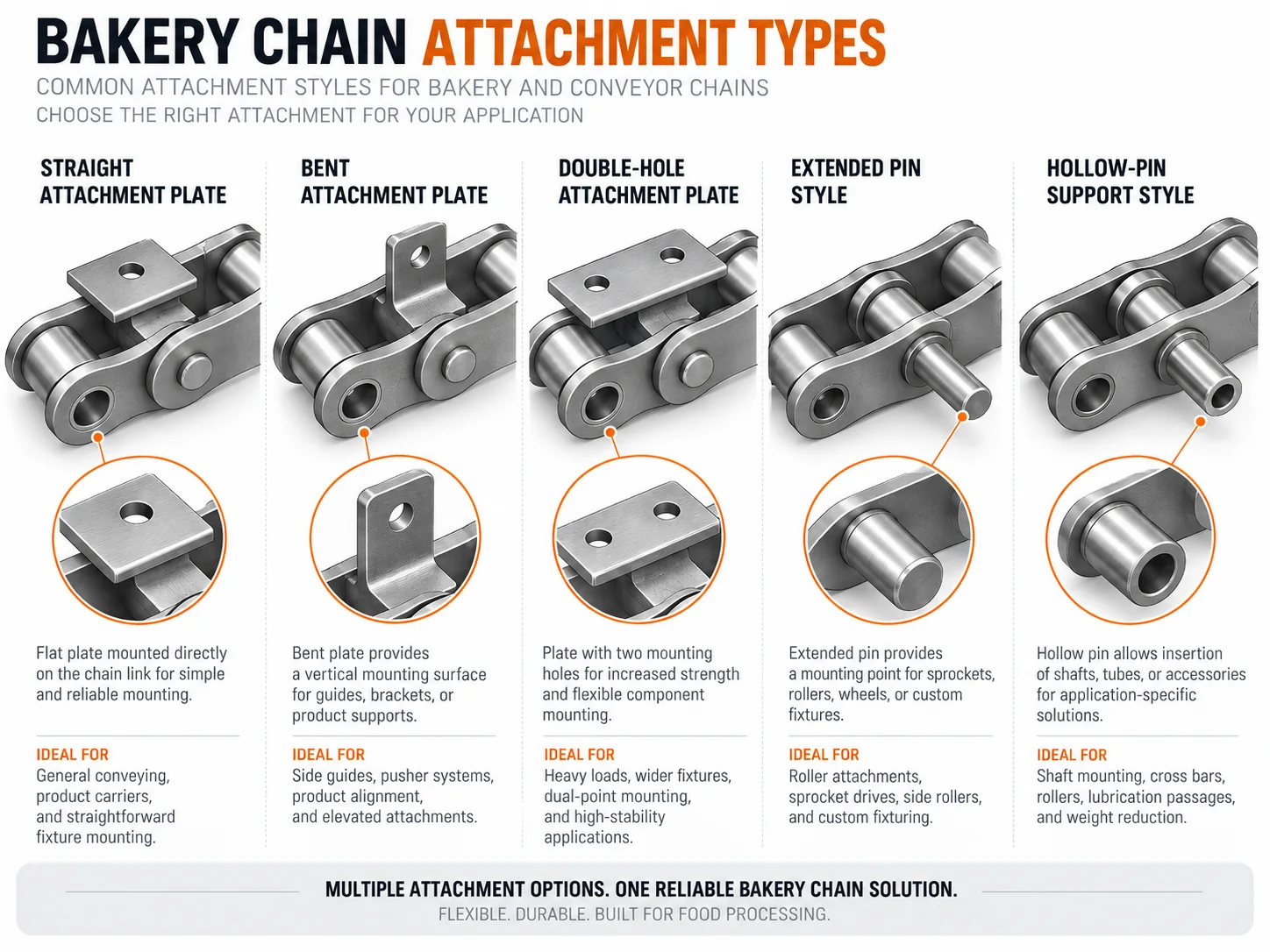
Mesurez plusieurs caractéristiques avant de retirer la chaîne. Le pas détermine le rapport d'engrenage de base, mais la largeur intérieure, le diamètre du rouleau ou de la bague, le diamètre de l'axe, la hauteur de la plaque, la largeur totale et les dimensions de fixation permettent de distinguer les configurations pouvant partager le même pas nominal.
Pour un maillon usé, mesurez le pas cumulé sur plusieurs maillons. Photographiez la chaîne de profil et d'extrémité, et incluez le pignon si possible.
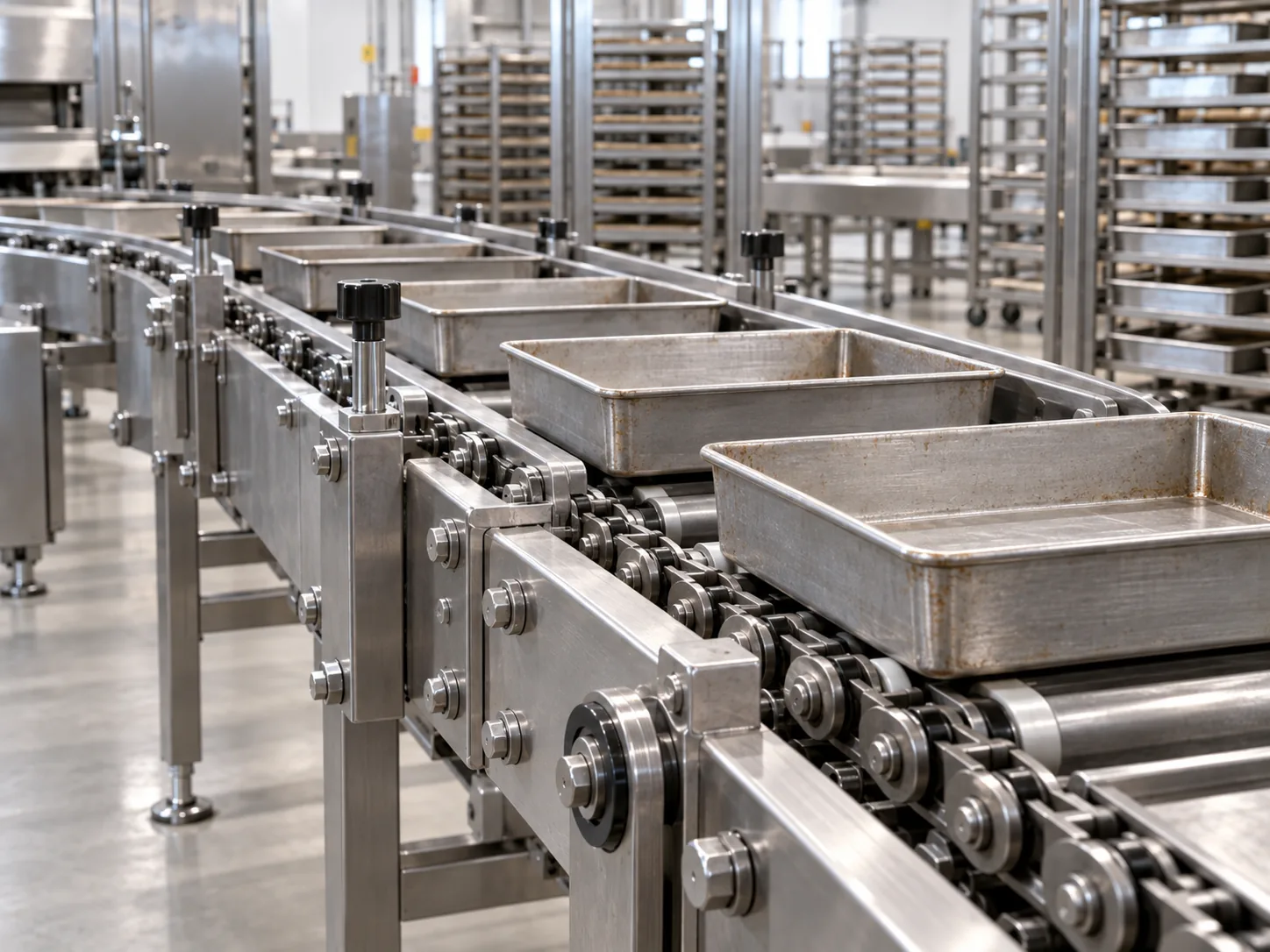
The same chain geometry can behave differently in a humid proofer, a hot oven, an ambient cooling section or a washdown area. For when should a bakery oven chain be replaced, document the exact machine zone, whether the chain carries product directly or moves pans/fixtures, and whether the joint sees heat, moisture, cleaning chemicals or abrasive residue.
Les données de processus permettent de déterminer quelles caractéristiques sont fixes du fait de l'interchangeabilité et quelles caractéristiques, telles que le matériau, le jeu ou la méthode de fabrication de la fixation, doivent être examinées pour l'application.
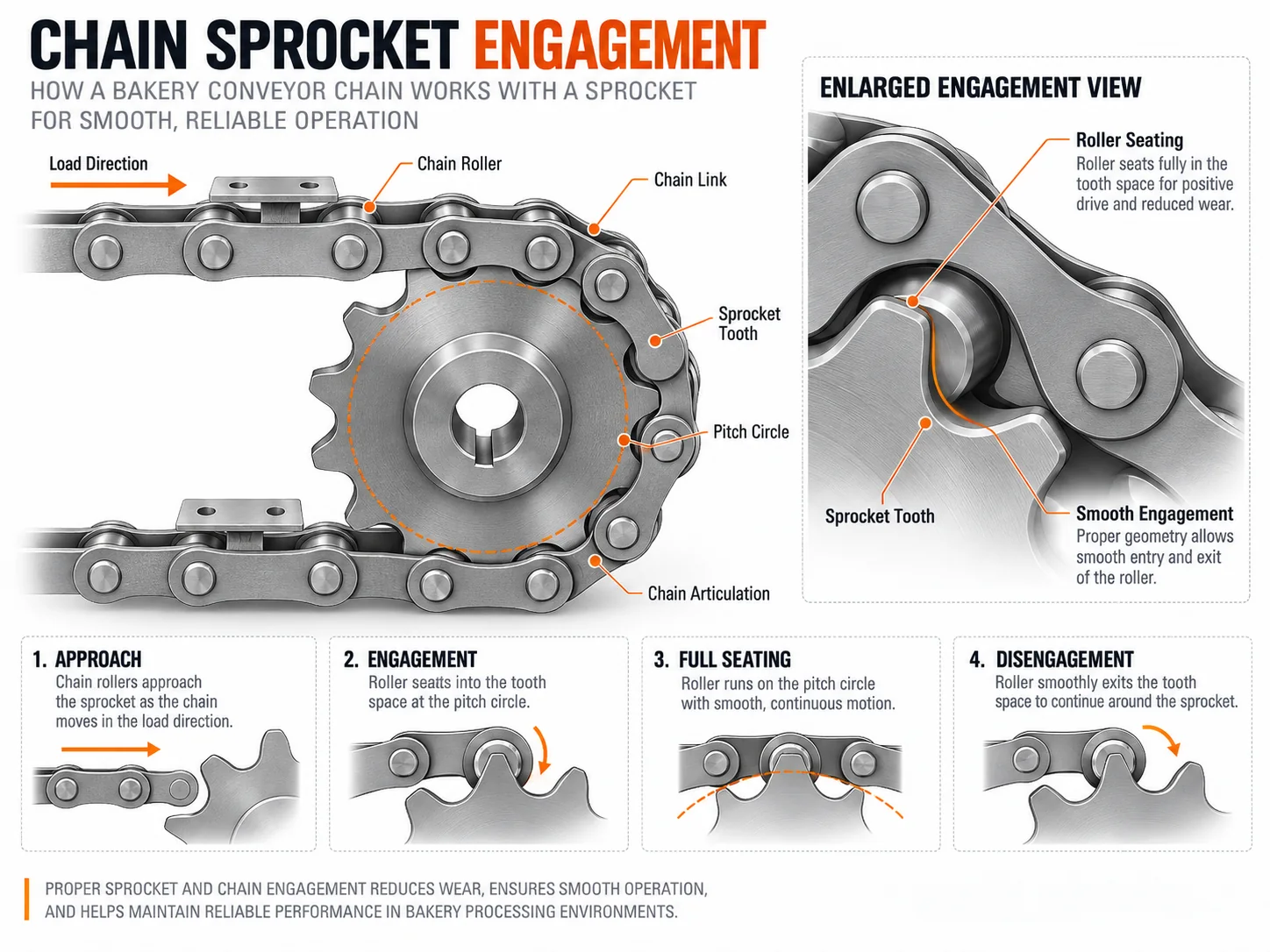
Une chaîne ne fonctionne pas de manière isolée. Les galets ou les bagues doivent s'insérer et se retirer des dents du pignon en douceur, tandis que les guides maintiennent le brin sans le contraindre latéralement. Des dents crochues, un mauvais alignement de l'arbre, des pignons excentrés ou un guide trop serré peuvent entraîner une usure rapide d'une chaîne neuve.
Inspectez le circuit complet. Si les dommages se reproduisent au même endroit sur la machine, examinez le support, le transfert ou le transporteur local avant de conclure à un défaut de la chaîne elle-même.
Pas, largeur, rouleau/bague, goupille, plaque, largeur totale et schéma de fixation.
Température, humidité, lavage, vitesse, charge, heures de production et démarrages.
Pignons, guides, centres de chaîne, tension, alignement et jeux du porte-chaîne.
Approuver la géométrie finale, les matériaux et la configuration dépendante de l'application avant l'installation.
Demandez ce qui a changé avant l'apparition du problème : cadence de production, poids du produit ou de la cuve, cycle de nettoyage, lubrifiant, température, intervalle de maintenance ou remplacement des pignons. Les tendances sont plus précieuses qu'une simple photo, car elles permettent de déterminer si l'usure est uniforme ou concentrée.
Lors de l'inspection de routine, vérifiez la présence de grippages au niveau des articulations, l'usure des rouleaux, le mouvement des axes, les fixations fissurées ou tordues, les contacts latéraux anormaux et l'enroulement irrégulier. Maintenez en place les dispositifs de protection et les procédures de sécurité conformément aux exigences du propriétaire de la machine.
Inclure les dimensions mesurées, le nom de la machine/du processus, des photos, un dessin si disponible, la quantité ou la longueur de chaîne requise, l'intervalle de fixation, l'entraxe de la chaîne, les informations sur le pignon, la température, les conditions de lavage, la charge et la plage horaire de livraison prévue. Examiner le guide de sélection des chaînes de boulangeries et le Aperçu de la gamme de produits pour la prochaine étape de décision.
A useful diagnosis starts with evidence that can be repeated by a second person. combining wear measurements with functional evidence and remaining adjustment range. Record multi-pitch elongation, joint articulation, take-up reserve, tooth wear and carrier timing. When the chain is worn, note which readings may be influenced by joint clearance or deformation, and prefer multi-pitch or multi-point measurements over one isolated dimension.
The chain does not operate by itself. In continuous ovens approaching maintenance shutdown, inspect the sprockets, guides, return path, take-up and carrier interface at the same time. The symptom to watch is loss of adjustment, persistent tight joints, irregular sprocket seating or repeated breakage. A local problem that repeats at one machine position often points to alignment, clearance or mating-hardware issues rather than a uniform chain problem.
The practical decision is to replace when measured wear and system behavior show that safe, stable operation cannot be restored by alignment or maintenance. That prevents a common error: changing chain tension, material or size before the root constraint has been identified. Use the chain drawing and the machine envelope together, because a configuration that looks correct in isolation can still interfere with a guard, transfer plate, sensor bracket or carrier.
Décrivez le cycle de fonctionnement plutôt que d'utiliser un seul adjectif comme « chaud », « humide » ou « alimentaire ». Indiquez la température normale et la température maximale le cas échéant, l'exposition à l'humidité ou au nettoyage, la vitesse, le comportement au démarrage et à l'arrêt, ainsi que les limitations de lubrification. Ces détails déterminent si les jeux, les matériaux ou les pratiques de maintenance doivent être modifiés, la géométrie de base restant inchangée.
| Vérifier | Pourquoi c'est important | Que faut-il envoyer ou vérifier ? |
|---|---|---|
| Identification | Confirm multi-pitch elongation, joint articulation, take-up reserve, tooth wear and carrier timing. Use a measurement sequence that can be repeated after removal so the installed and bench readings can be compared. | Croquis coté, photos à l'échelle et tout dessin ou numéro de pièce existant. |
| Position de l'itinéraire | Map where the chain runs through continuous ovens approaching maintenance shutdown. Mark the exact location of loss of adjustment, persistent tight joints, irregular sprocket seating or repeated breakage instead of reporting the condition only as a whole-line problem. | Photo de contexte montrant la section du convoyeur, les positions d'entraînement/de queue et le chemin de retour. |
| Pièces d'accouplement | Vérifiez le profil des dents, le logement des rouleaux, l'alignement arbre/pignon, le contact du guide et la marge de tension. Ces éléments peuvent présenter des signes d'usure similaires à un problème de sélection de la chaîne. | Nombre de dents du pignon et photos, disposition du guide et position de prise actuelle. |
| Chemin de chargement | Identify how product carriers, pans, rods or fixtures transfer load into the chain. For this topic, the key focus is combining wear measurements with functional evidence and remaining adjustment range. | Dessin du support, intervalle de fixation, espacement des centres de chaîne et masse/force supportée lorsque ces informations sont connues. |
| Environnement | Consignez la température, l'humidité, le lavage, la contamination et les restrictions de lubrification par zone de la machine. Distinguez l'exposition continue des pics ponctuels ou des opérations de nettoyage. | Résumé des conditions de fonctionnement et pratiques d'entretien/lubrification. |
| Libérer | The final engineering action is to replace when measured wear and system behavior show that safe, stable operation cannot be restored by alignment or maintenance. The approved drawing should distinguish fixed interchange dimensions from selectable options. | wear record, sprocket condition, take-up position, chain dimensions, duty cycle and quantity. |
A uniform change along the whole strand suggests a different mechanism from damage concentrated at one sprocket, guide or transfer. For When Should a Bakery Oven Chain Be Replaced?, compare left/right sides and loaded/return paths. The distribution of wear can reveal whether the driver is joint wear, side loading, contamination, thermal change or a carrier that is forcing the chain out of its natural path.
Increasing tension can temporarily change noise or tracking without correcting the underlying cause. If the observed issue is loss of adjustment, persistent tight joints, irregular sprocket seating or repeated breakage, first confirm alignment, take-up geometry and articulation. Excessive tension can add bearing load and make a marginal guide or attachment problem worse.
Les équipements de boulangerie peuvent passer par différentes phases : production, nettoyage et arrêt. Une chaîne peut fonctionner normalement à froid et se bloquer à chaud, ou encore tourner librement pendant la production mais se corroder après des arrêts répétés pour cause d'humidité. Il est important de consigner l'état dans lequel le problème se manifeste afin que l'action corrective choisie soit adaptée au cycle de fonctionnement réel.
For an unknown chain, one close-up is not enough. Pair a complete machine-zone image with side and end views of several pitches, a sprocket-engagement photo and a clear attachment/carrier view. Place a scale only where it does not hide the feature being measured. This photo set makes combining wear measurements with functional evidence and remaining adjustment range easier to evaluate remotely.
Record multi-pitch elongation, joint articulation, take-up reserve, tooth wear and carrier timing, chain centers, sprocket tooth count and the carrier interface before changing components.
Describe what happens in continuous ovens approaching maintenance shutdown, including temperature or moisture changes, speed, load and cleaning/lubrication constraints.
Document where loss of adjustment, persistent tight joints, irregular sprocket seating or repeated breakage appears. Compare drive, tail, loaded run, return run and transfer points rather than averaging the entire conveyor.
Include wear record, sprocket condition, take-up position, chain dimensions, duty cycle and quantity. State the required quantity or chain length and any documentation needed with the order.
Review pitch, widths, pin/roller geometry, attachments and material notes on one controlled drawing revision. For When Should a Bakery Oven Chain Be Replaced?, the release decision should explicitly address combining wear measurements with functional evidence and remaining adjustment range.
Après l'installation, effectuez au moins un tour complet, vérifiez l'entrée/sortie du pignon et le jeu du porte-satellites, puis revérifiez la tension de la chaîne conformément aux instructions du fabricant. N'utilisez pas de chaîne neuve pour compenser des pièces usées ou mal alignées.
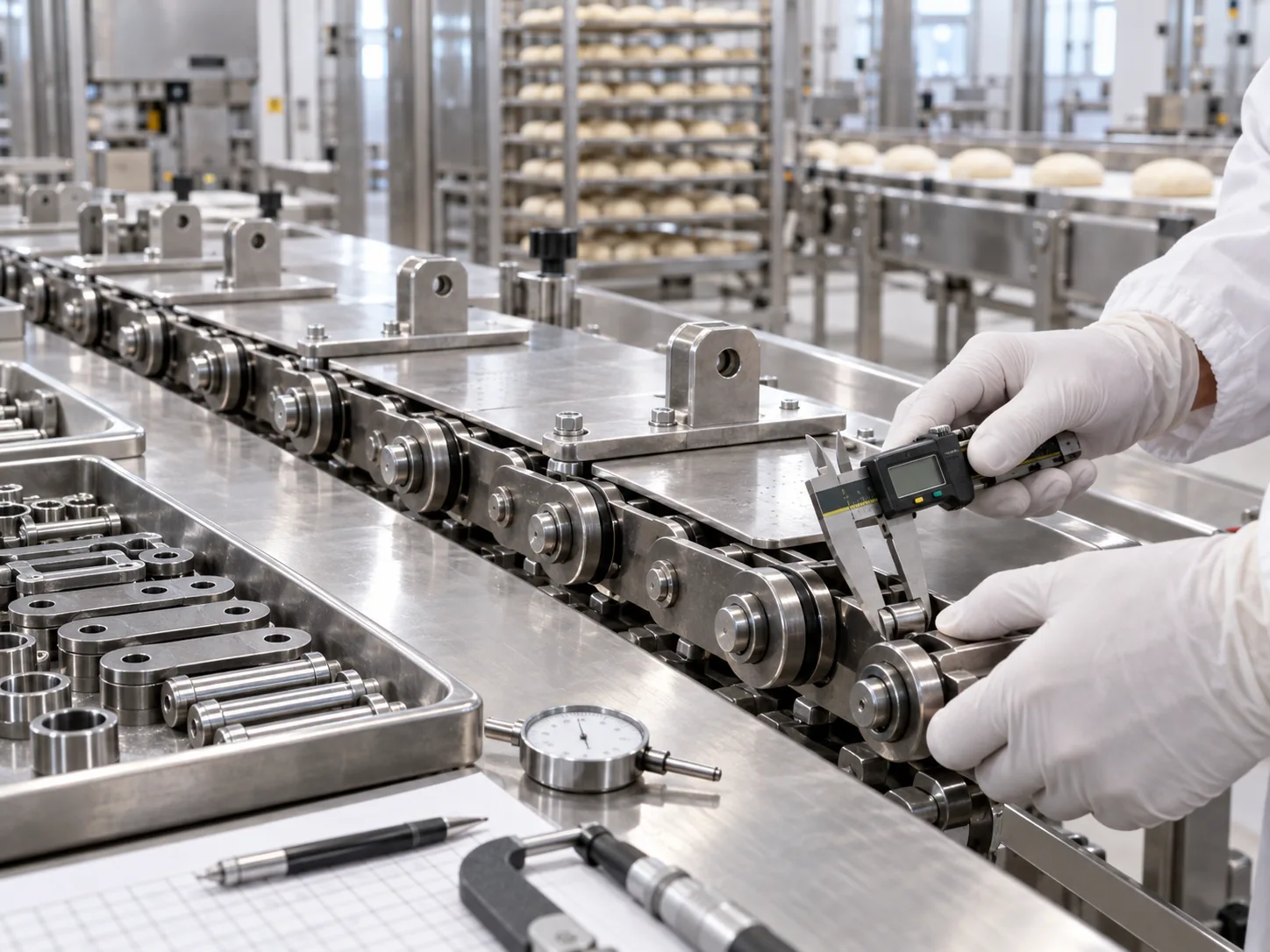
The main reason to keep this process structured is that combining wear measurements with functional evidence and remaining adjustment range interacts with more than one component. A change that improves one symptom can shift load into another part of the mechanism. For example, correcting guide alignment may reduce side wear but also expose a take-up setting that was previously compensating for the misalignment. Record changes one at a time so the result can be interpreted.
For planned maintenance, compare the present condition with a baseline whenever one exists. If there is no baseline, create one during the next shutdown: photograph the sprockets and guide surfaces, record take-up position, measure a defined number of pitches, and note the chain’s location in continuous ovens approaching maintenance shutdown. Repeating the same observations later is more informative than relying on general statements such as “the chain has stretched.”
Lorsqu'un schéma existant est disponible, vérifiez que le matériel installé y correspond toujours. Les équipements de boulangerie sont souvent modifiés au cours de leur durée de vie : les chariots peuvent être réparés, les rails de guidage déplacés, les pignons remplacés et les intervalles de fixation modifiés. Le schéma reste utile, mais une vérification sur le terrain permet d'éviter qu'un document ancien ne soit considéré comme une preuve de la configuration actuelle.
Procurement and engineering should use the same evidence package. The RFQ should not separate commercial quantity from technical context: wear record, sprocket condition, take-up position, chain dimensions, duty cycle and quantity. This makes it possible to judge whether a standard series, a modified attachment or a custom replacement is the appropriate route without creating unnecessary back-and-forth.
Finally, treat the website as a preparation tool rather than the controlling product drawing. Measurements and diagrams narrow the family and help organize the RFQ; the released drawing defines the ordered configuration. That distinction is especially important where loss of adjustment, persistent tight joints, irregular sprocket seating or repeated breakage could have more than one mechanical cause.
Use When Should a Bakery Oven Chain Be Replaced? as a machine-level question, not just a chain inspection. Compare the loaded and return runs, drive and tail ends, and any transfer or carrier transition in continuous ovens approaching maintenance shutdown. Document whether loss of adjustment, persistent tight joints, irregular sprocket seating or repeated breakage is distributed along the strand or repeats at one location. That pattern helps separate progressive joint wear from alignment, guide, sprocket or carrier problems that a new chain alone will not correct.
The working record should include multi-pitch elongation, joint articulation, take-up reserve, tooth wear and carrier timing. Mark which values are fixed by the existing machine and which values can be changed to improve service. The central engineering focus is combining wear measurements with functional evidence and remaining adjustment range. When a legacy part number conflicts with field measurements, hold the RFQ until the installed interface and the controlled drawing can be reconciled.
A useful enquiry combines commercial quantity with the technical package: wear record, sprocket condition, take-up position, chain dimensions, duty cycle and quantity. Also state whether the request is a direct replacement, a planned modification or a new machine design. The release objective is to replace when measured wear and system behavior show that safe, stable operation cannot be restored by alignment or maintenance. This reduces quote revisions and prevents a visually similar chain from being treated as interchangeable before geometry and duty have been checked.
Utilisez l'ancienne référence si elle est disponible, mais vérifiez la géométrie et le fonctionnement de la pièce installée. Des modifications de la machine, des substitutions antérieures ou l'usure peuvent rendre une référence de pièce seule incomplète.
Effectuez une mesure à pas multiple sur un nombre suffisant de maillons et consignez la méthode. Comparez-la au pas nominal et aux limites d'entretien de la machine plutôt que de vous fier à une seule mesure sur un maillon adjacent.
En cas d'usure des dents, d'accrochage, de problèmes d'alignement ou d'usure prématurée répétée de la chaîne, celle-ci et le pignon fonctionnent comme un système d'engrènement.