Geometria de registro
Passo, largura, rolete/bucha, pino, placa, largura total e padrão de fixação.
Guia Técnico da Cadeia de Padarias
How Thermal Expansion Affects Oven Chains is best answered by combining measured chain geometry, machine duty and the operating environment. This guide shows what to inspect, record and discuss before a replacement or new-chain decision.
How Thermal Expansion Affects Oven Chains should be evaluated from the actual conveyor. Start with chain pitch, transverse geometry, sprocket condition and any carrier attachment, then add temperature, moisture, washdown, load, speed and take-up information. The objective is not to identify a chain by appearance; it is to produce an RFQ that preserves the machine interface and makes application-dependent choices explicit.
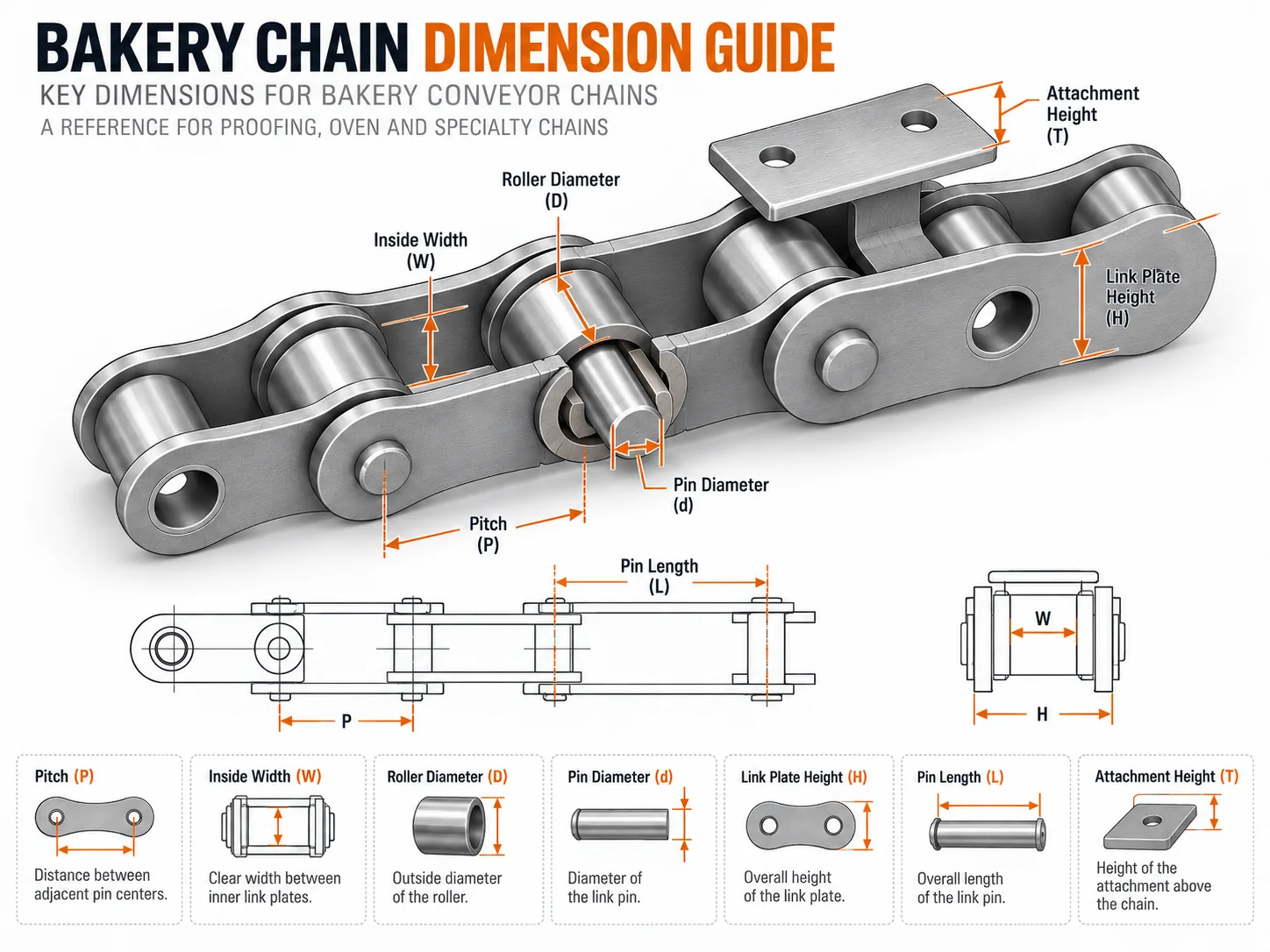
Meça diversas características antes de remover a corrente. O passo determina a relação básica de engrenagem, mas a largura interna, o diâmetro do rolete ou da bucha, o diâmetro do pino, a altura da placa, a largura total e as dimensões de fixação distinguem configurações que podem compartilhar o mesmo passo nominal.
Para uma corrente desgastada, meça o passo cumulativo em vários elos. Fotografe a corrente de lado e da extremidade, incluindo a roda dentada sempre que possível.
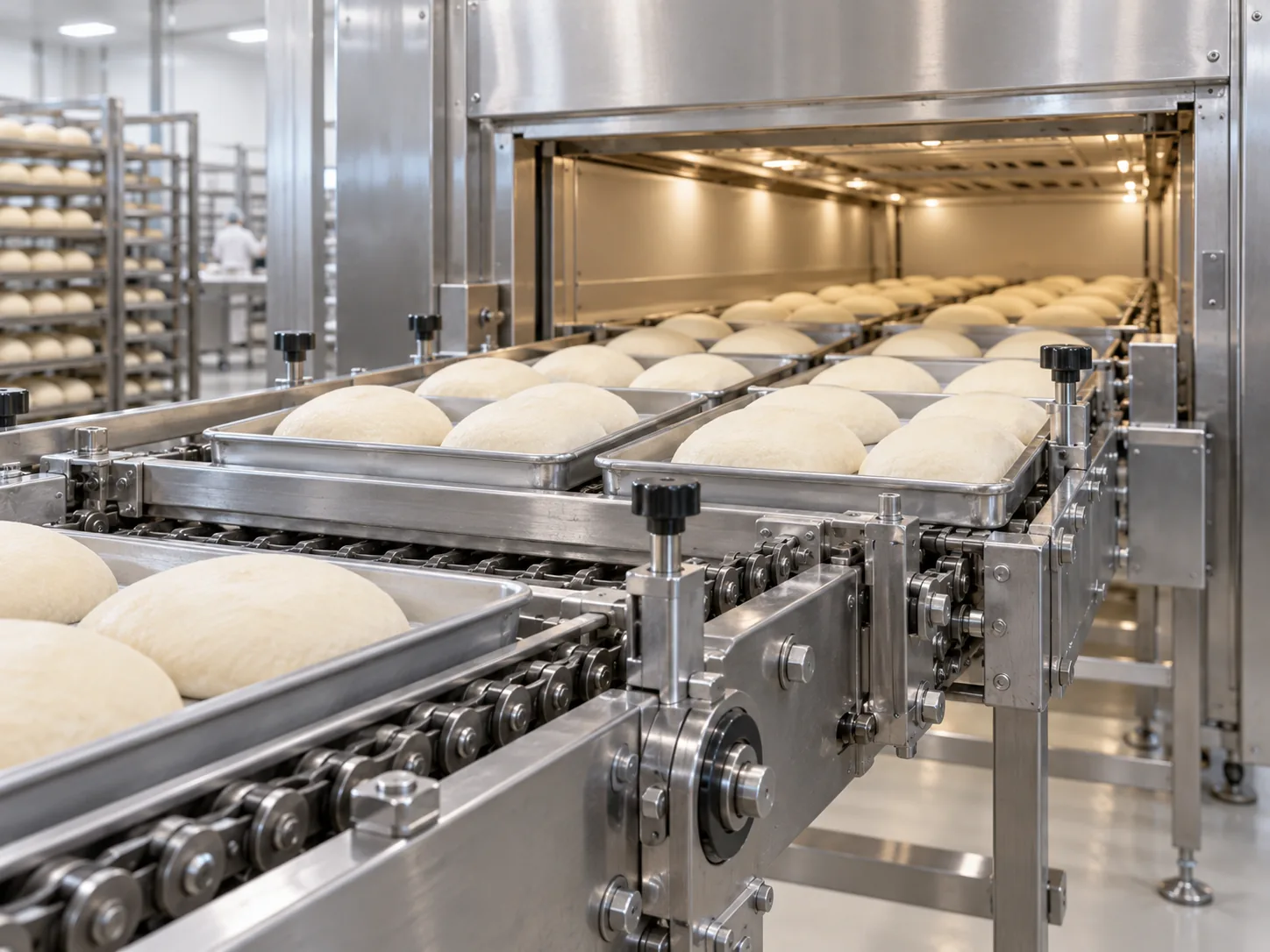
The same chain geometry can behave differently in a humid proofer, a hot oven, an ambient cooling section or a washdown area. For how thermal expansion affects oven chains, document the exact machine zone, whether the chain carries product directly or moves pans/fixtures, and whether the joint sees heat, moisture, cleaning chemicals or abrasive residue.
Os dados do processo ajudam a determinar quais características são fixas pela intercambialidade e quais características — como material, folga ou método de fabricação da fixação — devem ser revisadas para a aplicação.
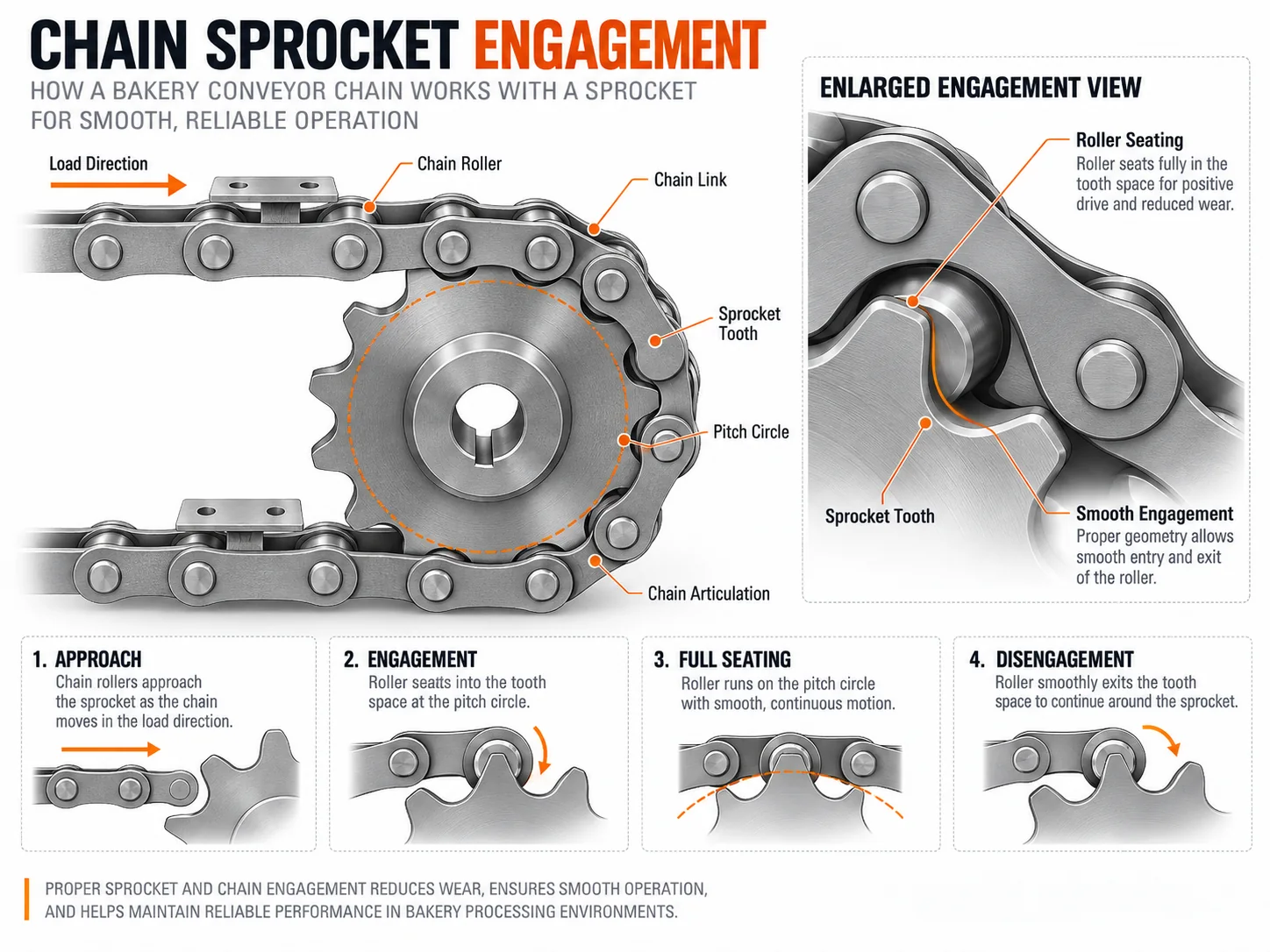
Uma corrente não funciona de forma independente. Os roletes ou buchas devem entrar e sair suavemente dos espaços entre os dentes da roda dentada, enquanto as guias sustentam a corrente sem forçá-la lateralmente. Dentes em gancho, desalinhamento do eixo, rodas dentadas excêntricas ou uma guia apertada podem causar desgaste rápido em uma corrente nova.
Inspecione todo o percurso ao longo de um circuito completo. Se o dano se repetir no mesmo local da máquina, investigue o suporte, a transferência ou o transportador local antes de presumir que a própria corrente esteja com defeito.
Passo, largura, rolete/bucha, pino, placa, largura total e padrão de fixação.
Temperatura, umidade, lavagem, velocidade, carga, horas de produção e partidas.
Rodas dentadas, guias, centros da corrente, tensionamento, alinhamento e folgas do suporte.
Aprovar a geometria final encomendada, o material e a configuração dependente da aplicação antes da instalação.
Pergunte o que mudou antes do problema aparecer: taxa de produção, peso do produto ou da panela, ciclo de limpeza, lubrificante, temperatura, intervalo de manutenção ou substituição de engrenagens. Informações sobre tendências são mais valiosas do que uma única fotografia, pois mostram se o desgaste é uniforme ou concentrado.
Durante a inspeção de rotina, verifique se há juntas rígidas, desgaste dos roletes, movimento dos pinos, acessórios rachados ou tortos, contato lateral anormal e recolhimento irregular. Mantenha as proteções e os procedimentos de segurança em vigor, de acordo com as exigências do proprietário da máquina.
Inclua as dimensões medidas, o nome da máquina/processo, fotos, desenho (se disponível), quantidade ou comprimento da corrente necessário, intervalo de fixação, espaçamento entre centros da corrente, informações sobre a roda dentada, temperatura, condições de lavagem, carga e janela de entrega prevista. Revise o guia de seleção de cadeias de padarias e o Visão geral da família de produtos para a próxima etapa de decisão.
A useful diagnosis starts with evidence that can be repeated by a second person. understanding how temperature changes pin, bush, plate and track clearances through a cycle. Record cold dimensions, operating temperature, chain path length, guide clearance and take-up position. When the chain is worn, note which readings may be influenced by joint clearance or deformation, and prefer multi-pitch or multi-point measurements over one isolated dimension.
The chain does not operate by itself. In long heated oven runs and return paths, inspect the sprockets, guides, return path, take-up and carrier interface at the same time. The symptom to watch is binding after heat-up or loss of alignment as the system expands. A local problem that repeats at one machine position often points to alignment, clearance or mating-hardware issues rather than a uniform chain problem.
The practical decision is to treat thermal growth as a system issue involving chain, guides, sprockets and supports rather than a chain-only property. That prevents a common error: changing chain tension, material or size before the root constraint has been identified. Use the chain drawing and the machine envelope together, because a configuration that looks correct in isolation can still interfere with a guard, transfer plate, sensor bracket or carrier.
Descreva o ciclo operacional em vez de usar um único adjetivo como "quente", "úmido" ou "grau alimentício". Indique a temperatura normal e máxima, quando relevante, a exposição à umidade ou a produtos de limpeza, a velocidade, o comportamento de partida/parada e as limitações de lubrificação. Esses detalhes determinam se as folgas, os materiais ou as práticas de manutenção precisam ser alterados, mantendo-se a geometria básica fixa.
| Verificar | Por que isso importa | O que enviar ou verificar |
|---|---|---|
| Identificação | Confirm cold dimensions, operating temperature, chain path length, guide clearance and take-up position. Use a measurement sequence that can be repeated after removal so the installed and bench readings can be compared. | Esboço com dimensões, fotos que levem em consideração a escala e qualquer desenho antigo ou número de peça. |
| Posição da rota | Map where the chain runs through long heated oven runs and return paths. Mark the exact location of binding after heat-up or loss of alignment as the system expands instead of reporting the condition only as a whole-line problem. | Foto contextual mostrando a seção da esteira transportadora, as posições de acionamento/extensão e o percurso de retorno. |
| Peças de acoplamento | Inspecione o perfil dos dentes, o assentamento dos roletes, o alinhamento do eixo/roda dentada, o contato da guia e a reserva de tensionamento. Essas peças podem criar padrões de desgaste que simulam um problema na seleção da corrente. | Número de dentes da roda dentada e fotos, disposição do guia e posição atual do tensionador. |
| Caminho de carregamento | Identify how product carriers, pans, rods or fixtures transfer load into the chain. For this topic, the key focus is understanding how temperature changes pin, bush, plate and track clearances through a cycle. | Desenho do transportador, intervalo de fixação, espaçamento entre centros de correntes e massa/força suportada, quando conhecidos. |
| Ambiente | Registre as restrições de temperatura, umidade, lavagem, contaminação e lubrificação por zona da máquina. Separe a exposição contínua de picos curtos ou eventos de limpeza. | Resumo das condições de funcionamento e práticas de manutenção/lubrificação. |
| Liberar | The final engineering action is to treat thermal growth as a system issue involving chain, guides, sprockets and supports rather than a chain-only property. The approved drawing should distinguish fixed interchange dimensions from selectable options. | temperature range, heated length, clearance observations, chain geometry and guide layout. |
A uniform change along the whole strand suggests a different mechanism from damage concentrated at one sprocket, guide or transfer. For How Thermal Expansion Affects Oven Chains, compare left/right sides and loaded/return paths. The distribution of wear can reveal whether the driver is joint wear, side loading, contamination, thermal change or a carrier that is forcing the chain out of its natural path.
Increasing tension can temporarily change noise or tracking without correcting the underlying cause. If the observed issue is binding after heat-up or loss of alignment as the system expands, first confirm alignment, take-up geometry and articulation. Excessive tension can add bearing load and make a marginal guide or attachment problem worse.
Os equipamentos de panificação podem alternar entre os estados de produção, limpeza e desligamento. Uma corrente pode articular normalmente quando fria e ficar rígida quando aquecida, ou funcionar livremente durante a produção, mas corroer após repetidas paradas em ambientes úmidos. Registre o estado em que o sintoma ocorre para que a ação corretiva selecionada seja adequada ao ciclo de trabalho real.
For an unknown chain, one close-up is not enough. Pair a complete machine-zone image with side and end views of several pitches, a sprocket-engagement photo and a clear attachment/carrier view. Place a scale only where it does not hide the feature being measured. This photo set makes understanding how temperature changes pin, bush, plate and track clearances through a cycle easier to evaluate remotely.
Record cold dimensions, operating temperature, chain path length, guide clearance and take-up position, chain centers, sprocket tooth count and the carrier interface before changing components.
Describe what happens in long heated oven runs and return paths, including temperature or moisture changes, speed, load and cleaning/lubrication constraints.
Document where binding after heat-up or loss of alignment as the system expands appears. Compare drive, tail, loaded run, return run and transfer points rather than averaging the entire conveyor.
Include temperature range, heated length, clearance observations, chain geometry and guide layout. State the required quantity or chain length and any documentation needed with the order.
Review pitch, widths, pin/roller geometry, attachments and material notes on one controlled drawing revision. For How Thermal Expansion Affects Oven Chains, the release decision should explicitly address understanding how temperature changes pin, bush, plate and track clearances through a cycle.
Após a instalação, observe pelo menos um circuito completo, verifique a entrada/saída da roda dentada e a folga do porta-ferramentas e verifique novamente o tensionamento de acordo com o procedimento do fabricante da máquina. Não utilize uma corrente nova para compensar componentes desgastados ou desalinhados.
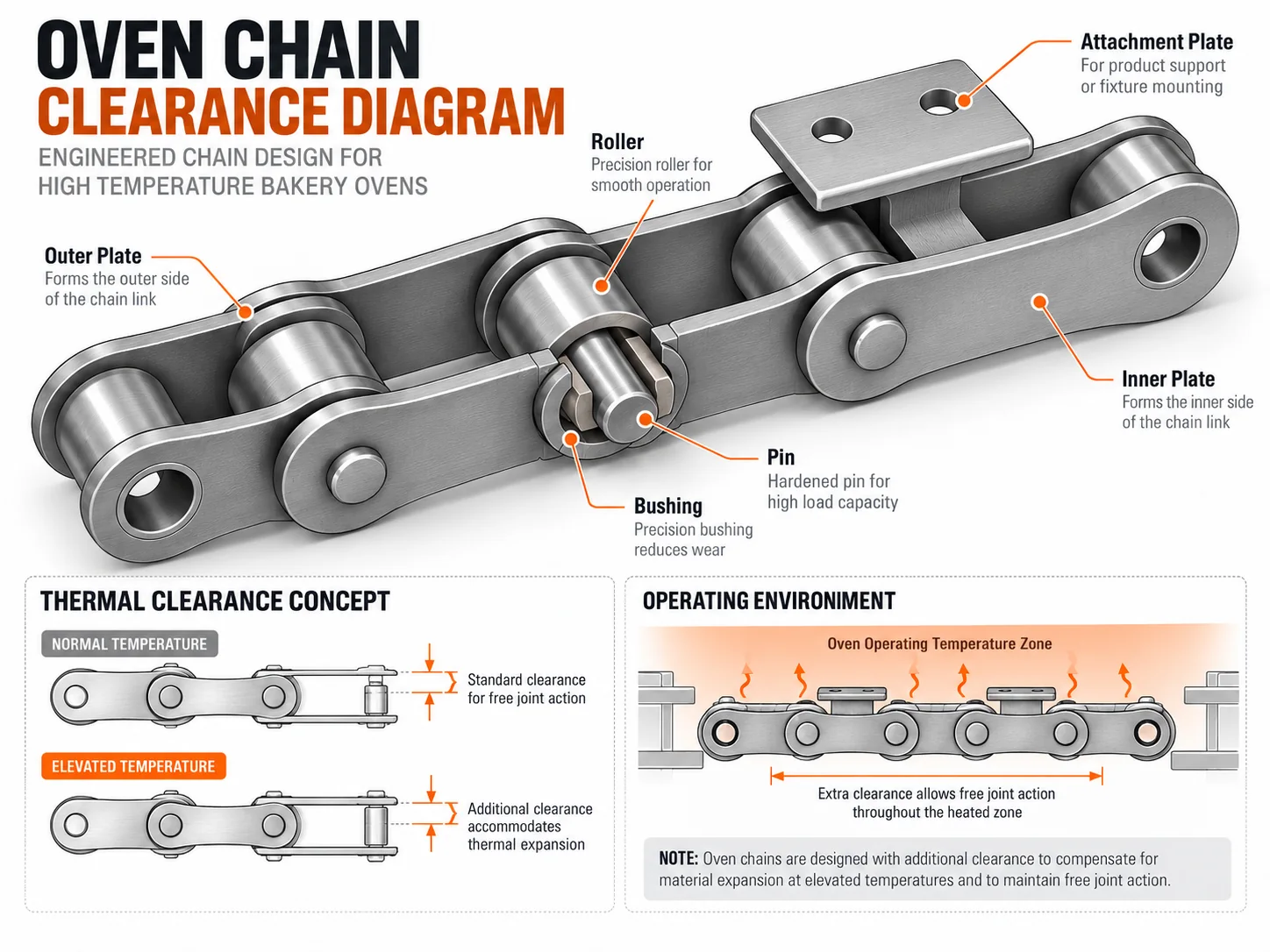
The main reason to keep this process structured is that understanding how temperature changes pin, bush, plate and track clearances through a cycle interacts with more than one component. A change that improves one symptom can shift load into another part of the mechanism. For example, correcting guide alignment may reduce side wear but also expose a take-up setting that was previously compensating for the misalignment. Record changes one at a time so the result can be interpreted.
For planned maintenance, compare the present condition with a baseline whenever one exists. If there is no baseline, create one during the next shutdown: photograph the sprockets and guide surfaces, record take-up position, measure a defined number of pitches, and note the chain’s location in long heated oven runs and return paths. Repeating the same observations later is more informative than relying on general statements such as “the chain has stretched.”
Quando houver um desenho disponível, verifique se o hardware instalado ainda corresponde a ele. Os equipamentos de panificação são frequentemente modificados ao longo de sua vida útil: os transportadores podem ser reparados, os trilhos-guia movidos, as rodas dentadas substituídas e os intervalos de fixação alterados. O desenho continua útil, mas a verificação em campo impede que um documento histórico seja considerado como prova da configuração atual.
Procurement and engineering should use the same evidence package. The RFQ should not separate commercial quantity from technical context: temperature range, heated length, clearance observations, chain geometry and guide layout. This makes it possible to judge whether a standard series, a modified attachment or a custom replacement is the appropriate route without creating unnecessary back-and-forth.
Finally, treat the website as a preparation tool rather than the controlling product drawing. Measurements and diagrams narrow the family and help organize the RFQ; the released drawing defines the ordered configuration. That distinction is especially important where binding after heat-up or loss of alignment as the system expands could have more than one mechanical cause.
Use How Thermal Expansion Affects Oven Chains as a machine-level question, not just a chain inspection. Compare the loaded and return runs, drive and tail ends, and any transfer or carrier transition in long heated oven runs and return paths. Document whether binding after heat-up or loss of alignment as the system expands is distributed along the strand or repeats at one location. That pattern helps separate progressive joint wear from alignment, guide, sprocket or carrier problems that a new chain alone will not correct.
The working record should include cold dimensions, operating temperature, chain path length, guide clearance and take-up position. Mark which values are fixed by the existing machine and which values can be changed to improve service. The central engineering focus is understanding how temperature changes pin, bush, plate and track clearances through a cycle. When a legacy part number conflicts with field measurements, hold the RFQ until the installed interface and the controlled drawing can be reconciled.
A useful enquiry combines commercial quantity with the technical package: temperature range, heated length, clearance observations, chain geometry and guide layout. Also state whether the request is a direct replacement, a planned modification or a new machine design. The release objective is to treat thermal growth as a system issue involving chain, guides, sprockets and supports rather than a chain-only property. This reduces quote revisions and prevents a visually similar chain from being treated as interchangeable before geometry and duty have been checked.
Utilize a referência antiga, se disponível, mas verifique a geometria e a faixa de operação da peça instalada. Modificações na máquina, substituições anteriores ou desgaste podem tornar apenas o número da peça incompleto.
Utilize uma medição de passo múltiplo em um número viável de elos e registre o método. Compare-o com o passo nominal e os limites de manutenção da máquina, em vez de confiar em uma única medição de elo adjacente.
Sempre que houver desgaste dos dentes, travamento, problemas de alinhamento ou desgaste prematuro repetido da corrente, a corrente e a roda dentada funcionam como um sistema de engrenamento.