기록된 형상
피치, 폭, 롤러/부시, 핀, 플레이트, 전체 폭 및 부착 패턴.
베이커리 체인 기술 가이드
Chain Design for Frequent Cleaning is best answered by combining measured chain geometry, machine duty and the operating environment. This guide shows what to inspect, record and discuss before a replacement or new-chain decision.
Chain Design for Frequent Cleaning should be evaluated from the actual conveyor. Start with chain pitch, transverse geometry, sprocket condition and any carrier attachment, then add temperature, moisture, washdown, load, speed and take-up information. The objective is not to identify a chain by appearance; it is to produce an RFQ that preserves the machine interface and makes application-dependent choices explicit.
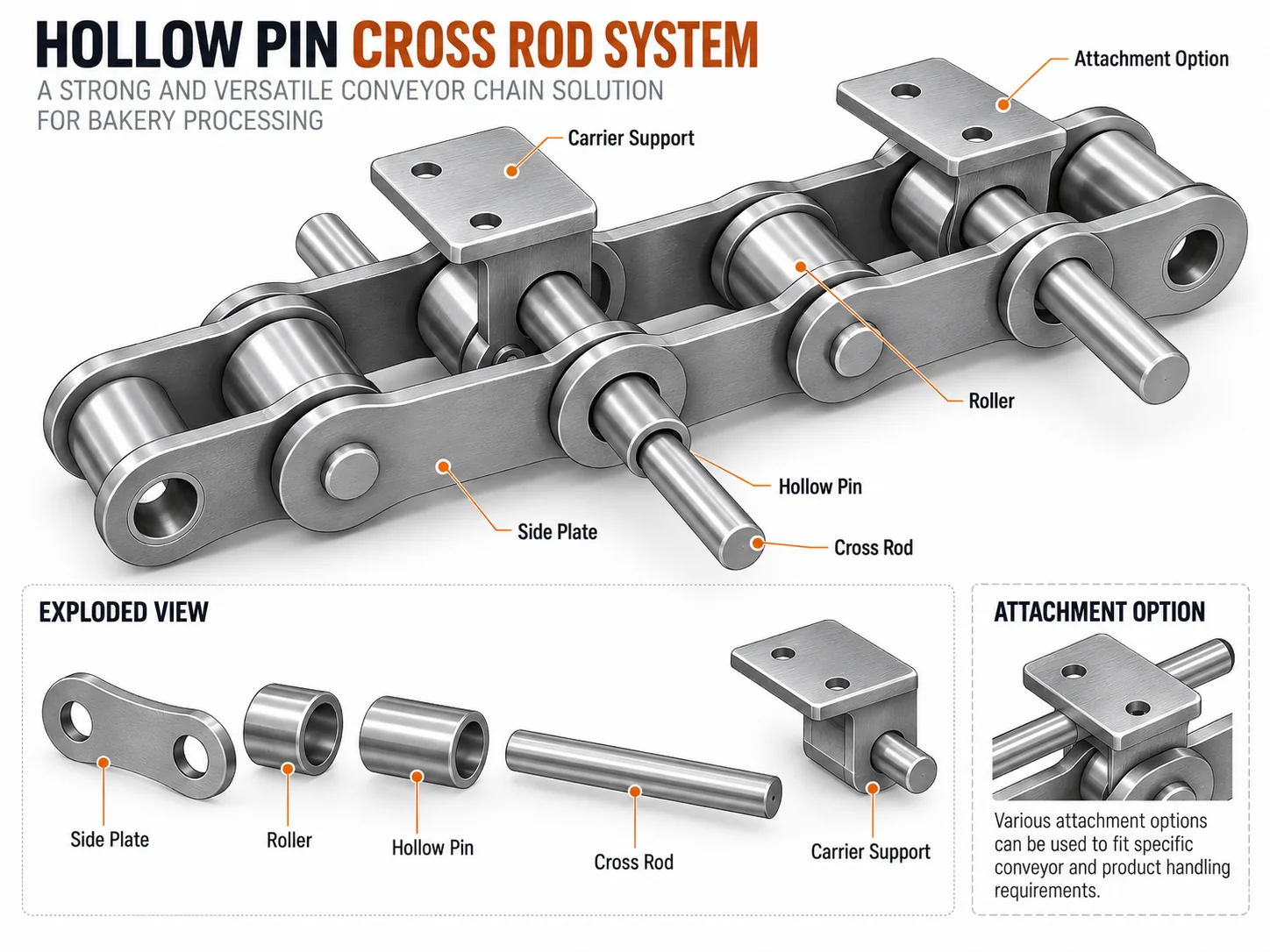
체인을 제거하기 전에 여러 가지 특성을 측정하십시오. 피치는 기본적인 기어 관계를 나타내지만, 내부 폭, 롤러 또는 부시 직경, 핀 직경, 플레이트 높이, 전체 폭 및 부착 치수는 동일한 공칭 피치를 공유할 수 있는 구성들을 구분하는 기준이 됩니다.
마모된 체인 가닥의 경우, 여러 링크에 걸쳐 누적 피치를 측정하십시오. 체인을 측면과 끝에서 촬영하고, 가능하면 스프로킷도 함께 촬영하십시오.
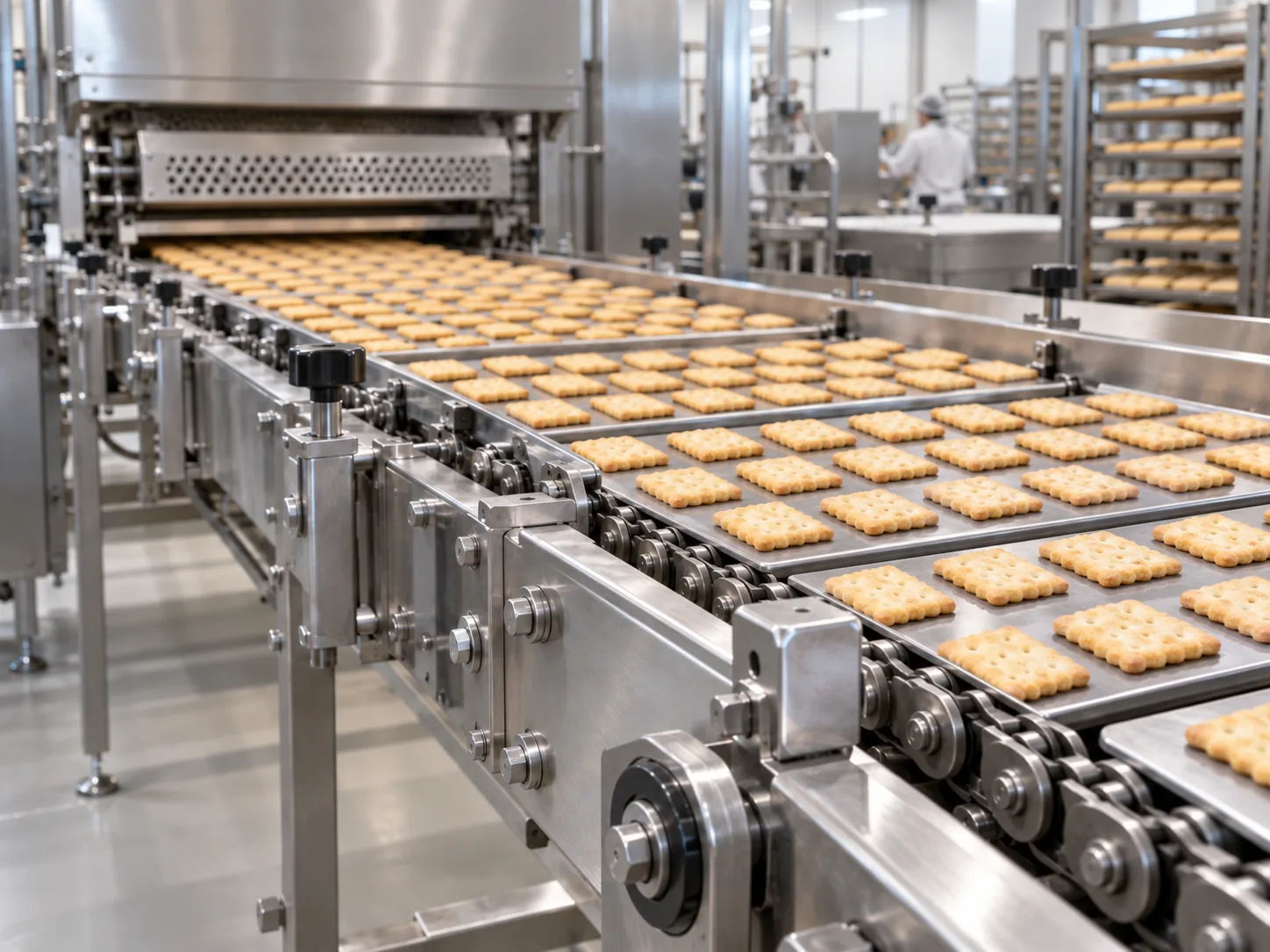
The same chain geometry can behave differently in a humid proofer, a hot oven, an ambient cooling section or a washdown area. For chain design for frequent cleaning, document the exact machine zone, whether the chain carries product directly or moves pans/fixtures, and whether the joint sees heat, moisture, cleaning chemicals or abrasive residue.
공정 데이터는 호환성에 의해 고정되는 특성과 재질, 간극 또는 부착물 제조 방법과 같은 적용 분야에 대해 검토해야 하는 특성을 결정하는 데 도움이 됩니다.
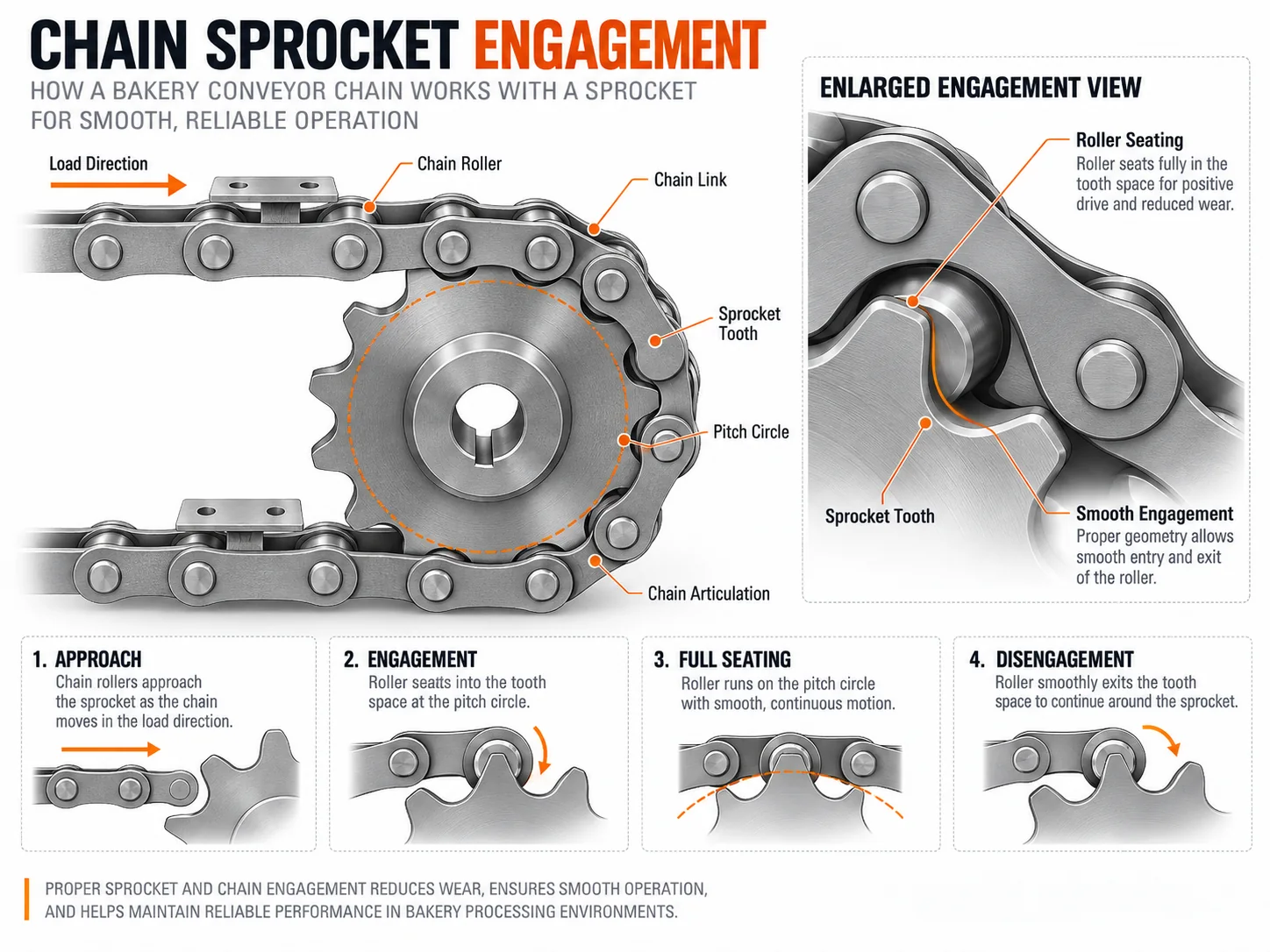
체인은 독립적으로 작동하지 않습니다. 롤러나 부싱은 스프로킷 톱니 사이를 부드럽게 드나들어야 하며, 가이드 트랙은 체인 가닥을 측면으로 쏠리지 않도록 지지해야 합니다. 톱니가 휘거나, 축이 정렬되지 않았거나, 스프로킷이 편심되었거나, 가이드가 너무 꽉 조여 있으면 새 체인이 빨리 마모될 수 있습니다.
전체 회로를 따라 전체 경로를 검사하십시오. 동일한 기계 위치에서 손상이 반복되는 경우, 체인 자체에 결함이 있다고 판단하기 전에 해당 위치의 지지대, 이송 장치 또는 운반 장치를 조사하십시오.
피치, 폭, 롤러/부시, 핀, 플레이트, 전체 폭 및 부착 패턴.
온도, 습도, 세척, 속도, 부하, 생산 시간 및 시작 횟수.
스프로킷, 가이드, 체인 중심, 장력 조절, 정렬 및 캐리어 간극.
설치 전에 최종 주문된 형상, 재질 및 용도별 구성을 승인하십시오.
문제가 발생하기 전에 무엇이 바뀌었는지 물어보세요. 생산 속도, 제품 또는 팬 무게, 세척 주기, 윤활유, 온도, 유지 보수 간격 또는 교체된 스프로킷 등을 확인하십시오. 마모가 균일하게 발생했는지 아니면 특정 부위에 집중되었는지 보여주기 때문에 단일 사진보다 추세 정보가 더 중요합니다.
정기 점검 시 관절의 뻑뻑함, 롤러 마모, 핀 움직임, 균열 또는 휨 현상이 있는 부착물, 비정상적인 측면 접촉 및 불균일한 장력 조절 등을 확인하십시오. 기계 소유자의 요구 사항에 따라 안전 가드 및 안전 절차를 유지하십시오.
측정된 치수, 기계/공정명, 사진, 가능한 경우 도면, 수량 또는 필요한 체인 길이, 부착 간격, 체인 중심 간격, 스프로킷 정보, 온도, 세척 조건, 하중 및 목표 납품 기간을 포함하십시오. 검토하십시오. 베이커리 체인 선택 가이드 그리고 제품군 개요 다음 결정 단계를 위해서입니다.
A useful diagnosis starts with evidence that can be repeated by a second person. designing the chain and carrier interface so cleaning access does not undermine joint performance. Record cleaning frequency, spray direction, chemistry, drainage path, joint exposure and re-lubrication practice. When the chain is worn, note which readings may be influenced by joint clearance or deformation, and prefer multi-pitch or multi-point measurements over one isolated dimension.
The chain does not operate by itself. In sanitary bakery transfer and washdown conveyors, inspect the sprockets, guides, return path, take-up and carrier interface at the same time. The symptom to watch is trapped residue, corrosion pockets, washed-out lubricant or slow drying. A local problem that repeats at one machine position often points to alignment, clearance or mating-hardware issues rather than a uniform chain problem.
The practical decision is to review cleanability, drainage and lubrication recovery as part of the original chain specification. That prevents a common error: changing chain tension, material or size before the root constraint has been identified. Use the chain drawing and the machine envelope together, because a configuration that looks correct in isolation can still interfere with a guard, transfer plate, sensor bracket or carrier.
"고온", "습윤", "식품 등급"과 같은 단일 형용사보다는 작동 사이클을 설명하십시오. 관련이 있는 경우 정상 및 최고 온도, 습도 또는 세척 노출, 속도, 시동/정지 동작 및 윤활 제한 사항을 명시하십시오. 이러한 세부 정보는 기본 형상은 고정된 상태로 유지하면서 간극, 재료 또는 유지 관리 방식을 변경해야 하는지 여부를 결정하는 데 중요합니다.
| 확인하다 | 왜 중요한가 | 무엇을 보내거나 확인해야 할까요? |
|---|---|---|
| 신분증 | Confirm cleaning frequency, spray direction, chemistry, drainage path, joint exposure and re-lubrication practice. Use a measurement sequence that can be repeated after removal so the installed and bench readings can be compared. | 치수가 표시된 스케치, 축척을 고려한 사진 및 기존 도면 또는 부품 번호. |
| 경로 위치 | Map where the chain runs through sanitary bakery transfer and washdown conveyors. Mark the exact location of trapped residue, corrosion pockets, washed-out lubricant or slow drying instead of reporting the condition only as a whole-line problem. | 컨베이어 구간, 구동/후미 위치 및 복귀 경로를 보여주는 현장 사진. |
| 결합 부품 | 톱니 형상, 롤러 착좌 상태, 축/스프로킷 정렬 상태, 가이드 접촉 상태 및 장력 여유를 점검하십시오. 이러한 부품들은 체인 이탈 문제와 유사한 마모 패턴을 생성할 수 있습니다. | 스프로킷 톱니 개수 및 사진, 가이드 배치 및 현재 장력 위치. |
| 로드 경로 | Identify how product carriers, pans, rods or fixtures transfer load into the chain. For this topic, the key focus is designing the chain and carrier interface so cleaning access does not undermine joint performance. | 캐리어 도면, 부착 간격, 체인 중심 간격 및 지지 질량/힘(알려진 경우). |
| 환경 | 기계 구역별로 온도, 습도, 세척, 오염 및 윤활 제한 사항을 기록하십시오. 지속적인 노출과 짧은 시간 동안의 온도 상승 또는 청소 작업을 구분하십시오. | 작동 조건 요약 및 유지보수/윤활 방법. |
| 풀어 주다 | The final engineering action is to review cleanability, drainage and lubrication recovery as part of the original chain specification. The approved drawing should distinguish fixed interchange dimensions from selectable options. | cleaning SOP summary, chain geometry, materials, lubrication restrictions and photos. |
A uniform change along the whole strand suggests a different mechanism from damage concentrated at one sprocket, guide or transfer. For Chain Design for Frequent Cleaning, compare left/right sides and loaded/return paths. The distribution of wear can reveal whether the driver is joint wear, side loading, contamination, thermal change or a carrier that is forcing the chain out of its natural path.
Increasing tension can temporarily change noise or tracking without correcting the underlying cause. If the observed issue is trapped residue, corrosion pockets, washed-out lubricant or slow drying, first confirm alignment, take-up geometry and articulation. Excessive tension can add bearing load and make a marginal guide or attachment problem worse.
제빵 장비는 생산, 세척 및 정지 상태를 오갈 수 있습니다. 체인은 차가울 때는 정상적으로 작동하지만 가열되면 뻑뻑해질 수 있고, 생산 중에는 원활하게 작동하지만 반복적인 습식 정지 후에는 부식될 수 있습니다. 선택된 시정 조치가 실제 작동 주기에 맞도록 증상이 발생하는 상태를 기록해야 합니다.
For an unknown chain, one close-up is not enough. Pair a complete machine-zone image with side and end views of several pitches, a sprocket-engagement photo and a clear attachment/carrier view. Place a scale only where it does not hide the feature being measured. This photo set makes designing the chain and carrier interface so cleaning access does not undermine joint performance easier to evaluate remotely.
Record cleaning frequency, spray direction, chemistry, drainage path, joint exposure and re-lubrication practice, chain centers, sprocket tooth count and the carrier interface before changing components.
Describe what happens in sanitary bakery transfer and washdown conveyors, including temperature or moisture changes, speed, load and cleaning/lubrication constraints.
Document where trapped residue, corrosion pockets, washed-out lubricant or slow drying appears. Compare drive, tail, loaded run, return run and transfer points rather than averaging the entire conveyor.
Include cleaning SOP summary, chain geometry, materials, lubrication restrictions and photos. State the required quantity or chain length and any documentation needed with the order.
Review pitch, widths, pin/roller geometry, attachments and material notes on one controlled drawing revision. For Chain Design for Frequent Cleaning, the release decision should explicitly address designing the chain and carrier interface so cleaning access does not undermine joint performance.
설치 후 최소 한 바퀴를 완전히 돌려보고 스프로킷 진입/출구 및 캐리어 간극을 확인한 후 기계 제조업체의 절차에 따라 장력 조절 상태를 다시 점검하십시오. 마모되었거나 정렬이 잘못된 부품을 보완하기 위해 새 체인을 사용해서는 안 됩니다.
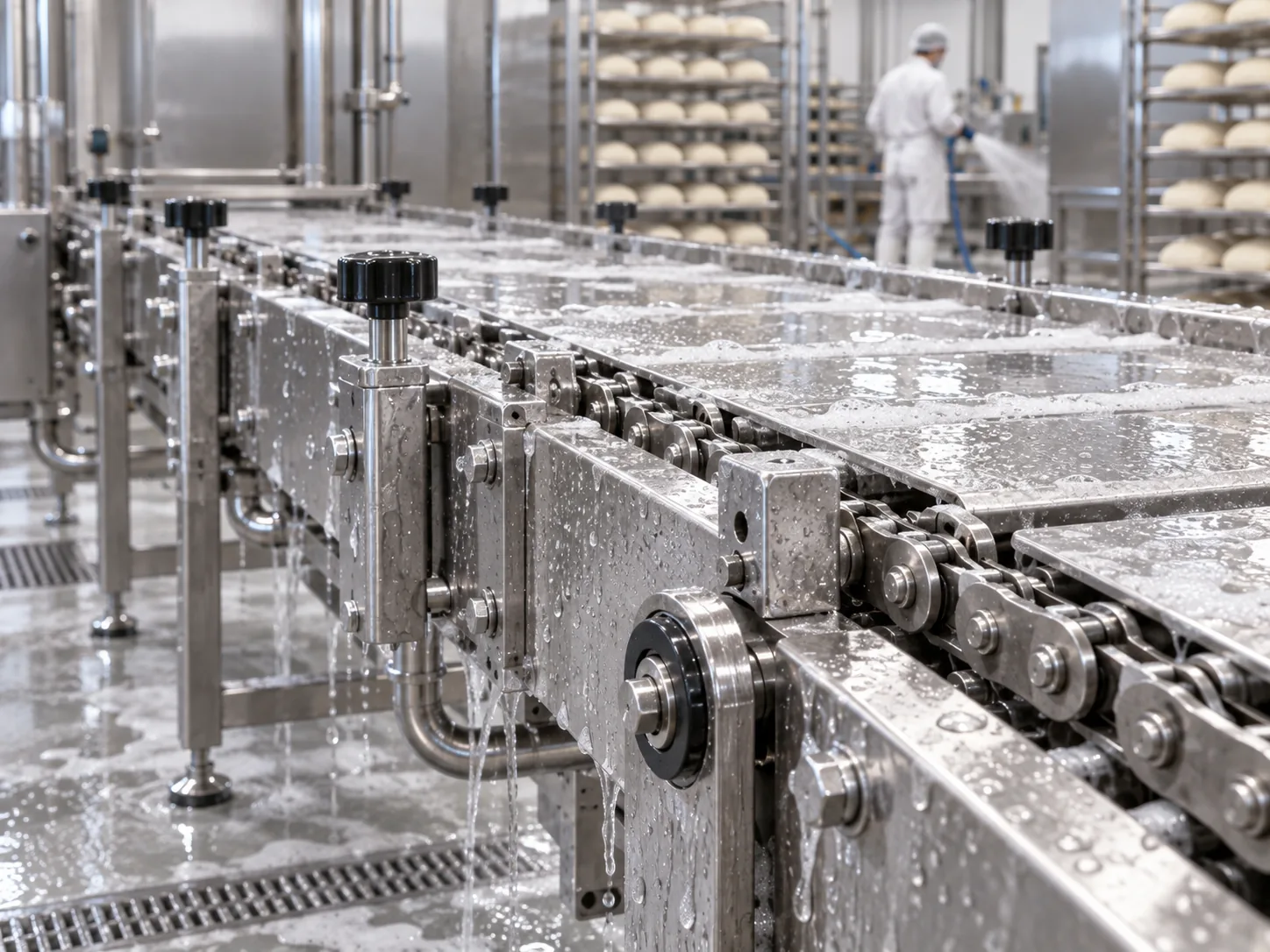
The main reason to keep this process structured is that designing the chain and carrier interface so cleaning access does not undermine joint performance interacts with more than one component. A change that improves one symptom can shift load into another part of the mechanism. For example, correcting guide alignment may reduce side wear but also expose a take-up setting that was previously compensating for the misalignment. Record changes one at a time so the result can be interpreted.
For planned maintenance, compare the present condition with a baseline whenever one exists. If there is no baseline, create one during the next shutdown: photograph the sprockets and guide surfaces, record take-up position, measure a defined number of pitches, and note the chain’s location in sanitary bakery transfer and washdown conveyors. Repeating the same observations later is more informative than relying on general statements such as “the chain has stretched.”
기존 도면이 있는 경우, 설치된 하드웨어가 도면과 일치하는지 확인해야 합니다. 제빵 장비는 사용 수명 동안 종종 개조됩니다. 예를 들어, 캐리어를 수리하거나, 가이드 레일을 이동하거나, 스프로킷을 교체하거나, 부착 간격을 변경할 수 있습니다. 도면은 여전히 유용하지만, 현장 검증을 통해 과거 도면을 현재 구성의 증거로 간주해서는 안 됩니다.
Procurement and engineering should use the same evidence package. The RFQ should not separate commercial quantity from technical context: cleaning SOP summary, chain geometry, materials, lubrication restrictions and photos. This makes it possible to judge whether a standard series, a modified attachment or a custom replacement is the appropriate route without creating unnecessary back-and-forth.
Finally, treat the website as a preparation tool rather than the controlling product drawing. Measurements and diagrams narrow the family and help organize the RFQ; the released drawing defines the ordered configuration. That distinction is especially important where trapped residue, corrosion pockets, washed-out lubricant or slow drying could have more than one mechanical cause.
Use Chain Design for Frequent Cleaning as a machine-level question, not just a chain inspection. Compare the loaded and return runs, drive and tail ends, and any transfer or carrier transition in sanitary bakery transfer and washdown conveyors. Document whether trapped residue, corrosion pockets, washed-out lubricant or slow drying is distributed along the strand or repeats at one location. That pattern helps separate progressive joint wear from alignment, guide, sprocket or carrier problems that a new chain alone will not correct.
The working record should include cleaning frequency, spray direction, chemistry, drainage path, joint exposure and re-lubrication practice. Mark which values are fixed by the existing machine and which values can be changed to improve service. The central engineering focus is designing the chain and carrier interface so cleaning access does not undermine joint performance. When a legacy part number conflicts with field measurements, hold the RFQ until the installed interface and the controlled drawing can be reconciled.
A useful enquiry combines commercial quantity with the technical package: cleaning SOP summary, chain geometry, materials, lubrication restrictions and photos. Also state whether the request is a direct replacement, a planned modification or a new machine design. The release objective is to review cleanability, drainage and lubrication recovery as part of the original chain specification. This reduces quote revisions and prevents a visually similar chain from being treated as interchangeable before geometry and duty have been checked.
가능하다면 기존 참조 자료를 사용하되, 설치된 형상과 용도를 확인하십시오. 기계 개조, 이전 교체 부품 또는 마모로 인해 부품 번호만으로는 완전한 정보를 얻을 수 없을 수 있습니다.
실제 사용 가능한 링크 수에 걸쳐 다중 피치 측정을 수행하고 그 방법을 기록하십시오. 단일 인접 링크 측정값에 의존하는 대신, 이를 공칭 피치 및 기계 유지 보수 한계와 비교하십시오.
톱니 마모, 걸림, 정렬 문제 또는 체인의 반복적인 조기 마모가 발생할 때마다 체인과 스프로킷은 맞물림 시스템으로 작동합니다.