Standard geometry
Use when a conventional roller or conveyor chain interface matches the equipment.
Bakery Application
Pizza & Flatbread Lines require chain selection that considers the process environment, carrier interface, layout and maintenance access as one system.
Pizza & Flatbread Lines sit inside a production flow where product state, temperature and handling sensitivity change from one operation to the next. The conveyor must move the product or carrier without creating an avoidable tracking, contamination or access problem. The chain is therefore selected together with sprockets, guides, supports and take-up.
For this application, start by mapping the duty cycle: how often the conveyor starts, how long it runs, the mass carried per pitch, the environment around the chain and whether cleaning exposes joints to water or chemicals.
Useful RFQ information includes product/carrier mass, conveyor speed, chain-center spacing, attachment spacing, operating temperature, washdown practice and the installed sprocket arrangement. Where trays or pans are carried, include their support points and required orientation.
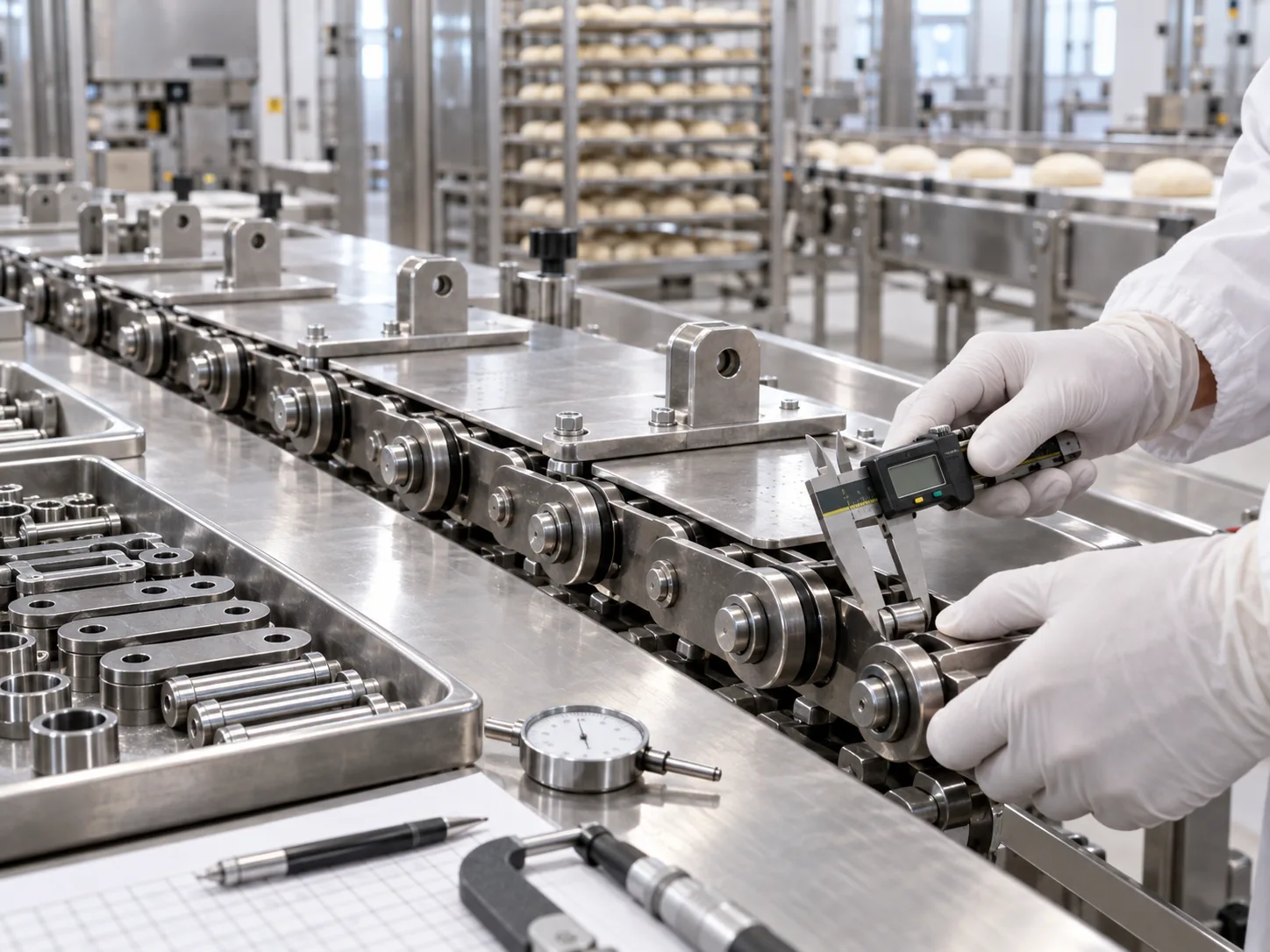
For replacement work, measure the installed chain before removal when possible. Wear can change pitch over a long measured length, so record both nominal pitch between adjacent pins and cumulative pitch across multiple links.
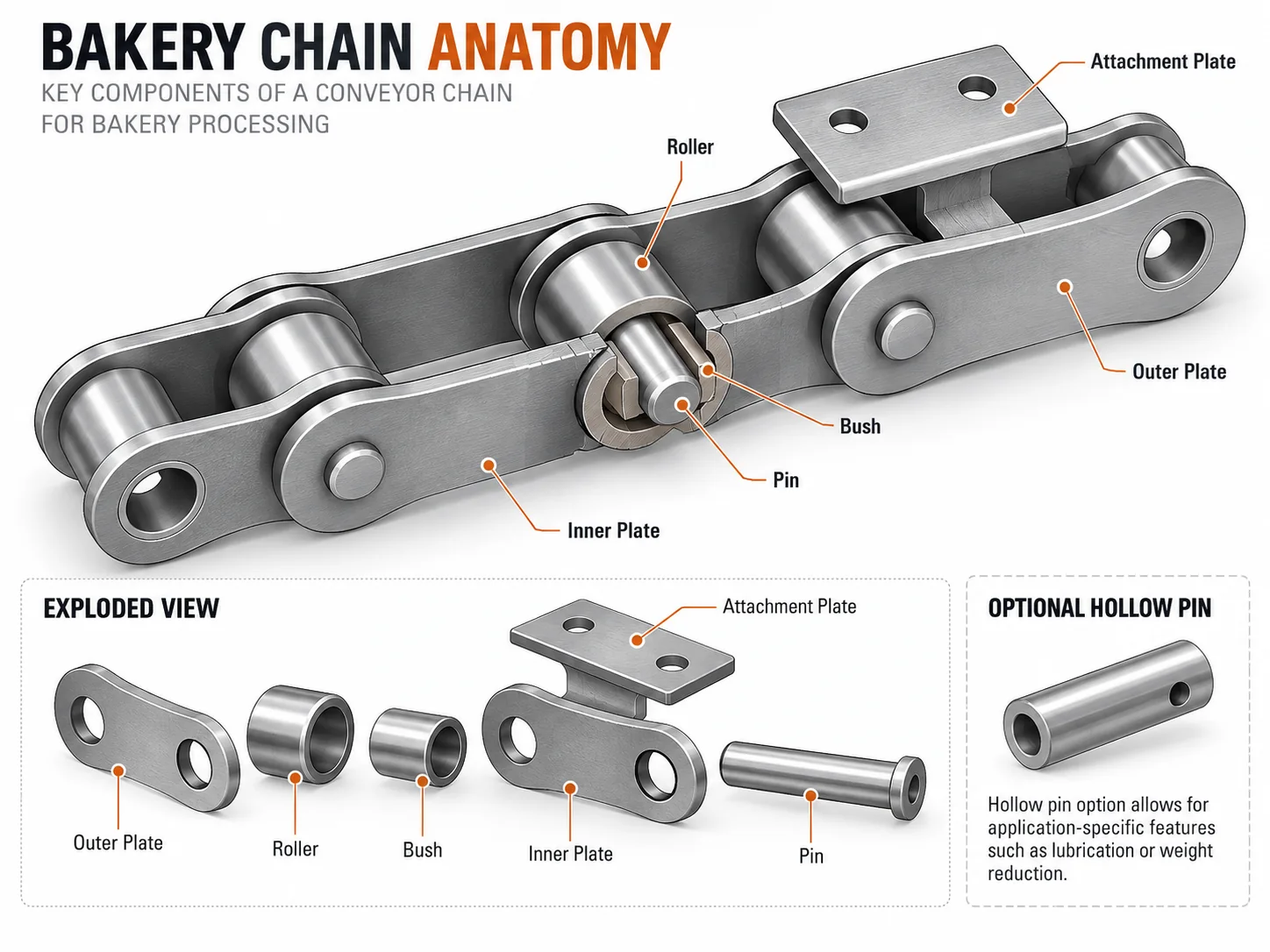
The most relevant starting families for this process are Наубайхана пештерінің тізбектері Наубайхана конвейерлік тізбектері. Final configuration depends on actual geometry and duty, not only the application name.
Use when a conventional roller or conveyor chain interface matches the equipment.
Review for moisture, washdown and corrosion-sensitive areas.
Use when trays, cross rods, fixtures or carriers require a dedicated interface.
Use where installed geometry, material or attachment spacing is non-standard.
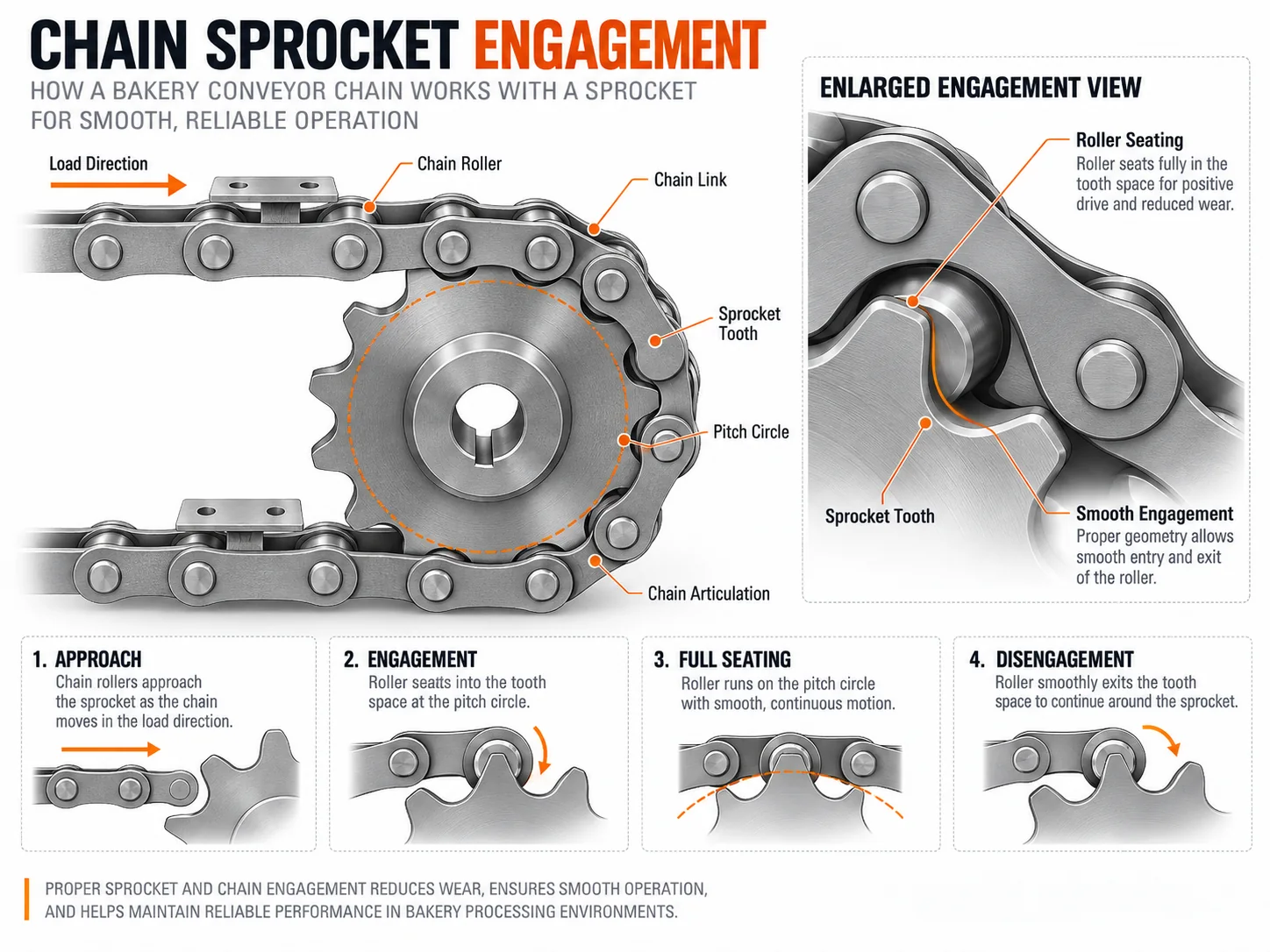
Check that the selected chain seats correctly on the sprocket, clears guides and frame members, and provides enough articulation through any return path. On parallel-chain conveyors, carrier bars can lock the strands together laterally, so chain-center spacing and synchronized take-up become especially important.
Do not compensate for a severe alignment problem by increasing tension. Excessive tension can raise bearing pressure and accelerate wear. Correct shaft alignment, guide position and sprocket condition first.
Inspection intervals should reflect heat, moisture, cleaning and start/stop frequency. Look for stiff joints, uneven roller wear, side plate rubbing, loose or distorted attachments and sprocket tooth wear. A problem that repeats at the same conveyor position may indicate a guide, carrier or frame interference rather than a chain-wide issue.
Before requesting a new strand, document the reason for replacement. That information helps determine whether a like-for-like replacement is appropriate or whether clearance, material, attachment or maintenance access should be reviewed.
Treat pizza and flatbread lines as a distinct duty zone. Record where the chain enters and leaves this zone, whether carriers accumulate, and whether the return path experiences different conditions from the product side.
Document oven heat, product transfer and downstream cooling. Use normal conditions and short-duration peaks separately, because material, joint clearance and lubrication decisions can respond differently to continuous exposure and transient events.
Verify stable conveyor geometry at wide product interfaces. For parallel strands, compare chain centers, attachment intervals and carrier squareness so one strand is not forced to absorb alignment error created elsewhere in the machine.
The first families to review are oven, high-temperature and conveyor chains. That is a screening direction, not an automatic recommendation; final selection still depends on the installed geometry, load path, sprocket set and requested documentation.
| Тексеру | Неліктен маңызды | Не жіберу немесе тексеру керек |
|---|---|---|
| Machine route | Drive/tail sprockets, guide tracks, transfers, return path and take-up. | Layout sketch and context photographs. |
| Тізбек геометриясы | Pitch, inside width, roller/bush, pin, plate and overall width. | Multi-pitch measurement plus end view. |
| Оператор интерфейсі | stable conveyor geometry at wide product interfaces. | Carrier drawing, attachment spacing and chain centers. |
| Duty and environment | oven heat, product transfer and downstream cooling. | Temperature/humidity/cleaning data, speed and supported load. |
| Maintenance evidence | Wear pattern, lubrication method, take-up history and sprocket condition. | Close-up photos and recent observations. |
Send machine type, process zone, photos, drawing if available, pitch, inside width, roller/bush diameter, pin size, attachment dimensions, chain centers, sprocket tooth count, speed, carried load, temperature, washdown condition and required quantity. Use the bakery chain selection guide as a checklist.
Walk the complete pizza and flatbread lines chain route and verify guards, guides, sprocket alignment, take-up reserve and the carrier interface. Confirm stable conveyor geometry at wide product interfaces. A static clearance problem should be corrected before speed or tension is used to mask it.
Run at a controlled speed and observe both the loaded and return paths. Mark any location where joints hesitate, carriers skew, rollers enter a sprocket unevenly or the chain rubs a guide. Repeating location-based symptoms are especially useful for diagnosing the machine interface.
Recheck after the equipment reaches its normal oven heat, product transfer and downstream cooling. Compare articulation, tracking and take-up position with the cold or idle condition. This is where thermal growth, moisture or cleaning-related changes can become visible.
After the system is stable, record take-up position, selected measurements, sprocket condition and representative photographs. Keep that baseline with the approved drawing for oven, high-temperature and conveyor chains; it gives maintenance and purchasing a reproducible reference for later wear checks or replacement requests.
Identify the pizza and flatbread lines section, chain path, drive and tail sprockets, take-up arrangement and any transfer points that constrain the chain envelope.
Document stable conveyor geometry at wide product interfaces, including repeated attachment spacing, chain-center distance and the parts that actually transfer load into the chain.
Describe oven heat, product transfer and downstream cooling together with speed, start/stop behavior, cleaning and lubrication limitations. Separate steady production conditions from short peaks or washdown events.
Use oven, high-temperature and conveyor chains as a starting family, then confirm the dimensions and machine interfaces on the quotation drawing before treating a configuration as interchangeable.